Gastroenterological Center, Department of Gastroenterological Surgery, Cancer Institute Hospital, Japanese Foundation for Cancer Research, Tokyo, Japan.
Department of Diagnostic Imaging, Cancer Institute Hospital, Japanese Foundation for Cancer Research, Tokyo, Japan.
PLoS One. 2018 Apr 9;13(4):e0195406. doi: 10.1371/journal.pone.0195406. eCollection 2018.
The impact of body composition on the short- or long-term outcomes of patients with surgically treated advanced rectal cancer after neoadjuvant chemoradiotherapy remains unclear. This study examined the correlation between low skeletal muscle mass and morbidity and survival in patients with advanced lower rectal cancer.
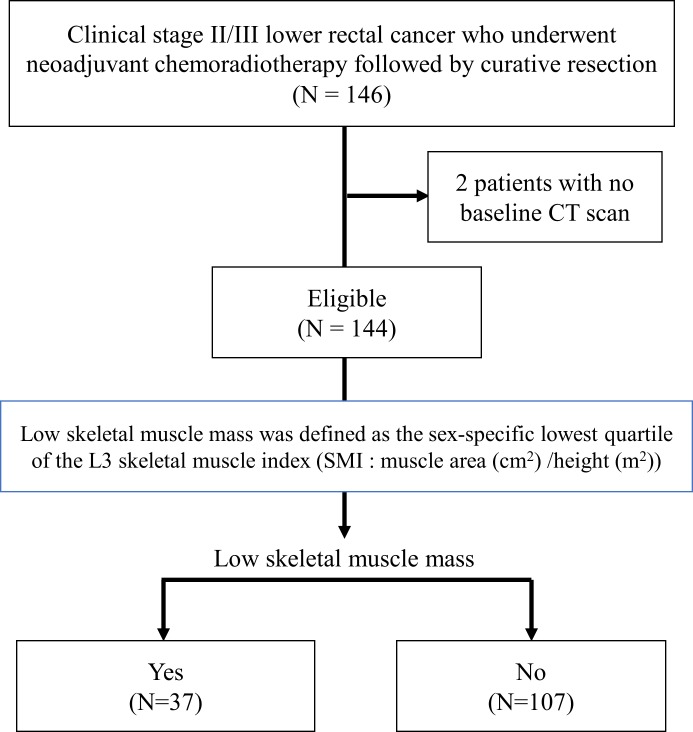
We enrolled 144 clinical stage II/III patients with advanced lower rectal cancer who underwent neoadjuvant chemoradiotherapy followed by curative resection between 2004 and 2011. The cross-sectional skeletal muscle area at the third lumbar vertebra (L3) level was evaluated by computed tomography before chemoradiotherapy, and this was normalized by the square of the height to obtain the skeletal muscle index. Low skeletal muscle mass was defined as the sex-specific lowest quartile of the L3 skeletal muscle index. The association between low skeletal muscle mass and morbidity, relapse-free survival, or overall survival was assessed.
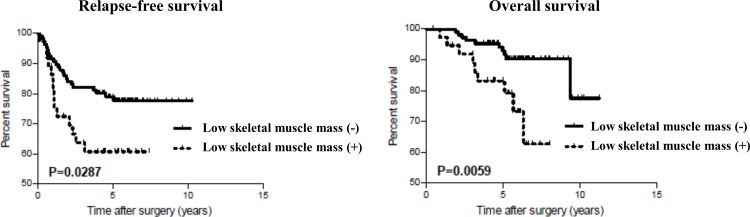
Low skeletal muscle mass was identified in 37 (25.7%) patients. Age and body mass index were associated with low skeletal muscle mass. By multivariate analysis, we found that low skeletal muscle mass was independently associated with poor overall survival (hazard ratio = 2.93; 95%CI: 1.11-7.71; p = 0.031) and relapse-free survival (hazard ratio = 2.15; 95%CI: 1.06-4.21; p = 0.035), but was not associated with the rate of postoperative complications.
Low skeletal muscle mass is an independent negative prognostic factor for relapse-free and overall survival in patients with advanced lower rectal cancer treated with neoadjuvant chemoradiotherapy.
新辅助放化疗后接受手术治疗的晚期直肠腺癌患者的体成分对短期或长期结局的影响尚不清楚。本研究旨在探讨低骨骼肌量与接受新辅助放化疗的晚期低位直肠腺癌患者的发病率和生存之间的相关性。
我们纳入了 2004 年至 2011 年间接受新辅助放化疗后行根治性切除术的 144 例临床 II/III 期的晚期低位直肠腺癌患者。在放化疗前通过 CT 评估第三腰椎(L3)水平的骨骼肌横断面面积,并通过身高的平方对其进行标准化,得到骨骼肌指数。低骨骼肌量定义为 L3 骨骼肌指数的性别特异性最低四分位数。评估低骨骼肌量与发病率、无复发生存率或总生存率之间的关系。
37 例(25.7%)患者存在低骨骼肌量。年龄和 BMI 与低骨骼肌量有关。通过多变量分析,我们发现低骨骼肌量与较差的总生存率(风险比=2.93;95%CI:1.11-7.71;p=0.031)和无复发生存率(风险比=2.15;95%CI:1.06-4.21;p=0.035)独立相关,而与术后并发症发生率无关。
低骨骼肌量是新辅助放化疗治疗的晚期低位直肠腺癌患者无复发生存率和总生存率的独立负性预后因素。