Lipke Mark C, Wu Yilei, Roy Indranil, Wang Yuping, Wasielewski Michael R, Stoddart J Fraser
Department of Chemistry and Chemical Biology, Rutgers, The State University of New Jersey, 610 Taylor Road, Piscataway, New Jersey 08854, United States.
Department of Chemistry, Northwestern University, 2145 Sheridan Road, Evanston, Illinois 60208, United States.
ACS Cent Sci. 2018 Mar 28;4(3):362-371. doi: 10.1021/acscentsci.7b00535. Epub 2018 Mar 2.
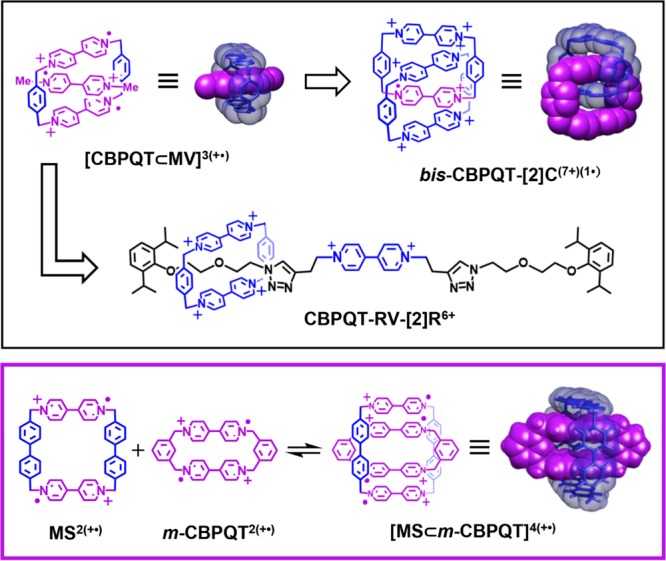
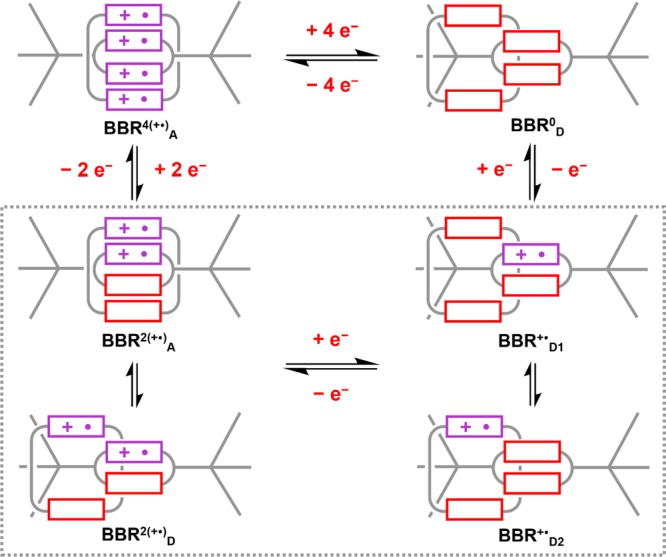
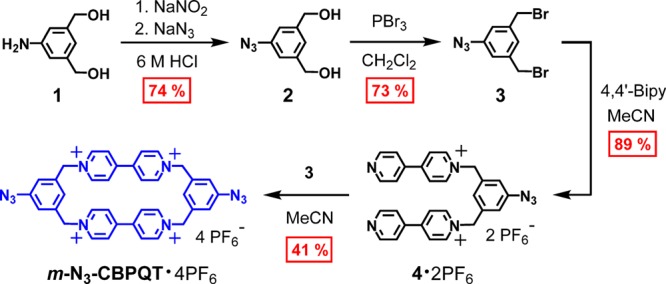
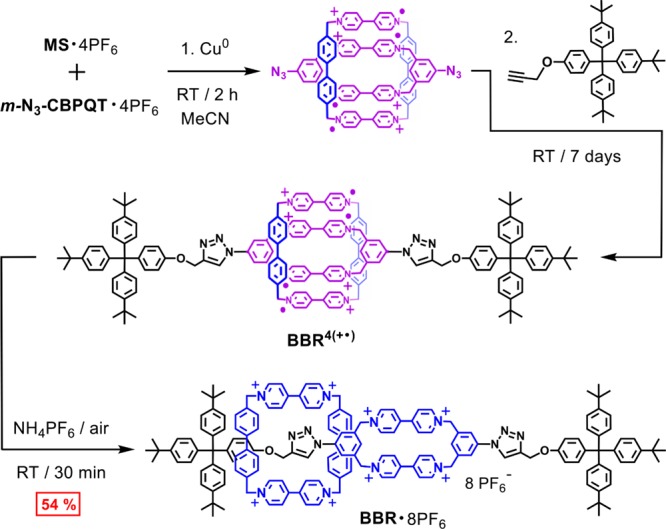
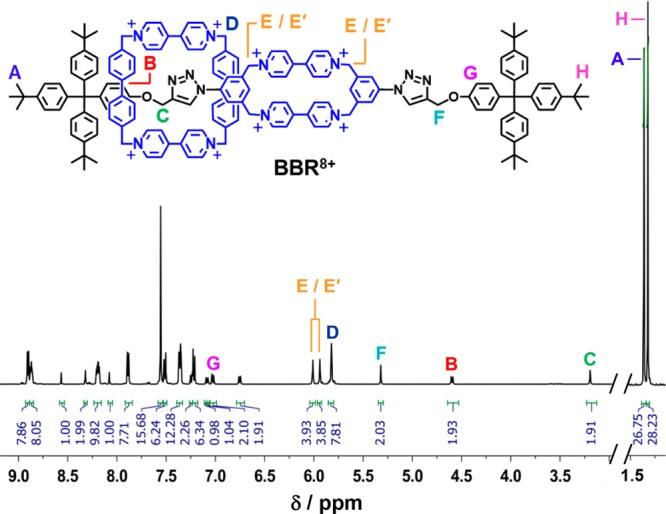
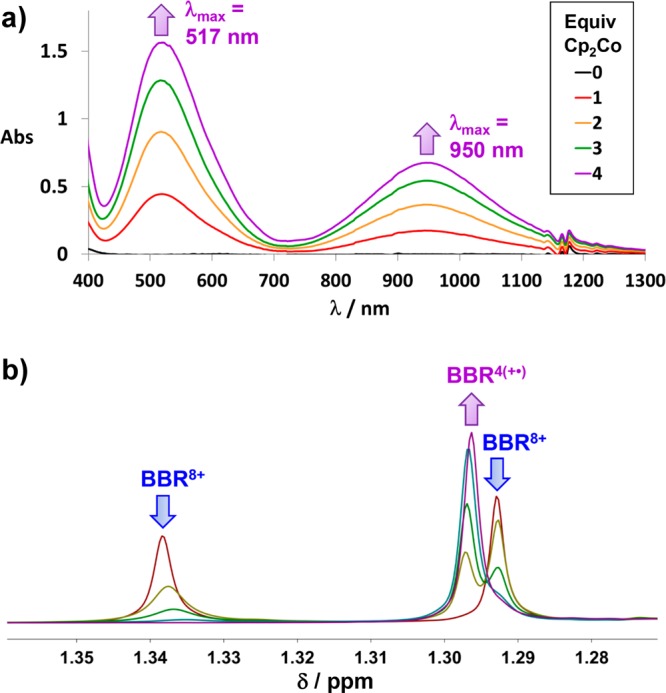
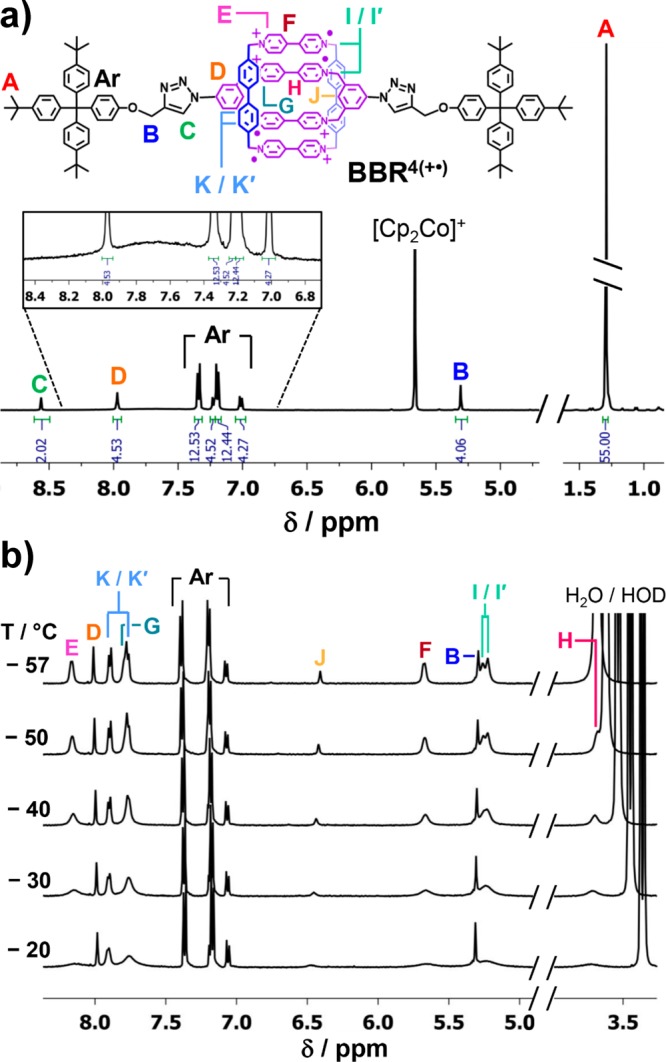
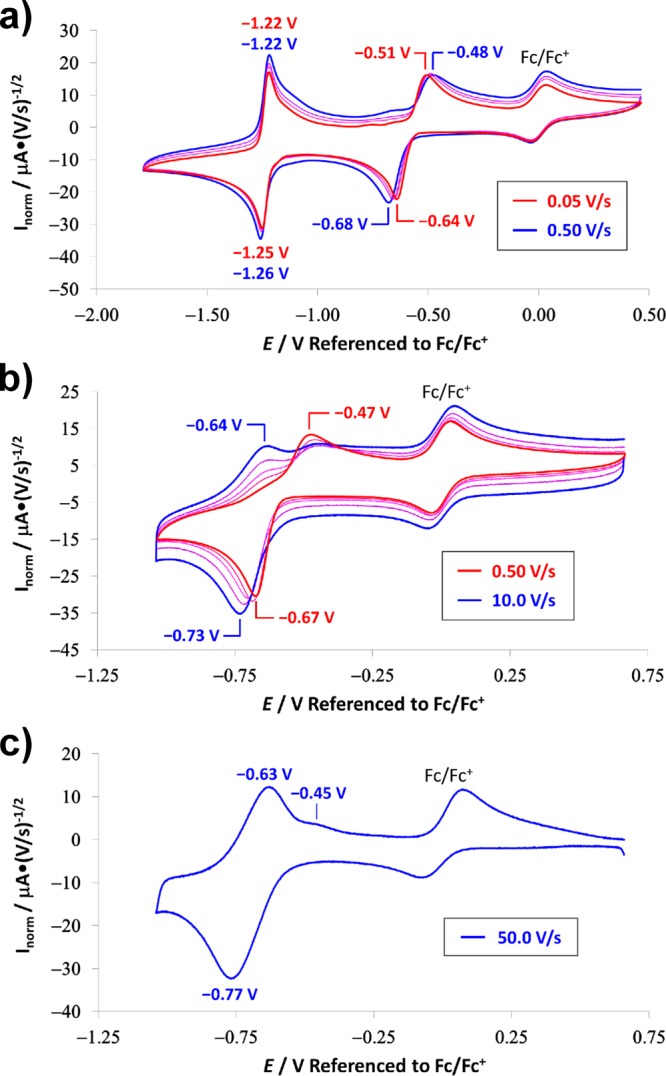
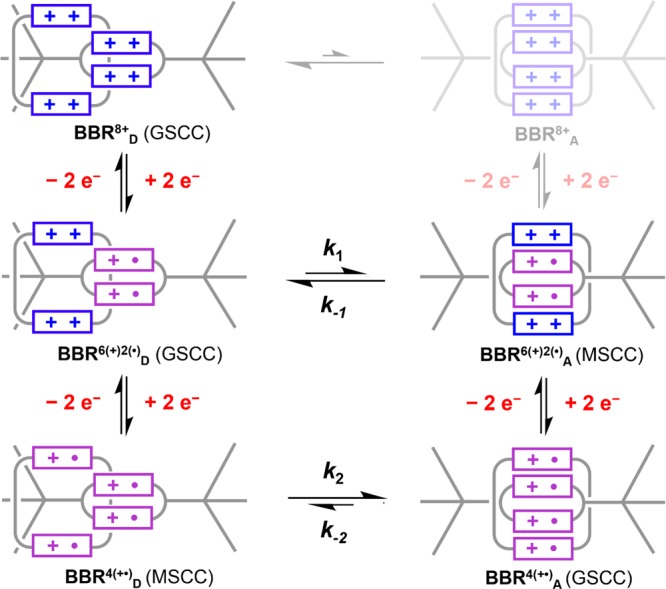
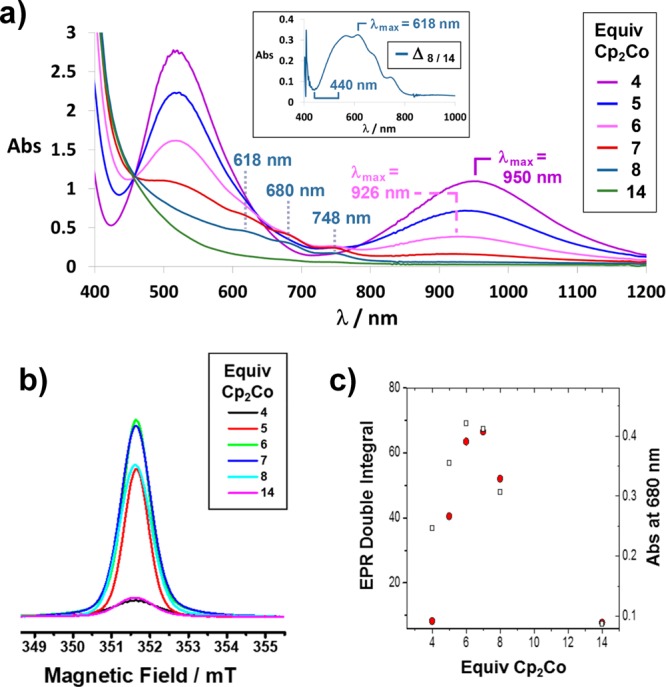
The trisradical recognition motif between a 4,4'-bipyridinium radical cation and a cyclo-bis-4,4'-bipyridinium diradical dication has been employed previously in rotaxanes to control their nanomechanical and electronic properties. Herein, we describe the synthesis and characterization of a redox-active ring-in-ring [2]rotaxane 8PF that employs a tetraradical variant of this recognition motif. A square-shaped bis-4,4'-bipyridinium cyclophane is mechanically interlocked around the dumbbell component of this rotaxane, and the dumbbell itself incorporates a smaller bis-4,4'-bipyridinium cyclophane into its covalently bonded structure. This small cyclophane serves as a significant impediment to the shuttling of the larger ring across the dumbbell component of , whereas reduction to the tetraradical tetracationic state results in strong association of the two cyclophanes driven by two radical-pairing interactions. In these respects, ·8PF exhibits qualitatively similar behavior to its predecessors that interconvert between hexacationic and trisradical tricationic states. The rigid preorganization of two bipyridinium groups within the dumbbell of ·8PF confers, however, two distinct properties upon this rotaxane: (1) the rate of shuttling is reduced significantly relative to those of its predecessors, resulting in marked electrochemical hysteresis observed by cyclic voltammetry for switching between the states, and (2) the formally tetraradical form of the rotaxane, , exhibits a diamagnetic ground state, which, as a result of the slow shuttling motions within , has a long enough lifetime to be characterized by H NMR spectroscopy.
4,4'-联吡啶自由基阳离子与环双-4,4'-联吡啶双自由基二价阳离子之间的三自由基识别基序此前已被用于轮烷中,以控制其纳米机械和电子性质。在此,我们描述了一种氧化还原活性的环中环[2]轮烷8PF的合成与表征,该轮烷采用了这种识别基序的四自由基变体。一个方形的双-4,4'-联吡啶环番机械互锁在该轮烷的哑铃型组分周围,并且哑铃型组分本身在其共价键合结构中包含一个较小的双-4,4'-联吡啶环番。这个小环番对大环在 的哑铃型组分上的穿梭起到了显著的阻碍作用,而还原为四自由基四价阳离子状态会导致由两种自由基配对相互作用驱动的两个环番的强烈缔合。在这些方面,·8PF表现出与其在六价阳离子和三自由基三价阳离子状态之间相互转化的前体在性质上相似的行为。然而,·8PF的哑铃型结构中两个联吡啶基团的刚性预组织赋予了该轮烷两个独特的性质:(1) 相对于其前体,穿梭速率显著降低,导致循环伏安法观察到在 状态之间切换时出现明显的电化学滞后现象,以及 (2) 轮烷的形式上的四自由基形式 表现出抗磁基态,由于 内缓慢的穿梭运动,其具有足够长的寿命以通过1H NMR光谱进行表征。