Jiang Qianli, Zhang Dan, Majaw Jerry, Zhao Chenjing, Chai Yanyan, Xu Zehua, Wang Ruiting, Li Xiaoli, Zou Chun, Huang Liting, Wu Hansen, Hu Pingling, Xiang Ping, Chen Qiufan, Ma Weimei, Zheng Zhihao, Sun Jing, Liu Tingfang, Li Wenyuan
1 Southern Medical University Nanfang Hospital, Guangzhou, Guangdong, China.
2 Institution for Hospital Management of Tsinghua University, Beijing, China, China.
J Int Med Res. 2018 Jun;46(6):2338-2345. doi: 10.1177/0300060517726863. Epub 2018 Apr 10.
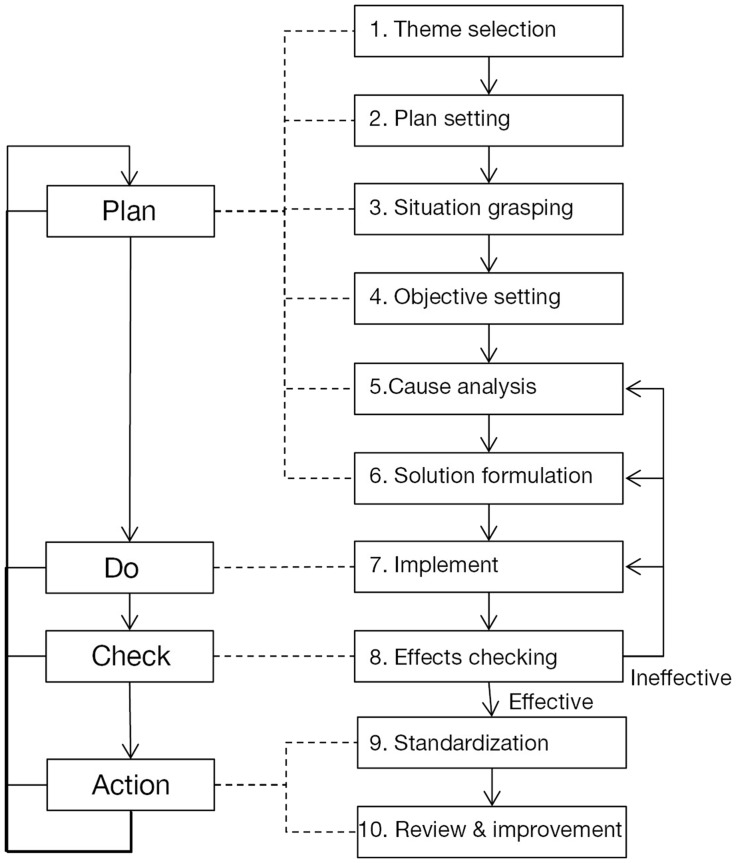
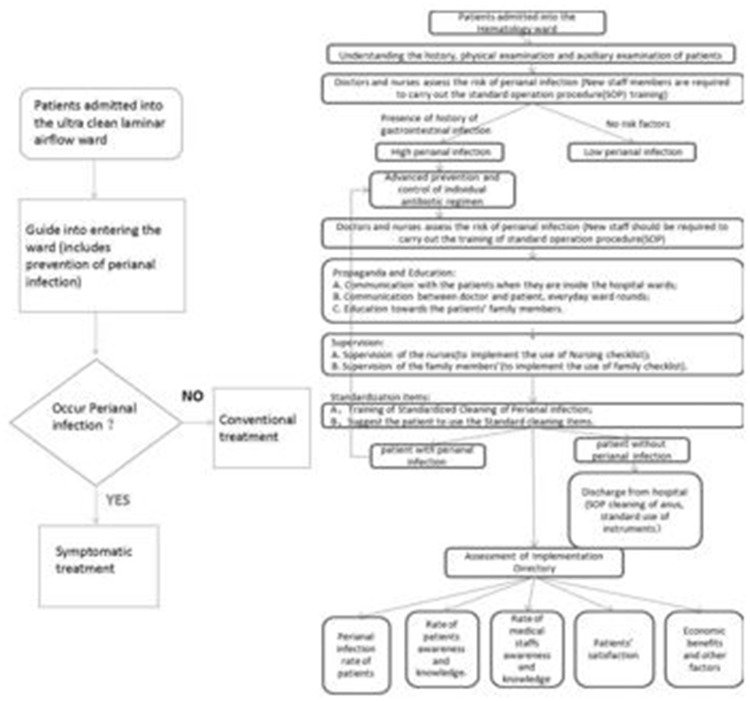
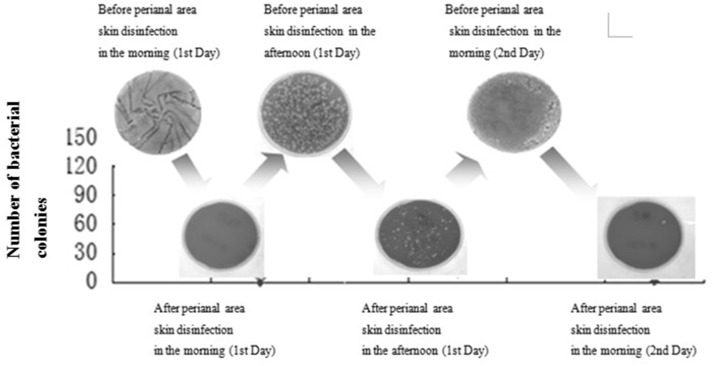
Objective The agranulocytosis-associated perianal infection (PI) rate ranges from 60% to 100% among patients with hematopoietic malignancies. In this study, we assessed the efficacy of a quality control circle (QCC) to minimize the PI rate. Methods Among 274 patients with severe immunodeficiency (agranulocytosis of ≥2 weeks) in our bone marrow transplantation center, the PI rate was 17.20%. A QCC was established following the 10 steps of the plan-do-check-act (PDCA) model; this was scientifically supported by culturing the bacterial colony from patients' perianal skin to determine the sanitization effect and interval time. Because a warm aqueous solution of potassium permanganate is recommended for sanitization, the bacterial colony culture was also used to determine the proper drug concentration, water temperature, and soaking time. All procedures were standardized. Patients, hospital staff, and medical students were enrolled into the QCC team based on the patient-hospital-student (PHS) win-win concept. Results After establishment of the PDCA model, the PI rate among 253 patients decreased from 17.20% to 5.93% and remained at 5.25% during the following year. The medical expenses and length of hospital stay consequently decreased. Conclusion The QCC and PHS win-win concept can reduce the PI rate and promote medical quality.
造血系统恶性肿瘤患者中粒细胞缺乏相关肛周感染(PI)率在60%至100%之间。在本研究中,我们评估了质量控制圈(QCC)降低PI率的效果。方法:在我们骨髓移植中心的274例严重免疫缺陷(粒细胞缺乏≥2周)患者中,PI率为17.20%。按照计划-执行-检查-行动(PDCA)模式的10个步骤建立了一个QCC;通过培养患者肛周皮肤的菌落以确定消毒效果和间隔时间,为其提供科学支持。由于推荐使用温热的高锰酸钾水溶液进行消毒,还通过菌落培养来确定合适的药物浓度、水温及浸泡时间。所有程序均实现标准化。基于患者-医院-学生(PHS)共赢理念,患者、医院工作人员和医学生被纳入QCC团队。结果:建立PDCA模式后,253例患者的PI率从17.20%降至5.93%,并在次年保持在5.25%。医疗费用和住院时间因此减少。结论:QCC和PHS共赢理念可降低PI率并提升医疗质量。