Department of Radiation Oncology, Dana-Farber Cancer Institute and Brigham and Women's Hospital, Harvard Medical School, Boston, MA 02115, USA.
Department of Medical Oncology, Dana-Farber Cancer Institute, Harvard Medical School, Boston, MA 02115, USA.
Nucleic Acids Res. 2018 Jul 6;46(12):e74. doi: 10.1093/nar/gky251.
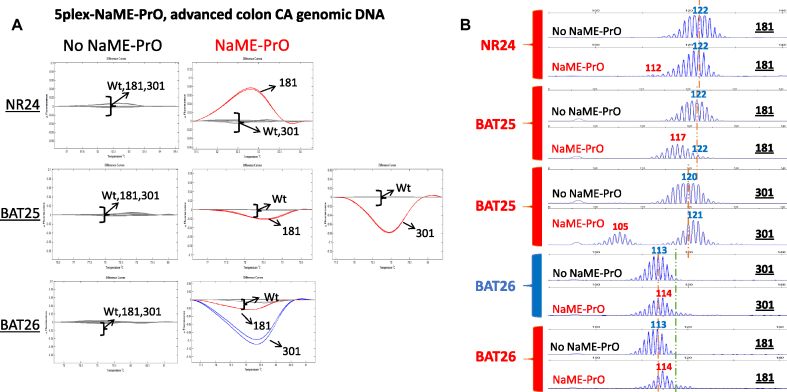
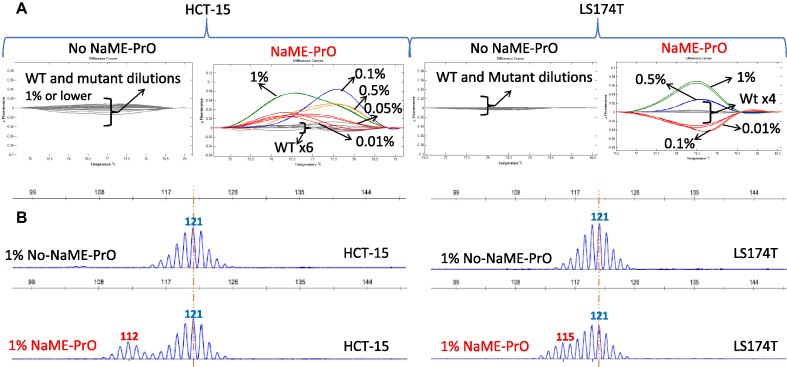
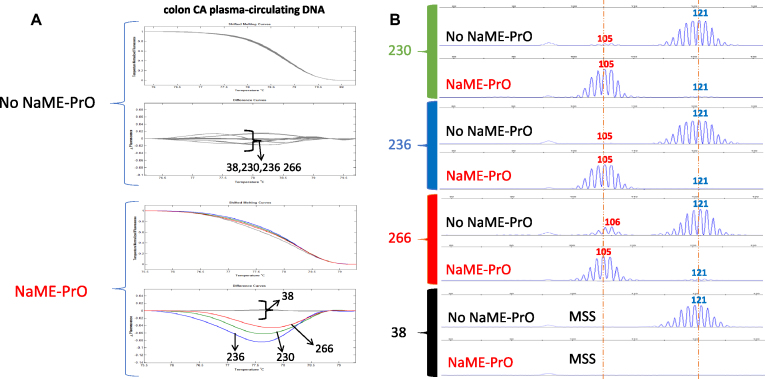
Detection of microsatellite-instability in colonoscopy-obtained polyps, as well as in plasma-circulating DNA, is frequently confounded by sensitivity issues due to co-existing excessive amounts of wild-type DNA. While also an issue for point mutations, this is particularly problematic for microsatellite changes, due to the high false-positive artifacts generated by polymerase slippage (stutter-bands). Here, we describe a nuclease-based approach, NaME-PrO, that uses overlapping oligonucleotides to eliminate unaltered micro-satellites at the genomic DNA level, prior to PCR. By appropriate design of the overlapping oligonucleotides, NaME-PrO eliminates WT alleles in long single-base homopolymers ranging from 10 to 27 nucleotides in length, while sparing targets containing variable-length indels at any position within the homopolymer. We evaluated 5 MSI targets individually or simultaneously, NR27, NR21, NR24, BAT25 and BAT26 using DNA from cell-lines, biopsies and circulating-DNA from colorectal cancer patients. NaME-PrO enriched altered microsatellites and detected alterations down to 0.01% allelic-frequency using high-resolution-melting, improving detection sensitivity by 500-1000-fold relative to current HRM approaches. Capillary-electrophoresis also demonstrated enhanced sensitivity and enrichment of indels 1-16 bases long. We anticipate application of this highly-multiplex-able method either with standard 5-plex reactions in conjunction with HRM/capillary electrophoresis or massively-parallel-sequencing-based detection of MSI on numerous targets for sensitive MSI-detection.
在结肠镜检查获得的息肉以及血浆循环 DNA 中检测微卫星不稳定性,由于存在大量野生型 DNA,通常会受到灵敏度问题的干扰。虽然这也是点突变的一个问题,但对于微卫星变化来说,这是一个特别棘手的问题,因为聚合酶滑动(短链重复)会产生大量的假阳性伪影。在这里,我们描述了一种基于核酸酶的方法 NaME-PrO,它使用重叠寡核苷酸在 PCR 之前消除基因组 DNA 水平上未改变的微卫星。通过重叠寡核苷酸的适当设计,NaME-PrO 消除了长单碱基同聚物中长达 10 到 27 个核苷酸的 WT 等位基因,同时保留了同聚物中任何位置具有可变长度插入/缺失的靶标。我们单独或同时评估了 5 个 MSI 靶标,即 NR27、NR21、NR24、BAT25 和 BAT26,使用来自结直肠癌患者的细胞系、活检和循环 DNA 的 DNA。NaME-PrO 富集了改变的微卫星,并使用高分辨率熔解检测到低至 0.01%等位基因频率的改变,与当前的 HRM 方法相比,检测灵敏度提高了 500-1000 倍。毛细管电泳也证明了 1-16 个碱基长的插入缺失的灵敏度和富集得到了提高。我们预计这种高度可扩展的方法将与标准的 5 重反应结合使用,用于 HRM/毛细管电泳或基于大规模平行测序的多个靶标 MSI 检测,以实现灵敏的 MSI 检测。