Key Laboratory of Zoological Systematics and Evolution, Institute of Zoology, Chinese Academy of Sciences, 1 Beichen West Road, Chaoyang District, Beijing, 100101, People's Republic of China.
College of Life Sciences, University of Chinese Academy of Sciences, Beijing, 100049, People's Republic of China.
BMC Evol Biol. 2018 Apr 10;18(1):50. doi: 10.1186/s12862-018-1168-3.
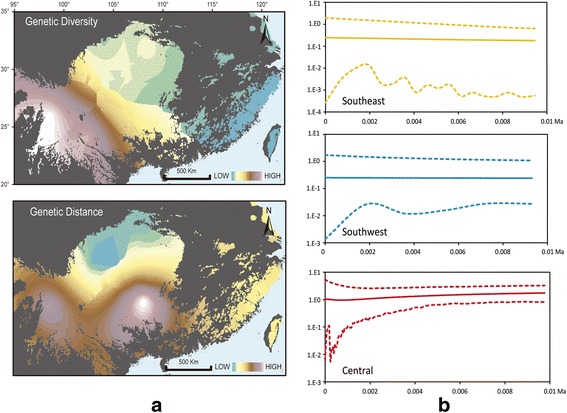
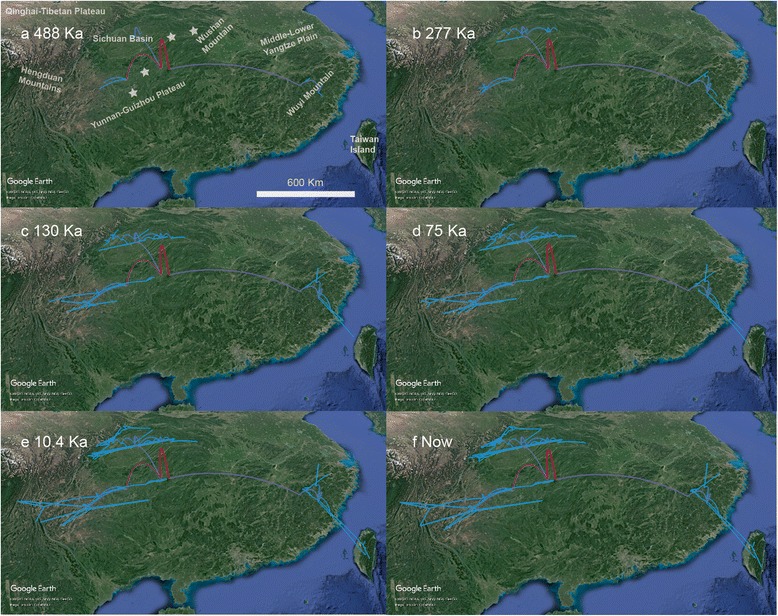
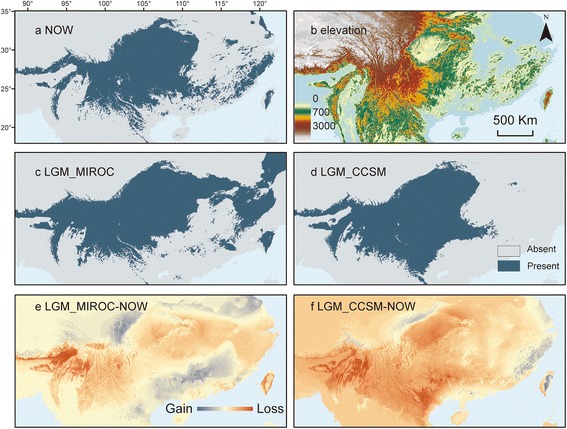
South China encompasses complex and diverse landforms, giving rise to high biological diversity and endemism from the Hengduan Mountains to Taiwan Island. Many species are widely distributed across South China with similar disjunct distribution patterns. To explore the causes of these disjunct distribution patterns and their genetic consequences, we investigated the endemic species Père David's Chinese Vole (Eothenomys melanogaster) by integrating geological and ecological factors. We analysed the genetic structure and divergence time of E. melanogaster based on fast-evolving mitochondrial and nuclear markers using Bayesian trees and coalescent species tree approaches. Historical scenarios of distribution range and demography were reconstructed based on spatial interpolations of genetic diversity and distance, extended Bayesian skyline plots, phylogeographic diffusion analysis, and ecological niche modelling (ENM) during different periods. We also assessed the relationships between geographical distance/ecological vicariance and genetic distance (isolation by distance, IBD; isolation by environment, IBE).
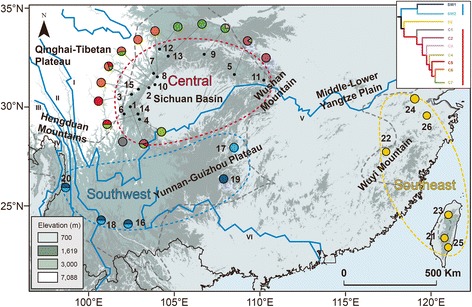
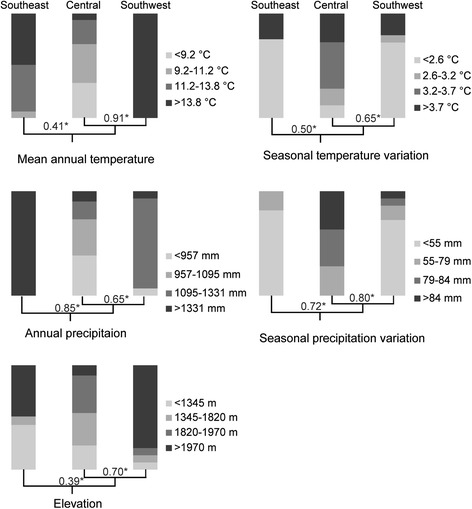
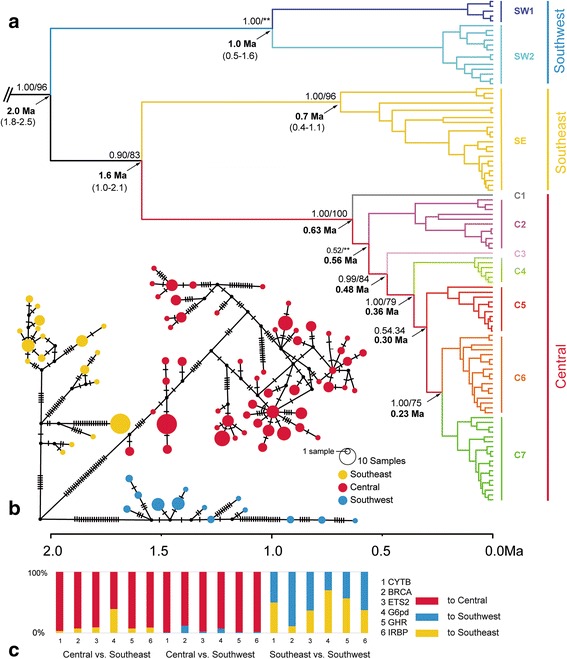
The genetic analysis revealed three deeply divergent clades-Southeast, Southwest and Central clades, centred on the Wuyi Mountains, the Yunnan-Guizhou Plateau (YGP) and the mountains around the Sichuan Basin, respectively-that have mostly developed since the Pleistocene. IBD played an important role in early divergence, and geological events (sedimentation of plains and linking of palaeo-rivers) and IBE further reinforced genetic differentiation. ENM shows the importance of suitable habitats and elevations.
Our results suggest that the primary cause of the disjunct distribution in E. melanogaster is the high dependence on middle-high-altitude habitat in the current period. Mountains in the occurence range have served as "sky islands" for E. melanogaster and hindered gene flow. Pleistocene climatic cycles facilitated genetic admixture in cold periods and genetic diversification in warm periods for inland clades. During cold periods, these cycles led to multiple colonization events between the mainland and Taiwan and erased genetic differentiation.
华南地区拥有复杂多样的地形,从横断山脉到台湾岛,生物多样性和特有性都很高。许多物种在华南地区广泛分布,具有相似的间断分布模式。为了探究这些间断分布模式的成因及其遗传后果,我们整合了地质和生态因素,对特有种——大足鼠耳蝠(Eothenomys melanogaster)进行了研究。我们利用贝叶斯树和合并种系发生树方法,基于快速进化的线粒体和核标记,分析了 E. melanogaster 的遗传结构和分化时间。基于遗传多样性和距离的空间插值、扩展贝叶斯天际线图、系统地理扩散分析和不同时期的生态位模型(ENM),重建了分布范围和种群动态的历史情景。我们还评估了地理距离/生态隔离与遗传距离(距离隔离,IBD;环境隔离,IBE)之间的关系。
遗传分析揭示了三个深度分化的分支——东南、西南和中央分支,分别以武夷山、云贵高原(YGP)和四川盆地周围的山脉为中心,主要形成于更新世。IBD 在早期分化中起重要作用,地质事件(平原沉积和古河流连接)和 IBE 进一步加强了遗传分化。ENM 表明了适宜栖息地和海拔的重要性。
我们的结果表明,E. melanogaster 间断分布的主要原因是当前对中高海拔生境的高度依赖。发生范围内的山脉为 E. melanogaster 提供了“天空岛屿”,阻碍了基因流动。更新世气候循环促进了内陆分支在寒冷时期的基因混合和温暖时期的遗传多样化。在寒冷时期,这些循环导致了大陆和台湾之间的多次殖民事件,并消除了遗传分化。