Institute of Immunology, Centre of Biomedical Education and Research (ZBAF), Witten/Herdecke University, Stockumer Str. 10, 58448, Witten, Germany.
BioGenes GmbH, Köpenicker Str. 325, 12555, Berlin, Germany.
Cell Commun Signal. 2018 Apr 10;16(1):14. doi: 10.1186/s12964-018-0226-1.
In addition to physiological events such as fertilisation, placentation, osteoclastogenesis, or tissue regeneration/wound healing, cell fusion is involved in pathophysiological conditions such as cancer. Cell fusion, which applies to both the proteins and conditions that induce the merging of two or more cells, is not a fully understood process. Inflammation/pro-inflammatory cytokines might be a positive trigger for cell fusion. Using a Cre-LoxP-based cell fusion assay we demonstrated that the fusion between human M13SV1-Cre breast epithelial cells and human MDA-MB-435-pFDR1 cancer cells was induced by the pro-inflammatory cytokine tumour necrosis factor-α (TNF-α).
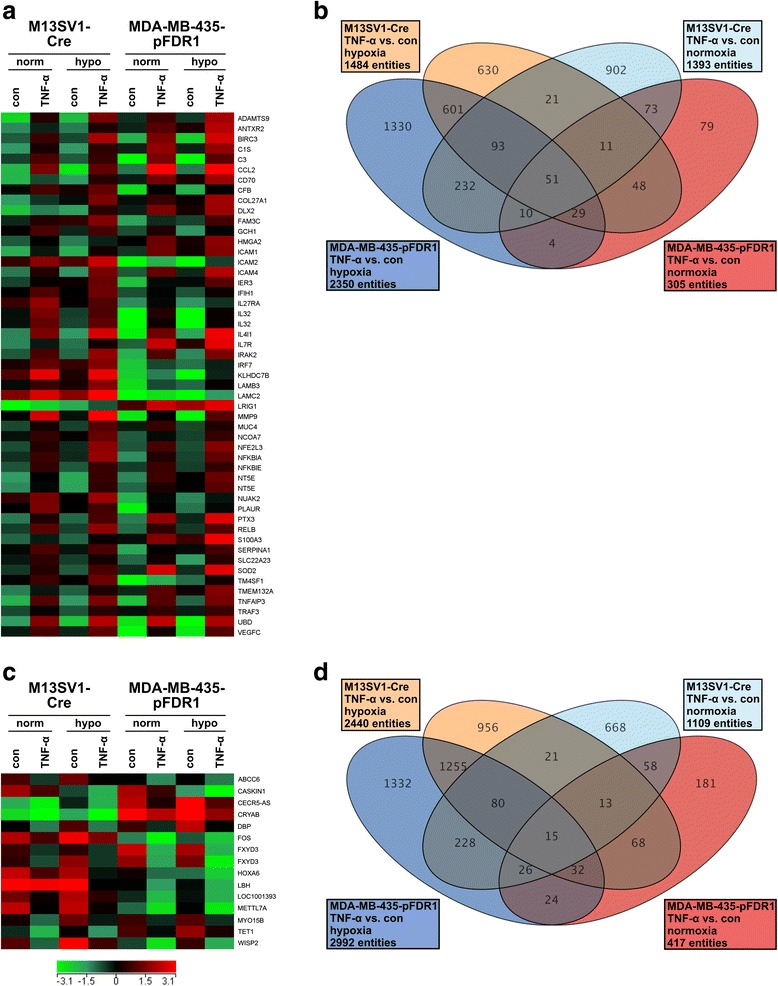
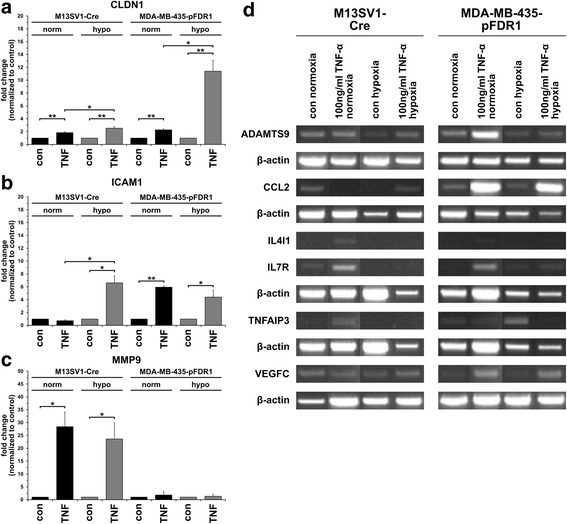
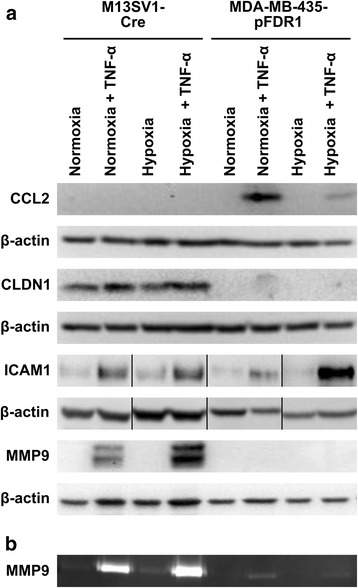
The gene expression profile of the cells in the presence of TNF-α and under normoxic and hypoxic conditions was analysed by cDNA microarray analysis. cDNA microarray data were verified by qPCR, PCR, Western blot and zymography. Quantification of cell fusion events was determined by flow cytometry. Proteins of interest were either blocked or knocked-down using a specific inhibitor, siRNA or a blocking antibody.
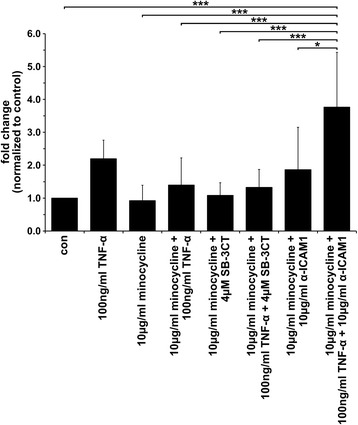
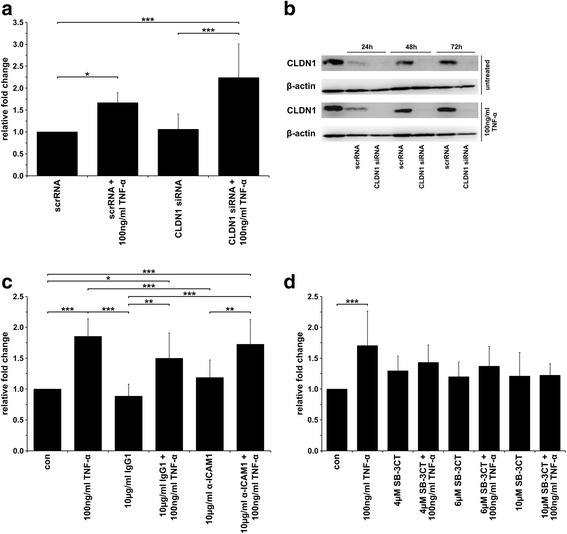
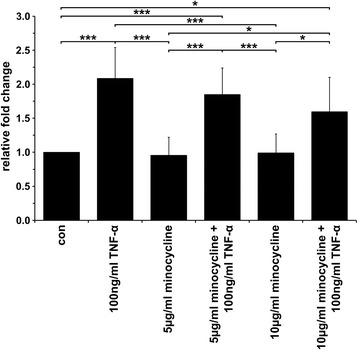
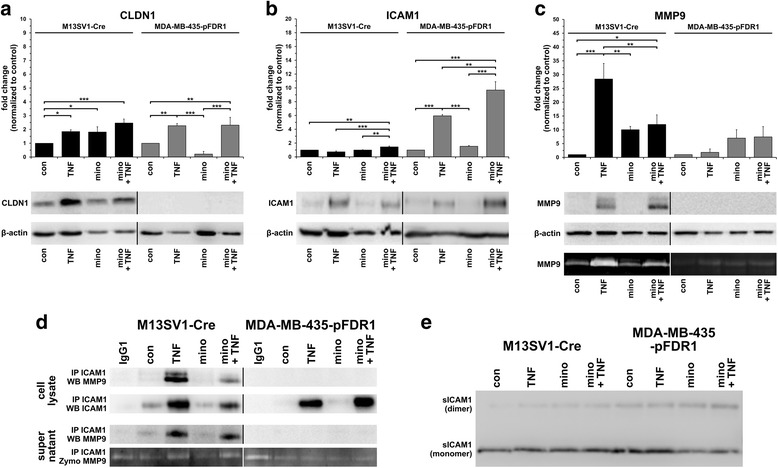
The data showed an up-regulation of various genes, including claudin-1 (CLDN1), ICAM1, CCL2 and MMP9 in M13SV1-Cre and/or MDA-MB-435-pFDR1 cells. Inhibition of these proteins using a blocking ICAM1 antibody, CLDN1 siRNA or an MMP9 inhibitor showed that only the blockage of MMP9 was correlated with a decreased fusion rate of the cells. Likewise, the tetracycline-based antibiotic minocycline, which exhibits anti-inflammatory properties, was also effective in both inhibiting the TNF-α-induced MMP9 expression in M13SV1-Cre cells and blocking the TNF-α-induced fusion frequency of human M13SV1-Cre breast epithelial cells and human MDA-MB-435-pFDR1 cancer cells.
The matrix metalloproteinase-9 (MMP9) is most likely involved in the TNF-α-mediated fusion of human M13SV1-Cre breast epithelial cells and human MDA-MB-435-pFDR1 cancer cells. Likewise, our data indicate that the tetracycline-based antibiotic minocycline might exhibit anti-fusogenic properties because it inhibits a cell fusion-related mechanism.
除了受精、胎盘形成、破骨细胞生成或组织再生/伤口愈合等生理事件外,细胞融合还涉及癌症等病理生理状况。细胞融合适用于诱导两个或多个细胞融合的蛋白质和条件,但这一过程尚未被完全理解。炎症/促炎细胞因子可能是细胞融合的正向触发因素。我们使用基于 Cre-LoxP 的细胞融合测定法证明,促炎细胞因子肿瘤坏死因子-α(TNF-α)诱导人 M13SV1-Cre 乳腺上皮细胞与 MDA-MB-435-pFDR1 癌细胞之间的融合。
通过 cDNA 微阵列分析分析 TNF-α存在下以及常氧和缺氧条件下细胞的基因表达谱。通过 qPCR、PCR、Western blot 和酶谱法验证 cDNA 微阵列数据。通过流式细胞术确定细胞融合事件的定量。使用特定抑制剂、siRNA 或阻断抗体阻断或敲低感兴趣的蛋白质。
数据显示,M13SV1-Cre 和/或 MDA-MB-435-pFDR1 细胞中多种基因上调,包括 Claudin-1(CLDN1)、ICAM1、CCL2 和 MMP9。使用阻断 ICAM1 抗体、CLDN1 siRNA 或 MMP9 抑制剂抑制这些蛋白质表明,只有 MMP9 的阻断与细胞融合率的降低相关。同样,基于四环素的抗生素米诺环素具有抗炎特性,它在抑制 M13SV1-Cre 细胞中 TNF-α诱导的 MMP9 表达和阻断人 M13SV1-Cre 乳腺上皮细胞和 MDA-MB-435-pFDR1 癌细胞之间 TNF-α诱导的融合频率方面均有效。
基质金属蛋白酶 9(MMP9)很可能参与 TNF-α介导的人 M13SV1-Cre 乳腺上皮细胞和 MDA-MB-435-pFDR1 癌细胞融合。同样,我们的数据表明,基于四环素的抗生素米诺环素可能具有抗融合特性,因为它抑制了与细胞融合相关的机制。