Madathilethu Jude, Roberts Matthew, Peak Matthew, Blair Joanne, Prescott Rebecca, Ford James L
School of Pharmacy and Biomolecular Sciences, Liverpool John Moores University, Liverpool, UK.
Paediatric Medicines Research Unit, Alder Hey Children's NHS Foundation Trust, Liverpool, UK.
BMJ Paediatr Open. 2018 Jan 29;2(1):e000198. doi: 10.1136/bmjpo-2017-000198. eCollection 2018.
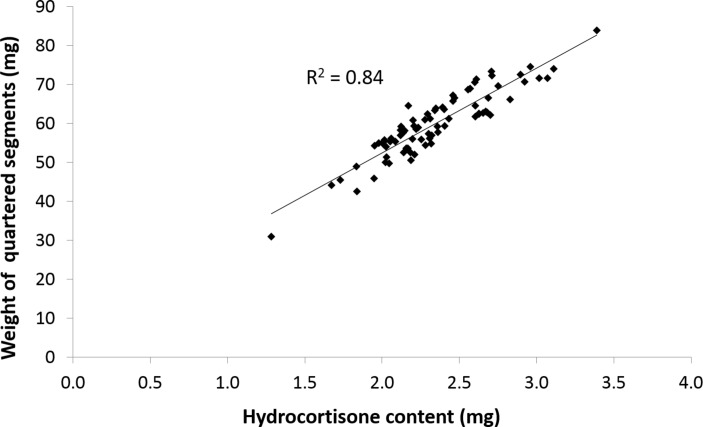
Children requiring cortisol replacement therapy are often prescribed hydrocortisone doses of 2.5 mg, but as this is commercially unavailable 10 mg tablets, with functional break lines, are split commonly in an attempt to deliver the correct dose. This study aimed to determine the dose variation obtained from quartered hydrocortisone tablets when different operators performed the splitting procedure and to ascertain whether better uniformity could be attained from mini-tablets as an alternative formulation.
Hydrocortisone 10 mg tablets were quartered by four different operators using a standard pill splitter. Hydrocortisone 2.5 mg mini-tablets (3 mm diameter) were formulated using a wet granulation method and manufactured using a high-speed rotary press simulator. The weight and content uniformity of the quartered tablets and mini-tablets were assessed according to pharmacopoeial standards. The physical strength and dissolution profiles of the mini-tablets were also determined.
More than half of all quartered 10 mg tablets were outside of the ±10% of the stated US Pharmacopoeia hydrocortisone content (mean 2.34 mg, SD 0.36, coefficient of variation (CV) 15.18%) and more than 40% of the quartered tablets were outside the European Pharmacopoeia weight variation. Robust mini-tablets (tensile strengths of >4 MPa) were produced successfully. The mini-tablets passed the pharmacopoeial weight and content uniformity requirements (mean 2.54 mg, SD 0.04, CV 1.72%) and drug release criteria during in vitro dissolution testing.
This study confirmed that quartering 10 mg hydrocortisone tablets produces unacceptable dose variations and that it is feasible to produce 3 mm mini-tablets containing more accurate doses for paediatric patients.
需要皮质醇替代疗法的儿童通常被开具2.5毫克氢化可的松的剂量,但由于市面上没有该剂量的药品,通常会将有功能性刻痕线的10毫克片剂掰开以达到正确剂量。本研究旨在确定不同操作人员进行掰开操作时,从四分之一剂量的氢化可的松片剂中获得的剂量差异,并确定作为替代剂型的微型片剂是否能实现更好的均匀性。
四名不同的操作人员使用标准药丸分割器将10毫克氢化可的松片剂分成四等份。采用湿法制粒法制备2.5毫克氢化可的松微型片剂(直径3毫米),并使用高速旋转压片机模拟器进行生产。根据药典标准评估四分之一剂量片剂和微型片剂的重量和含量均匀度。还测定了微型片剂的物理强度和溶出曲线。
所有四分之一剂量的10毫克片剂中,超过一半超出了美国药典规定的氢化可的松含量的±10%(平均2.34毫克,标准差0.36,变异系数(CV)15.18%),超过40%的四分之一剂量片剂超出了欧洲药典的重量差异范围。成功生产出了坚固的微型片剂(抗张强度>4兆帕)。微型片剂在体外溶出试验中通过了药典的重量和含量均匀度要求(平均2.54毫克,标准差0.04,CV 1.72%)以及药物释放标准。
本研究证实,将10毫克氢化可的松片剂分成四等份会产生不可接受的剂量差异,并且生产含更准确剂量的3毫米微型片剂用于儿科患者是可行的。