Yan Lihua, Jiang Tingbo, Yang Xiangjun, Xu Mingzhu
Department of Thoracic and Cardiovascular Surgery, Nantong First People's Hospital, the Second Affiliated Hospital of Nantong University, Nantong Department of Cardiology, the First Affiliated Hospital of Soochow University, Suzhou, Jiangsu, P.R. China.
Medicine (Baltimore). 2018 Apr;97(15):e0442. doi: 10.1097/MD.0000000000010442.
Hyperkalemia is a life-threatening electrolyte disturbance which could lead to arrhythmias and potentially death.
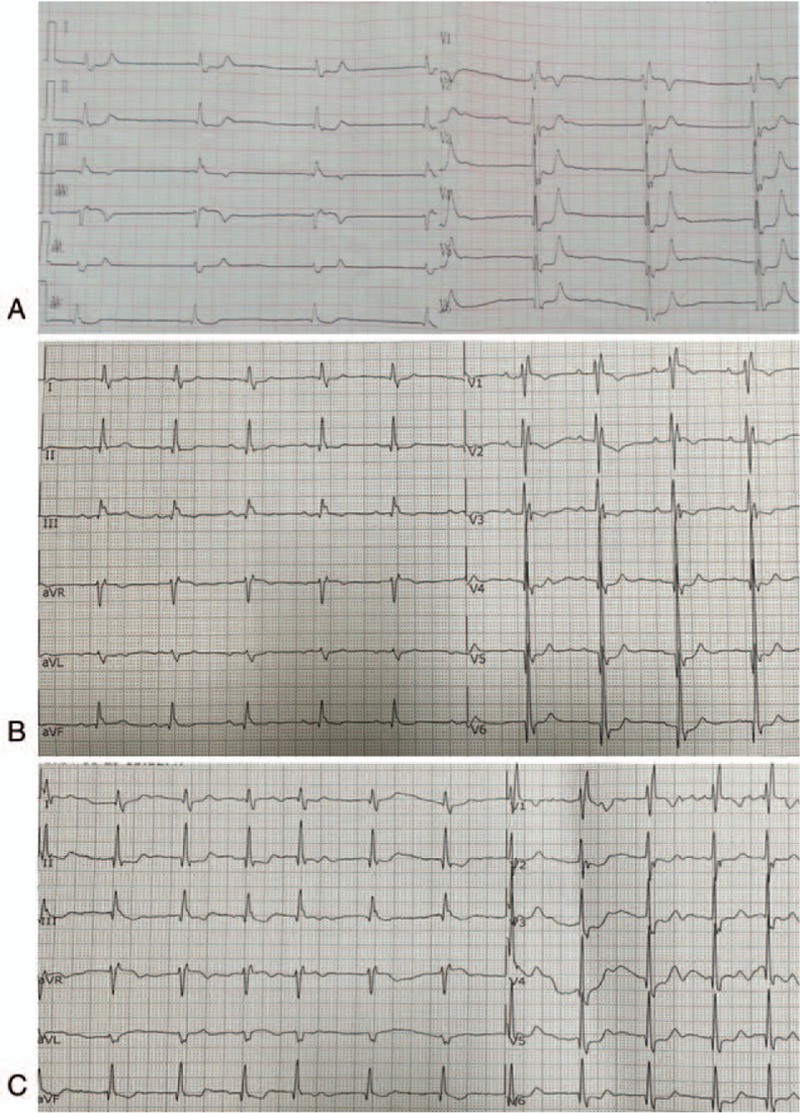
An 82-year-old male patient who presented typical electrocardiographic indications of hyperkalemia, including the absence of P waves, prolongation of QRS complex, sinoventricular conduction, bradyarrhythmia and tall peaked T waves. He developed a rare self-defibrillation of atrial fibrillation to sinus rhythm due to hyperkalemia. Besides, he developed secondary thrombosis caused by abrupt termination of atrial fibrillation.
This patient was diagnosed with hyperkalemia, hypertension, and AF.
He was treated with an intravenous infusion of calcium gluconate, insulin and dextrose, an oral kayexalate, and emergency hemodialysis.
The patient was managed effectively and discharged with stable status.
Hyperkalemia could induce malignant arrhythmia with high mortality. Thus we suggested more attention be paid to monitoring electrolyte disorders and maintaining anticoagulation treatments to avoid thromboembolism.
高钾血症是一种危及生命的电解质紊乱,可导致心律失常并可能致死。
一名82岁男性患者,出现了高钾血症的典型心电图表现,包括P波消失、QRS波群增宽、窦室传导、缓慢性心律失常和高耸T波。他因高钾血症发生了罕见的房颤自行除颤转为窦性心律。此外,他还因房颤突然终止而继发血栓形成。
该患者被诊断为高钾血症、高血压和房颤。
给予静脉输注葡萄糖酸钙、胰岛素和葡萄糖、口服聚苯乙烯磺酸钠,并进行紧急血液透析治疗。
患者得到有效治疗,出院时病情稳定。
高钾血症可诱发恶性心律失常,死亡率高。因此,我们建议应更加重视监测电解质紊乱并维持抗凝治疗,以避免血栓栓塞。