Adelaide Medical School and National Health and Medical Research Council of Australia Centre of Research Excellence in Translating Nutritional Science to Good Health, Level 5 Adelaide Health and Medical Sciences Building, Corner North Terrace and George Street, Adelaide 5005, Australia.
Department of Nutritional Physiology, Technical University of Munich, Gregor-Mendel Strasse 2, 85354 Freising, Germany.
Nutrients. 2018 Apr 8;10(4):463. doi: 10.3390/nu10040463.
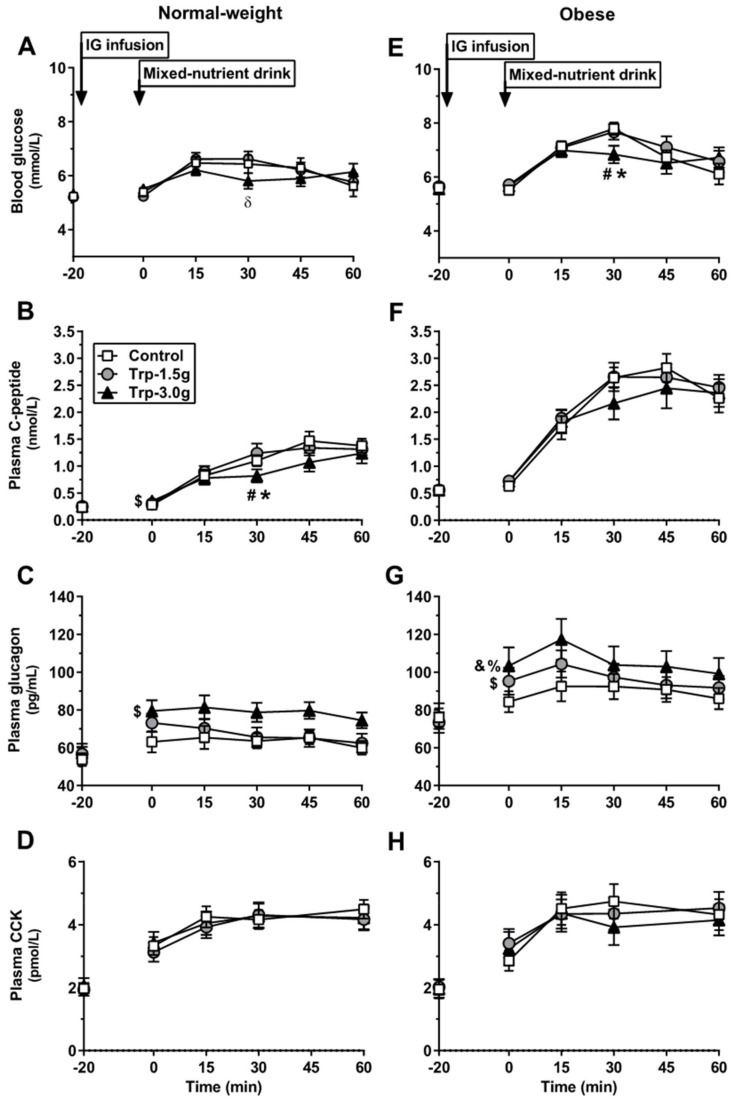
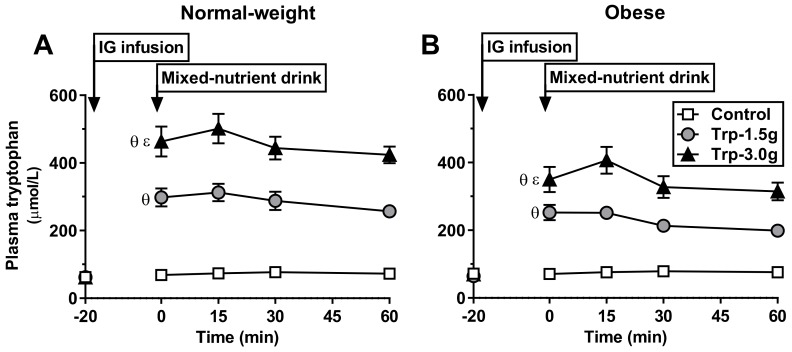
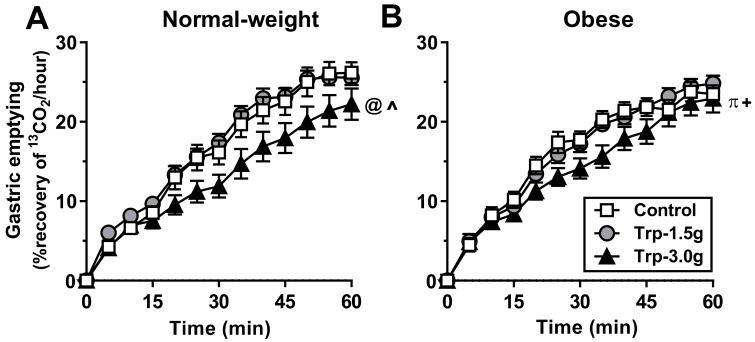
Tryptophan stimulates plasma cholecystokinin and pyloric pressures, both of which slow gastric emptying. Gastric emptying regulates postprandial blood glucose. Tryptophan has been reported to decrease energy intake. We investigated the effects of intragastric tryptophan on the glycaemic response to, and gastric emptying of, a mixed-nutrient drink, and subsequent energy intake. Lean and obese participants ( = 16 each) received intragastric infusions of 1.5 g ("Trp-1.5g") or 3.0 g ("Trp-3.0g") tryptophan, or control, and 15 min later consumed a mixed-nutrient drink (56 g carbohydrates). Gastric emptying (C-acetate breath-test), blood glucose, plasma C-peptide, glucagon, cholecystokinin and tryptophan concentrations were measured ( = 0-60 min). Energy intake was assessed between = 60-90 min. In lean individuals, Trp-3.0g, but not Trp-1.5g, slowed gastric emptying, reduced C-peptide and increased glucagon (all < 0.05), but did not significantly decrease the blood glucose response to the drink, stimulate cholecystokinin or reduce mean energy intake, compared with control. In obese individuals, Trp-3.0g, but not Trp-1.5g, tended to slow gastric emptying ( = 0.091), did not affect C-peptide, increased glucagon ( < 0.001) and lowered blood glucose at = 30 min ( < 0.05), and did not affect cholecystokinin or mean energy intake. In obese individuals, intragastrically administered tryptophan may reduce postprandial blood glucose by slowing gastric emptying; the lack of effect on mean energy intake requires further investigation.
色氨酸刺激血浆胆囊收缩素和幽门压力,这两者都能减缓胃排空。胃排空调节餐后血糖。色氨酸已被报道能减少能量摄入。我们研究了胃内色氨酸对混合营养素饮料的血糖反应和胃排空的影响,以及随后的能量摄入。瘦人和肥胖参与者(各 16 人)接受 1.5 克(“Trp-1.5g”)或 3.0 克(“Trp-3.0g”)色氨酸或对照的胃内输注,输注 15 分钟后饮用混合营养素饮料(56 克碳水化合物)。测量胃排空(C-醋酸呼气试验)、血糖、血浆 C 肽、胰高血糖素、胆囊收缩素和色氨酸浓度(= 0-60 分钟)。在 = 60-90 分钟之间评估能量摄入。在瘦人中,Trp-3.0g,但不是 Trp-1.5g,能减缓胃排空,降低 C 肽并增加胰高血糖素(均 < 0.05),但与对照相比,对饮料的血糖反应没有显著降低,没有刺激胆囊收缩素,也没有减少平均能量摄入。在肥胖者中,Trp-3.0g,但不是 Trp-1.5g,胃排空有减缓的趋势(= 0.091),不影响 C 肽,增加胰高血糖素( < 0.001),并在 = 30 分钟时降低血糖(< 0.05),不影响胆囊收缩素或平均能量摄入。在肥胖者中,胃内给予色氨酸可能通过减缓胃排空来降低餐后血糖;对平均能量摄入的影响需要进一步研究。