Division of Population Medicine, Neuadd Meirionnydd, Cardiff University, Heath Park, Cardiff, CF14 4YS, UK.
Centre for Trials Research, Cardiff University, Cardiff, UK.
BMC Pregnancy Childbirth. 2018 Apr 11;18(1):90. doi: 10.1186/s12884-018-1725-1.
Many women in the UK stop breastfeeding before they would like to, and earlier than is recommended by the World Health Organization (WHO). Given the potential health benefits for mother and baby, new ways of supporting women to breastfeed for longer are required. The purpose of this study was to develop and characterise a novel Motivational Interviewing (MI) informed breastfeeding peer-support intervention.
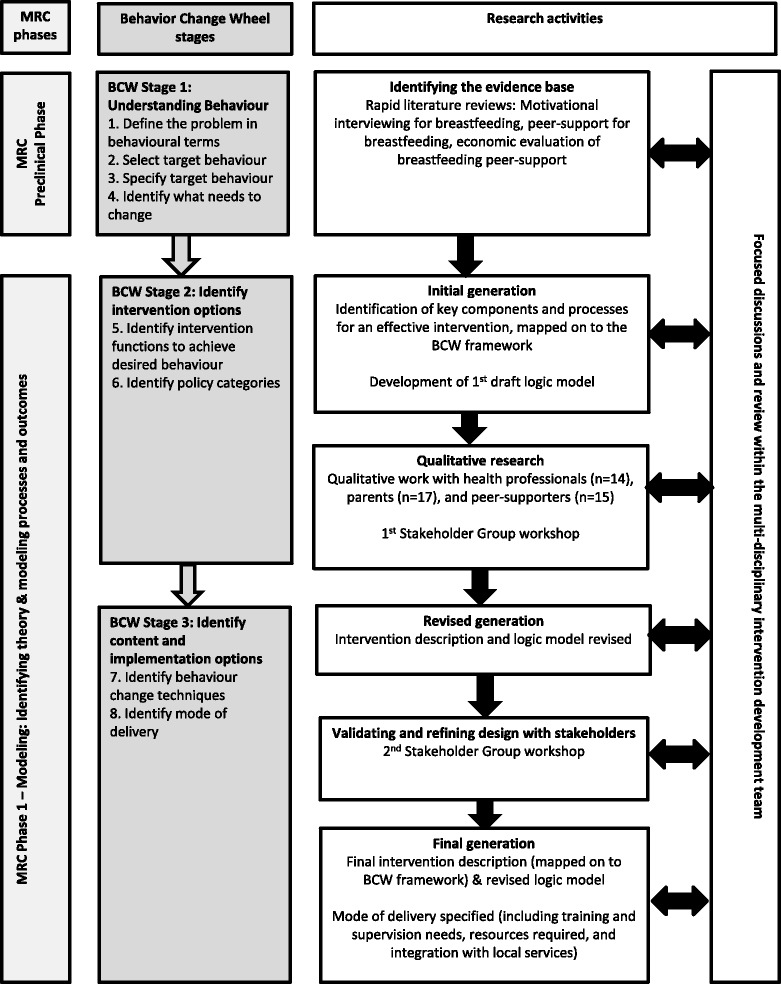
Qualitative interviews with health professionals and service providers (n = 14), and focus groups with mothers (n = 14), fathers (n = 3), and breastfeeding peer-supporters (n = 15) were carried out to understand experiences of breastfeeding peer-support and identify intervention options. Data were audio-recorded, transcribed, and analysed thematically. Consultation took place with a combined professional and lay Stakeholder Group (n = 23). The Behaviour Change Wheel (BCW) guided intervention development process used the findings of the qualitative research and stakeholder consultation, alongside evidence from existing literature, to identify: the target behaviour to be changed; sources of this behaviour based on the Capability, Opportunity and Motivation (COM-B) model; intervention functions that could alter this behaviour; and; mode of delivery for the intervention. Behaviour change techniques included in the intervention were categorised using the Behaviour Change Technique Taxonomy Version 1 (BCTTv1).
Building knowledge, skills, confidence, and providing social support were perceived to be key functions of breastfeeding peer-support interventions that aim to decrease early discontinuation of breastfeeding. These features of breastfeeding peer-support mapped onto the BCW education, training, modelling and environmental restructuring intervention functions. Behaviour change techniques (BCTTv1) included social support, problem solving, and goal setting. The intervention included important inter-personal relational features (e.g. trust, honesty, kindness), and the BCTTv1 needed adaptation to incorporate this.
The MI-informed breastfeeding peer-support intervention developed using this systematic and user-informed approach has a clear theoretical basis and well-described behaviour change techniques. The process described could be useful in developing other complex interventions that incorporate peer-support and/or MI.
在英国,许多女性在她们愿意的时候之前就停止了母乳喂养,而且比世界卫生组织(WHO)建议的时间更早。鉴于母乳喂养对母婴双方的潜在健康益处,需要寻找新的方法来支持女性更长时间地母乳喂养。本研究的目的是开发和描述一种新颖的基于动机访谈(MI)的母乳喂养同伴支持干预措施。
对卫生专业人员和服务提供者(n=14)进行定性访谈,并对母亲(n=14)、父亲(n=3)和母乳喂养同伴支持者(n=15)进行焦点小组讨论,以了解母乳喂养同伴支持的经验,并确定干预方案。对数据进行录音、转录和主题分析。与一个由专业人员和非专业人员组成的利益相关者小组(n=23)进行了磋商。行为改变轮(BCW)指导了干预措施的开发过程,使用定性研究和利益相关者磋商的结果,以及来自现有文献的证据,确定了需要改变的目标行为;基于能力、机会和动机(COM-B)模型的这种行为的来源;可以改变这种行为的干预功能;以及干预措施的交付模式。纳入干预措施的行为改变技术是根据行为改变技术分类学版本 1(BCTTv1)进行分类的。
知识、技能、信心的建立和社会支持的提供被认为是母乳喂养同伴支持干预措施的关键功能,这些干预措施旨在减少母乳喂养的早期中断。这些母乳喂养同伴支持的特点与 BCW 的教育、培训、示范和环境重构干预功能相对应。行为改变技术(BCTTv1)包括社会支持、解决问题和设定目标。该干预措施包括重要的人际关系特征(如信任、诚实、善良),并需要对 BCTTv1 进行改编以纳入这些特征。
使用这种系统和用户驱动的方法开发的基于 MI 的母乳喂养同伴支持干预措施具有明确的理论基础和描述良好的行为改变技术。所描述的过程对于开发其他包含同伴支持和/或 MI 的复杂干预措施可能是有用的。