Anaesthesiology Unit, Medical School, The University of Western Australia, 35 Stirling Highway, Crawley, WA, 6009, UK.
Department for Anaesthesiology, operative Intensive Care and Pain Medicine, University Hospital Muenster, Albert-Schweitzer-Campus 1, A1, 48149, Muenster, Germany.
Sci Rep. 2018 Apr 11;8(1):5794. doi: 10.1038/s41598-018-24127-2.
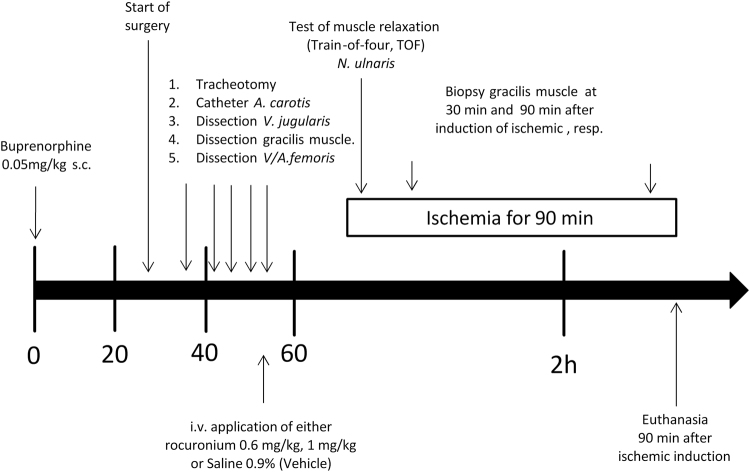
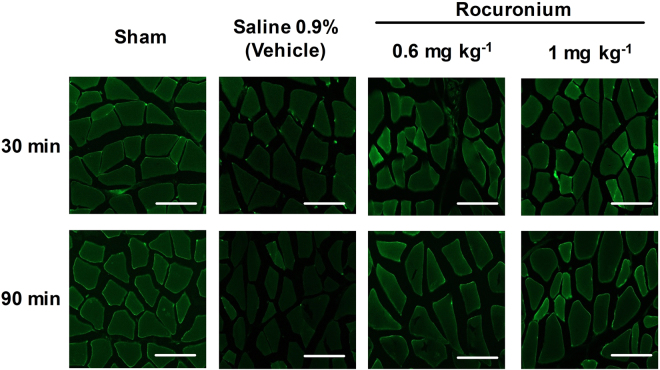
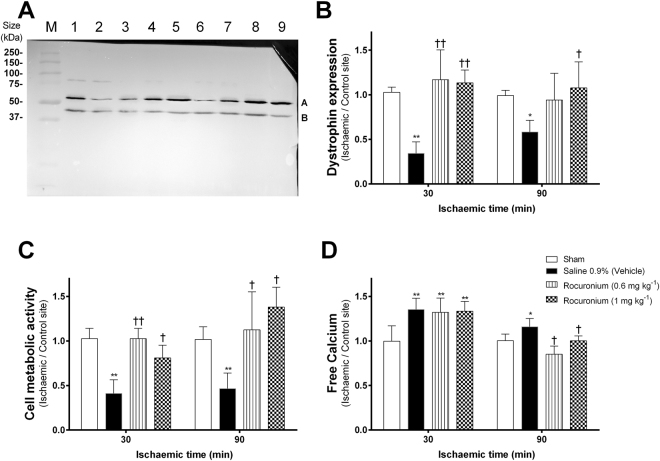
Muscle ischaemia is frequently induced intraoperatively by i.e. a surgical tourniquet or during the re-grafting phase of a free muscle transplant. The resulting muscle cell damage may impact on postoperative recovery. Neuromuscular paralysis may mitigate the effects of ischaemia. After ethics approval, 25 male Sprague-Dawley rats were anaesthetized and randomly assigned to 1 of 4 groups: Sham operation, treatment with normal saline, treatment with rocuronium (muscle relaxant) 0.6 or 1 mg kg, respectively. In the non-sham groups, ischaemia of one hind leg was achieved by ligation of the femoral vessels. Muscle biopsies were taken at 30 and 90 min, respectively. Cell damage was assessed in the biopsies via the expression of dystrophin, free calcium, as well as the assessment of cell viability. Pre-ischaemia muscle relaxation led to a reduction in ischaemia-induced muscle cell damage when measured by the expression of dystrophin, cell viability and the expression of free calcium even after 90 min of ischaemia (i.e. ratio control/ischaemic site for dystrophin expression after saline 0.58 ± 0.12 vs. after 1 mg/kg rocuronium 1.08 ± 0.29; P < 0.05). Muscle relaxation decreased the degree of ischaemia-induced muscle cell damage. The results may have significant clinical implications.
肌肉缺血在术中经常由手术止血带或游离肌肉移植的再移植阶段引起。由此产生的肌肉细胞损伤可能会影响术后恢复。神经肌肉麻痹可以减轻缺血的影响。在获得伦理批准后,将 25 只雄性 Sprague-Dawley 大鼠麻醉,并随机分为 4 组中的 1 组:假手术组、生理盐水处理组、罗库溴铵(肌肉松弛剂)0.6 或 1mg/kg 处理组。在非假手术组中,通过结扎股血管来实现一条后腿的缺血。分别在 30 和 90 分钟时采集肌肉活检。通过肌营养不良蛋白的表达、游离钙以及细胞活力评估来评估活检中的细胞损伤。缺血前肌肉松弛可通过肌营养不良蛋白表达、细胞活力和游离钙的表达来减少缺血引起的肌肉细胞损伤,即使在缺血 90 分钟后也是如此(即生理盐水 0.58±0.12,1mg/kg 罗库溴铵 1.08±0.29;P<0.05)。肌肉松弛降低了缺血引起的肌肉细胞损伤的程度。结果可能具有重要的临床意义。