Gopal Ambarish, Ribeiro Nathalia, Squiers John J, Holper Elizabeth M, Black Michael, Gopal Deepika, Szerlip Molly, Harrington Katherine B, Potluri Srinivas, DiMaio J Michael, Brown David L, Grayburn Paul A, Mack Michael J, Brinkman William T
The Heart Hospital Baylor Plano, 4716 Alliance Blvd, Suite 340, Plano, TX 75093, USA.
Glob Cardiol Sci Pract. 2017 Jun 30;2017(2):15. doi: 10.21542/gcsp.2017.15.
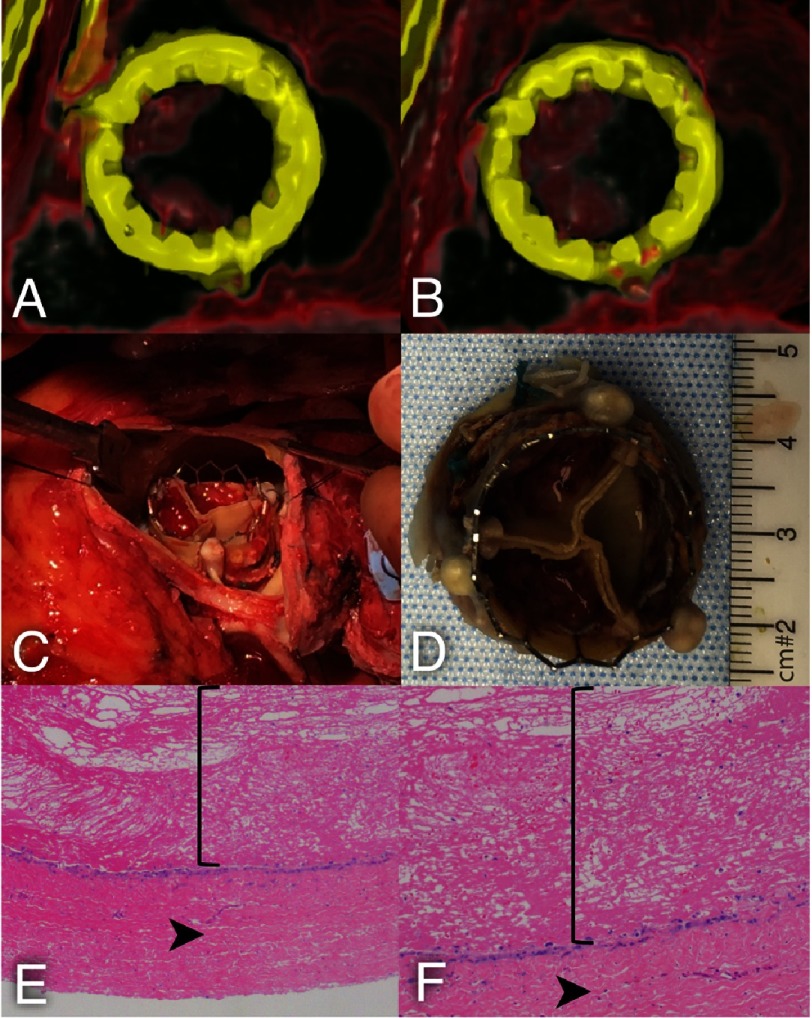
A major concern regarding transcatheter aortic valve replacement (TAVR) is leaflet thrombosis. Four-dimensional computed tomography (4D-CT) is the preferred imaging modality to evaluate patients with suspected valve thrombosis. To date, the abnormal findings visualized by 4D-CT suggestive of leaflet thrombosis have lacked pathologic confirmation from a surgically explanted valve in a surviving patient. Herein, we provide pathologic confirmation of thrombus formation following surgical explantation of a thrombosed TAVR prosthesis that was initially identified by 4D-CT.
经导管主动脉瓣置换术(TAVR)的一个主要问题是瓣叶血栓形成。四维计算机断层扫描(4D-CT)是评估疑似瓣膜血栓形成患者的首选成像方式。迄今为止,4D-CT显示的提示瓣叶血栓形成的异常发现,尚未得到存活患者手术取出瓣膜的病理证实。在此,我们提供了一例经手术取出的血栓形成的TAVR假体的病理证实,该假体最初是通过4D-CT识别的。