Wendt Amanda S, Stephenson Rob, Young Melissa F, Verma Pankaj, Srikantiah Sridhar, Webb-Girard Amy, Hogue Carol J, Ramakrishnan Usha, Martorell Reynaldo
UniversitätsKlinikum Heidelberg, Institut für Public Health, Im Neuenheimer Feld 324, 69120, Heidelberg, Germany.
Nutrition and Health Sciences, Division of Biological and Biomedical Sciences, Emory University, 1462 Clifton Rd. Suite 314, Atlanta, GA, 30322, USA.
BMC Health Serv Res. 2018 Apr 12;18(1):281. doi: 10.1186/s12913-018-3017-x.
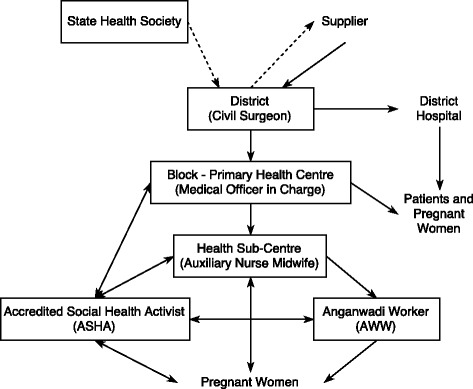
Maternal anaemia prevalence in Bihar, India remains high despite government mandated iron supplementation targeting pregnant women. Inadequate supply has been identified as a potential barrier to iron and folic acid (IFA) receipt. Our study objective was to examine the government health system's IFA supply and distribution system and identify bottlenecks contributing to insufficient IFA supply.
Primary data collection was conducted in November 2011 and July 2012 across 8 districts in Bihar, India. A cross-sectional, observational, mixed methods approach was utilized. Auxiliary Nurse Midwives were surveyed on current IFA supply and practices. In-depth interviews (n = 59) were conducted with health workers at state, district, block, health sub-centre, and village levels.
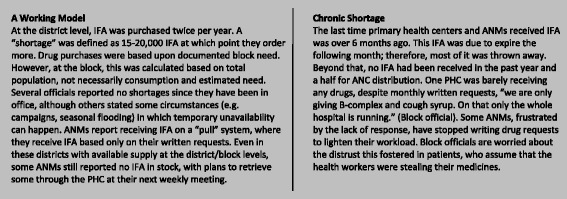
Overall, 44% of Auxiliary Nurse Midwives were out of IFA stock. Stock levels and supply chain practices varied greatly across districts. Qualitative data revealed specific bottlenecks impacting IFA forecasting, procurement, storage, disposal, lack of personnel, and few training opportunities for key players in the supply chain.
Inadequate IFA supply is a major constraint to the IFA supplementation program, the extent of which varies widely across districts. Improvements at all levels of infrastructure, practices, and effective monitoring will be critical to strengthen the IFA supply chain in Bihar.
尽管印度比哈尔邦政府规定对孕妇进行铁补充剂干预,但该邦孕妇贫血患病率仍然很高。供应不足已被确定为铁和叶酸(IFA)获取的潜在障碍。我们的研究目的是检查政府卫生系统的IFA供应和分配系统,并确定导致IFA供应不足的瓶颈。
2011年11月和2012年7月在印度比哈尔邦的8个地区进行了原始数据收集。采用横断面观察性混合方法。对助理护士助产士进行了关于当前IFA供应和做法的调查。对州、区、街区、卫生分中心和村级的卫生工作者进行了深入访谈(n = 59)。
总体而言,44%的助理护士助产士的IFA库存告罄。各地区的库存水平和供应链做法差异很大。定性数据揭示了影响IFA预测、采购、储存、处置、人员短缺以及供应链关键参与者培训机会少的具体瓶颈。
IFA供应不足是IFA补充计划的主要制约因素,其程度在各地区差异很大。改善各级基础设施、做法和有效监测对于加强比哈尔邦的IFA供应链至关重要。