National Malaria Elimination Centre, Chainama Hills Hospital Grounds, PO Box 32509, Lusaka, Zambia.
Vector Biology Department, Liverpool School of Tropical Medicine, Pembroke Place, Liverpool, L35QA, UK.
Malar J. 2018 Apr 13;17(1):164. doi: 10.1186/s12936-018-2309-2.
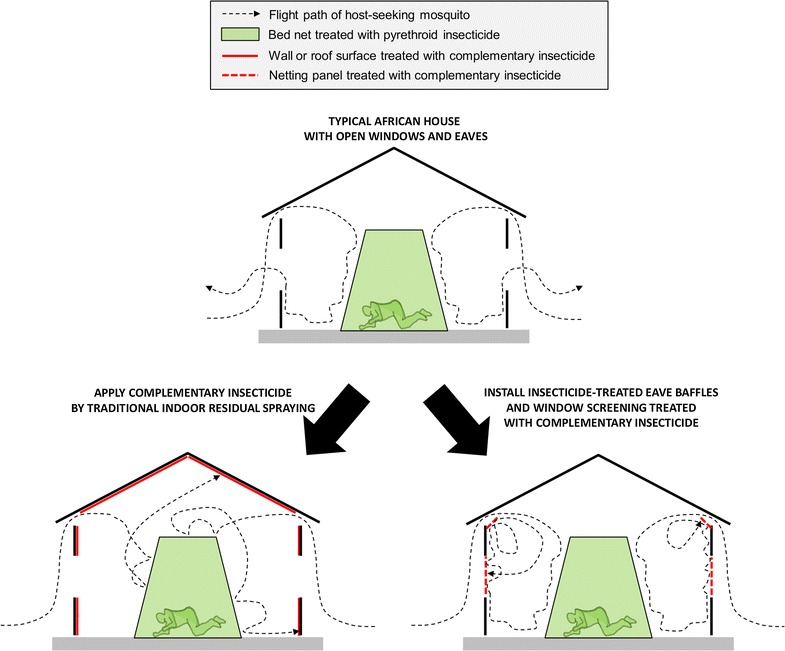
The effectiveness of long-lasting insecticidal-treated nets (LLINs) and indoor residual spraying (IRS) for malaria control is threatened by resistance to commonly used pyrethroid insecticides. Rotations, mosaics, combinations, or mixtures of insecticides from different complementary classes are recommended by the World Health Organization (WHO) for mitigating against resistance, but many of the alternatives to pyrethroids are prohibitively expensive to apply in large national IRS campaigns. Recent evaluations of window screens and eave baffles (WSEBs) treated with pirimiphos-methyl (PM), to selectively target insecticides inside houses, demonstrated malaria vector mortality rates equivalent or superior to IRS. However, the durability of efficacy when co-applied with polyacrylate-binding agents (BA) remains to be established. This study evaluated whether WSEBs, co-treated with PM and BA have comparable wash resistance to LLINs and might therefore remain insecticidal for years rather than months.
WHO-recommended wire ball assays of insecticidal efficacy were applied to polyester netting treated with or without BA plus 1 or 2 g/sq m PM. They were then tested for insecticidal efficacy using fully susceptible insectary-reared Anopheles gambiae mosquitoes, following 0, 5, 10, 15, then 20 washes as per WHO-recommended protocols for accelerated ageing of LLINs. This was followed by a small-scale field trial in experimental huts to measure malaria vector mortality achieved by polyester netting WSEBs treated with BA and 2 g/sq m PM after 0, 10 and then 20 standardized washes, alongside recently applied IRS using PM.
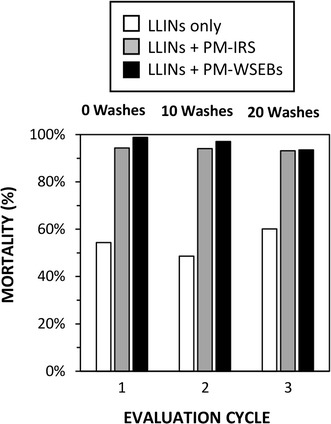
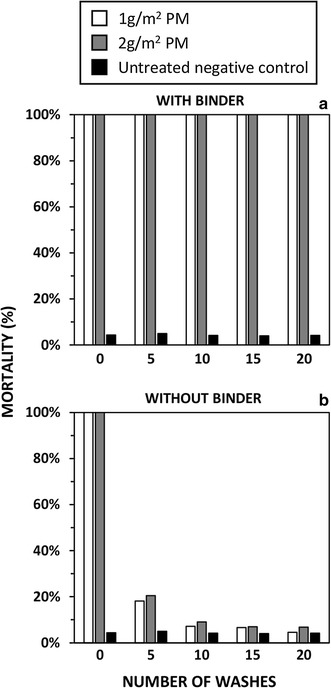
Co-treatment with BA and either dosage of PM remained insecticidal over 20 washes in the laboratory. In experimental huts, WSEBs treated with PM plus BA consistently killed similar proportions of Anopheles arabiensis mosquitoes to PM-IRS (both consistently ≥ 94%), even after 20 washes.
Co-treating WSEBs with both PM and BA results in wash-resistant insecticidal activity comparable with LLINs. Insecticide treatments for WSEBs may potentially last for years rather than months, therefore, reducing insecticide consumption by an order of magnitude relative to IRS. However, durability of WSEBs will still have to be assessed in real houses under representative field conditions of exposure to wear and tear, sunlight and rain.
长效杀虫处理网(LLINs)和室内滞留喷洒(IRS)在疟疾控制方面的有效性受到对常用拟除虫菊酯杀虫剂的抗性的威胁。世界卫生组织(WHO)建议轮换、镶嵌、组合或混合来自不同互补类别的杀虫剂,以减轻抗性,但许多拟除虫菊酯替代品在大规模国家 IRS 运动中应用过于昂贵。最近对用吡虫啉(PM)处理的窗纱和屋檐挡板(WSEBs)的评估表明,选择性针对房屋内的杀虫剂,可以达到与 IRS 相当或更高的疟疾媒介死亡率。然而,当与聚丙烯酸结合剂(BA)共同应用时,其功效的耐久性仍有待确定。本研究评估了 PM 和 BA 共同处理的 WSEBs 是否具有与 LLINs 相当的耐洗性,因此可能在数年内而不是数月内保持杀虫效果。
对涂有或不涂 BA 且涂有 1 或 2 g/sq m PM 的聚酯网进行了 WHO 推荐的钢丝球杀虫功效测试。然后,按照 WHO 加速 LLIN 老化的推荐方案对其进行了 0、5、10、15 然后 20 次洗涤后的杀虫功效测试,使用完全敏感的昆虫饲养的冈比亚按蚊进行测试。随后,在实验性小屋中进行了小规模现场试验,测量了 BA 和 2 g/sq m PM 处理的聚酯网 WSEBs 在 0、10 和 20 次标准化洗涤后的疟疾媒介死亡率,同时还测量了最近使用 PM 进行的 IRS。
在实验室中,BA 和 PM 的任一种剂量的共同处理在 20 次洗涤后仍具有杀虫活性。在实验性小屋中,用 PM 加 BA 处理的 WSEBs 对阿拉伯按蚊的杀灭比例与 PM-IRS 相似(均一致≥94%),即使经过 20 次洗涤也是如此。
用 PM 和 BA 共同处理 WSEBs 可产生与 LLINs 相当的耐洗杀虫活性。WSEBs 的杀虫剂处理可能持续数年而不是数月,因此与 IRS 相比,杀虫剂的消耗减少了一个数量级。然而,WSEBs 的耐久性仍有待在实际房屋中根据暴露于磨损、阳光和雨水的代表性现场条件进行评估。