Ren Fang, Ward Logan, Williams Travis, Laws Kevin J, Wolverton Christopher, Hattrick-Simpers Jason, Mehta Apurva
Stanford Synchrotron Radiation Lightsource, SLAC National Accelerator Laboratory, Menlo Park, CA 94025, USA.
Department of Materials Science and Engineering, Northwestern University, Evanston, IL 60208, USA.
Sci Adv. 2018 Apr 13;4(4):eaaq1566. doi: 10.1126/sciadv.aaq1566. eCollection 2018 Apr.
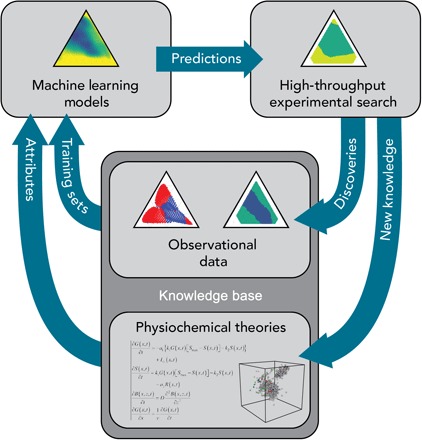
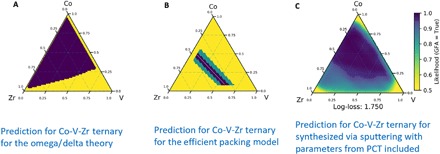
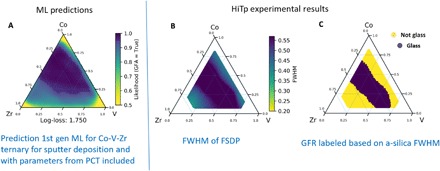
With more than a hundred elements in the periodic table, a large number of potential new materials exist to address the technological and societal challenges we face today; however, without some guidance, searching through this vast combinatorial space is frustratingly slow and expensive, especially for materials strongly influenced by processing. We train a machine learning (ML) model on previously reported observations, parameters from physiochemical theories, and make it synthesis method-dependent to guide high-throughput (HiTp) experiments to find a new system of metallic glasses in the Co-V-Zr ternary. Experimental observations are in good agreement with the predictions of the model, but there are quantitative discrepancies in the precise compositions predicted. We use these discrepancies to retrain the ML model. The refined model has significantly improved accuracy not only for the Co-V-Zr system but also across all other available validation data. We then use the refined model to guide the discovery of metallic glasses in two additional previously unreported ternaries. Although our approach of iterative use of ML and HiTp experiments has guided us to rapid discovery of three new glass-forming systems, it has also provided us with a quantitatively accurate, synthesis method-sensitive predictor for metallic glasses that improves performance with use and thus promises to greatly accelerate discovery of many new metallic glasses. We believe that this discovery paradigm is applicable to a wider range of materials and should prove equally powerful for other materials and properties that are synthesis path-dependent and that current physiochemical theories find challenging to predict.
元素周期表中有一百多种元素,存在大量潜在的新材料可用于应对我们当今面临的技术和社会挑战;然而,没有一些指导的话,在这个庞大的组合空间中进行搜索极其缓慢且成本高昂,尤其是对于受加工过程强烈影响的材料。我们基于先前报道的观察结果、物理化学理论的参数训练了一个机器学习(ML)模型,并使其依赖于合成方法,以指导高通量(HiTp)实验,从而在Co-V-Zr三元系中找到一种新型金属玻璃体系。实验观察结果与模型预测结果吻合良好,但在预测的精确成分上存在定量差异。我们利用这些差异对ML模型进行重新训练。经过改进的模型不仅在Co-V-Zr体系中,而且在所有其他可用的验证数据上,都显著提高了准确性。然后,我们使用改进后的模型在另外两个先前未报道的三元系中指导金属玻璃的发现。尽管我们迭代使用ML和HiTp实验的方法引导我们快速发现了三种新型玻璃形成体系,但它也为我们提供了一种对金属玻璃定量准确、对合成方法敏感的预测器,该预测器会随着使用而提高性能,因此有望极大地加速许多新型金属玻璃的发现。我们相信,这种发现范式适用于更广泛的材料,并且对于其他依赖合成路径且当前物理化学理论难以预测的材料和性能,也应同样有效。