Department of Biotechnology, College of Biomedical and Health Science, Konkuk University, Chung-Ju, 27478, Korea.
Department of Biomolecular Sciences, The Weizmann Institute of Science, 76100, Rehovot, Israel.
Cell Death Differ. 2018 Jun;25(6):1107-1117. doi: 10.1038/s41418-018-0104-9. Epub 2018 Apr 17.
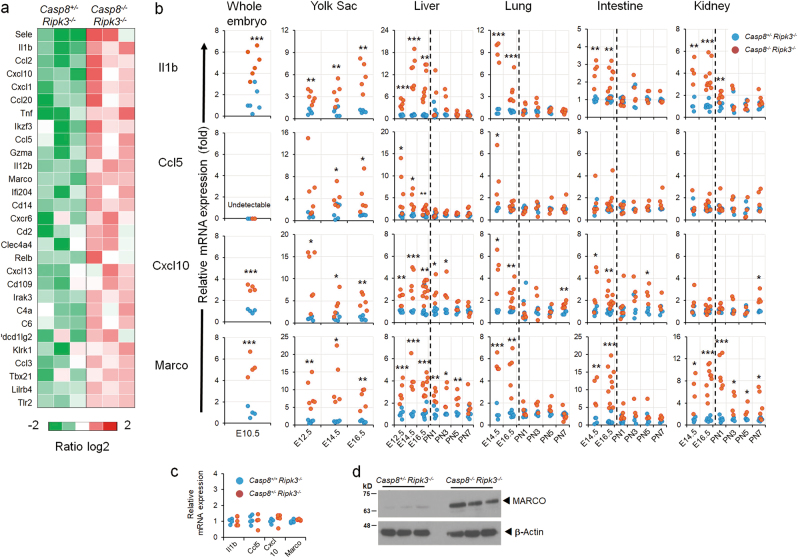
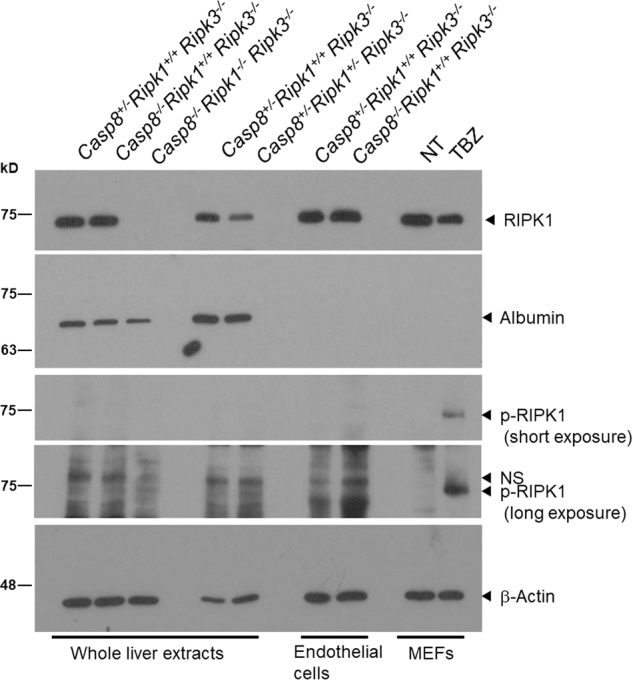
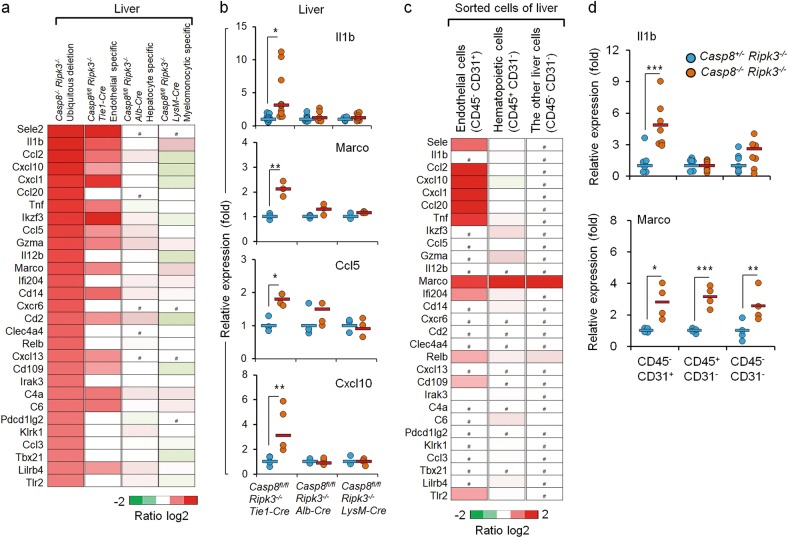
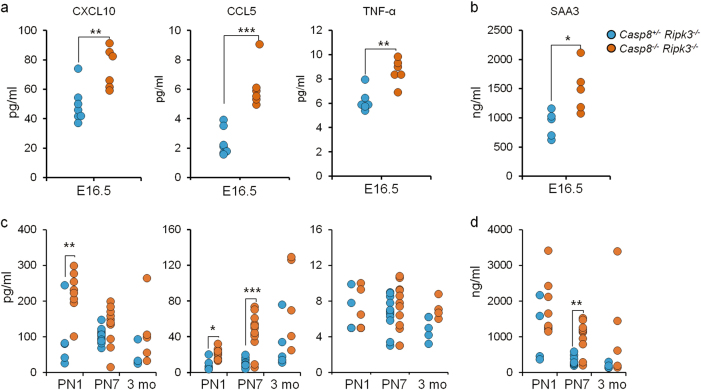
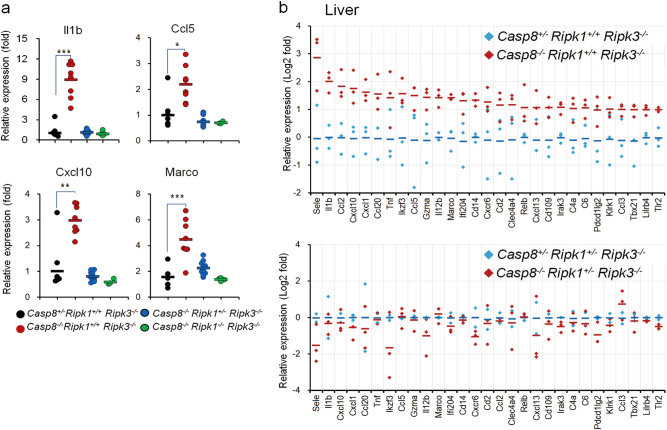
Deletion of the Casp8 gene in epithelial tissues of mice results in severe inflammatory pathologies. Its ubiquitous deletion, or its specific deletion in endothelial cells, results in intrauterine death associated with capillary damage. These pathologies are all preventable by co-deletion of Casp8 and the genes encoding either the RIPK1 or the RIPK3 protein kinase. Since activation of RIPK3 in Caspase-8-deficient cells can trigger necroptotic cell death, and since RIPK1 can activate RIPK3, it is widely assumed that the inflammatory states resulting from Caspase-8 deficiency occur as a consequence of RIPK3-induced necroptosis. Here, we report that although on a Ripk3-null background Casp8 deletion in mice does not result in outright pathological changes, it triggers enhanced expression of a variety of inflammatory genes in utero, which gradually subsides after birth. Deletion of Ripk1, or even of only one of its two alleles, obliterates this activation. Resembling the embryonic pathology observed in RIPK3-expressing cells, the activation of inflammatory genes observed on a Ripk3-null background seems to be initiated in endothelial cells. Analysis of endothelial cells isolated from livers of Caspase-8-deficient embryos revealed neither an increase in the amount of RIPK1 in these cells after Casp8 deletion, nor triggering of RIPK1 phosphorylation. These findings indicate that the triggering of inflammation by Casp8 deletion in mice occurs, in part, independently of necroptosis or other functions of RIPK3, and rather reflects enhanced RIPK1-dependent signaling for activation of inflammatory genes.
在小鼠的上皮组织中删除 Casp8 基因可导致严重的炎症性病理。其普遍缺失,或在血管内皮细胞中特异性缺失,可导致与毛细血管损伤相关的宫内死亡。这些病理均可通过同时删除 Casp8 和编码 RIPK1 或 RIPK3 蛋白激酶的基因来预防。由于在 Caspase-8 缺陷细胞中激活 RIPK3 可触发坏死性细胞死亡,并且 RIPK1 可以激活 RIPK3,因此广泛认为 Caspase-8 缺乏引起的炎症状态是 RIPK3 诱导的坏死性细胞死亡的结果。在这里,我们报告说,尽管在 Ripk3 缺陷背景下,Casp8 的缺失在小鼠中不会导致明显的病理变化,但它会在子宫内触发多种炎症基因的增强表达,这些表达在出生后逐渐消退。Ripk1 的缺失,甚至其两个等位基因中的一个缺失,都会消除这种激活。与在 RIPK3 表达细胞中观察到的胚胎病理相似,在 Ripk3 缺陷背景下观察到的炎症基因的激活似乎起始于血管内皮细胞。对 Caspase-8 缺陷胚胎肝脏分离的内皮细胞进行分析表明,在 Casp8 缺失后,这些细胞中 RIPK1 的量既没有增加,也没有触发 RIPK1 磷酸化。这些发现表明,Casp8 缺失在小鼠中引发炎症的部分机制独立于坏死性细胞死亡或 RIPK3 的其他功能,而是反映了增强的 RIPK1 依赖性信号通路,用于激活炎症基因。