Alanazy Mohammed H, Barakeh Rima B, Asiri Alanood, Edrees Maha F, Abuzinadah Ahmad R, Aljafen Bandar N, Muayqil Taim
Department of Internal Medicine, King Saud University Medical City and College of Medicine, King Saud University, Riyadh, Saudi Arabia.
Department of Internal Medicine, King Abdulaziz University, Jeddah, Saudi Arabia.
Neurol Res Int. 2018 Feb 13;2018:1695014. doi: 10.1155/2018/1695014. eCollection 2018.
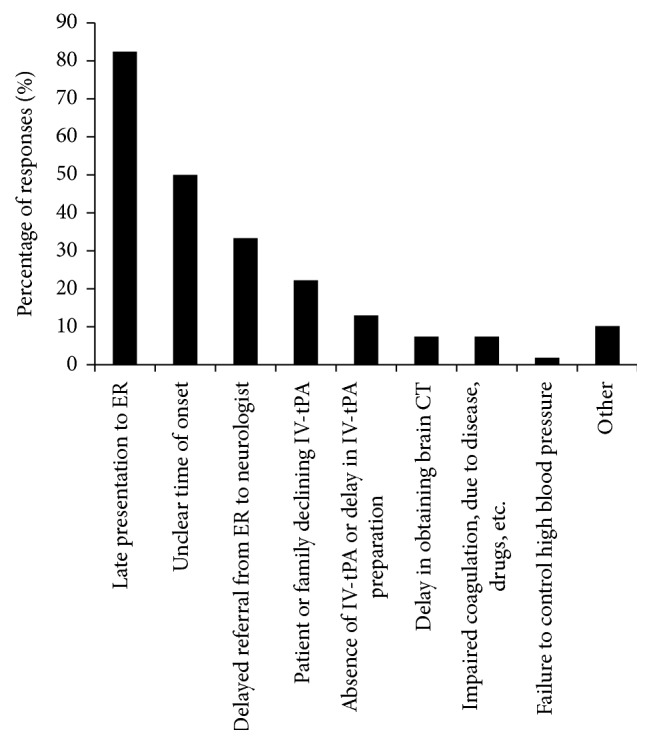
Only a small fraction of patients with acute ischemic stroke receive intravenous thrombolysis (IVT). We sought to assess barriers and practice patterns in using IVT for acute ischemic stroke among neurologists in Saudi Arabia. An electronic survey was sent to all neurologists registered with the Saudi Commission for Health Specialties. A total of 148 (77.5%) neurologists responded. The most common reported barriers for IVT administration were delayed presentation to hospitals (82.4%) and unclear time of symptom onset (50.0%). Only 9.9% of neurologists reported strict adherence to the American Heart Association/American Stroke Association guidelines for IVT administration. The most frequently waived criteria were "minor stroke with National Institutes of Health Stroke Scale [NIHSS] < 5" (49.4%) and "seizure at onset" (45.7%). For the extended 3-4.5-hour window, 18.5% of neurologists reported strict adherence to the four exclusion criteria. The most frequently waived criteria were "age older than 80 years" (53.1%) and "history of both diabetes and prior stroke" (42.0%). In conclusion, most neurologists do not adhere to the IVT exclusion criteria. However, little consensus exists regarding which criteria do not interfere with IVT administration. Barriers to IVT administration were identified and require immediate action by healthcare authorities in Saudi Arabia.
仅有一小部分急性缺血性中风患者接受静脉溶栓治疗(IVT)。我们试图评估沙特阿拉伯神经科医生在使用IVT治疗急性缺血性中风方面的障碍和实践模式。向沙特卫生专业委员会注册的所有神经科医生发送了电子调查问卷。共有148名(77.5%)神经科医生回复。报告的IVT给药最常见障碍是到医院就诊延迟(82.4%)和症状发作时间不明(50.0%)。只有9.9%的神经科医生报告严格遵循美国心脏协会/美国中风协会的IVT给药指南。最常被放宽的标准是“美国国立卫生研究院卒中量表[NIHSS]<5的轻度中风”(49.4%)和“发病时癫痫发作”(45.7%)。对于延长至3 - 4.5小时的时间窗,18.5%的神经科医生报告严格遵循四项排除标准。最常被放宽的标准是“年龄大于80岁”(53.1%)和“糖尿病和既往中风史”(42.0%)。总之,大多数神经科医生不遵循IVT排除标准。然而,对于哪些标准不影响IVT给药几乎没有共识。确定了IVT给药的障碍,沙特阿拉伯的卫生当局需要立即采取行动。