Shi Fang-Hong, Li Hao, Cui Min, Zhang Zai-Li, Gu Zhi-Chun, Liu Xiao-Yan
Department of Pharmacy, Renji Hospital Department of Pharmacy, Shanghai Children's Medical Center, School of Medicine, Shanghai Jiaotong University, Shanghai, China.
Medicine (Baltimore). 2018 Apr;97(16):e0420. doi: 10.1097/MD.0000000000010420.
It is a great challenge for type 2 diabetes mellitus (T2DM) patients to maintain optimal glycemia, control body weight, blood pressure, and avoiding hypoglycemia. Glucagon-like peptide-1 (GLP-1) receptor agonists (GLP-1 RAs) can stimulate glucose-dependent insulin while inhibit glucagon secretion, delay gastric emptying, reduce appetite, and energy intake. Recently, a new once-weekly GLP-1 RAs, semaglutide, has been registered to treat patients with T2DM.
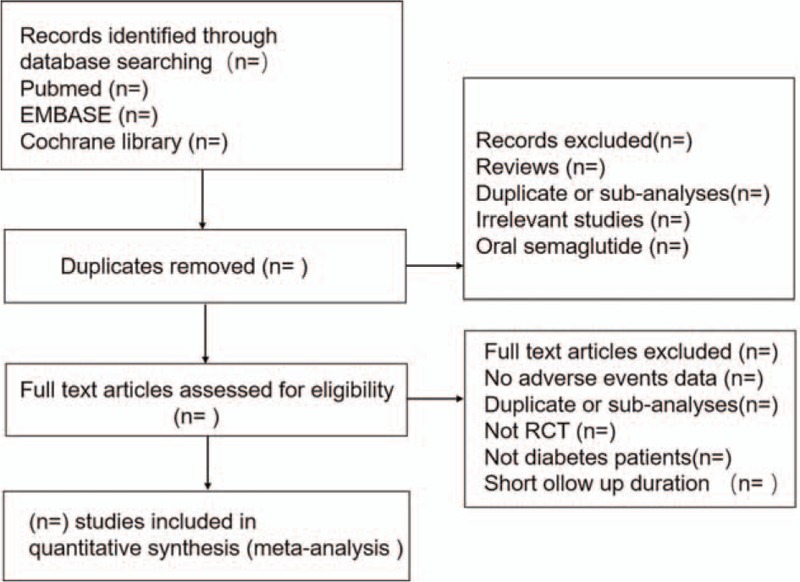
We will search Medline, Embase, Cochrane Library, and the ClinicalTrials.gov Website up to February 2018. Studies will be screened by title, abstract, and full text independently in duplicate. Phase III randomized controlled trials (RCTs) reports efficacy and safety data of semaglutide will be eligible for inclusion. Outcome variables will be assessed included glycemic control indexes (glycosylated hemoglobin [HbA1c]%, fasting plasma glucose [FPG], self-monitoring of blood glucose [SMPG], postprandial self-monitoring of blood glucose [PSMPG]), blood pressure indexes (systolic blood pressure [SBP], diastolic blood pressure [DBP], and pulse rate), body weight control indexes (body weight, body mass index [BMI], and waist circumference), and any adverse events (including adverse events [AEs] varying degrees and AEs occurring in ≥5% patients by preferred term or other of clinical interest). Assessment of risk of bias and data synthesis will be performed using STATA software (version 12, Statacorp, College Station, Texas). Outcomes will report by weight mean difference (WMD) and risk ratios (RRs) and their 95% confidence intervals (95% CIs). Heterogeneity among studies will be evaluated using the I statistic.
This review will evaluate glycemic, blood pressure, body weight control, and any adverse events of semaglutide as compared with other therapies.
Our study will provide a comprehensive picture of semaglutide in T2DM.
对于2型糖尿病(T2DM)患者而言,维持最佳血糖水平、控制体重、血压并避免低血糖是一项巨大挑战。胰高血糖素样肽-1(GLP-1)受体激动剂(GLP-1 RAs)可刺激葡萄糖依赖性胰岛素分泌,同时抑制胰高血糖素分泌,延缓胃排空,降低食欲及能量摄入。最近,一种新型的每周一次GLP-1 RAs司美格鲁肽已获批用于治疗T2DM患者。
我们将检索截至2018年2月的Medline、Embase、Cochrane图书馆及ClinicalTrials.gov网站。研究将由两名独立人员分别通过标题、摘要及全文进行筛选。纳入标准为Ⅲ期随机对照试验(RCT)报告司美格鲁肽的疗效和安全性数据。将评估的结局变量包括血糖控制指标(糖化血红蛋白[HbA1c]%、空腹血糖[FPG]、自我血糖监测[SMPG]、餐后自我血糖监测[PSMPG])、血压指标(收缩压[SBP]、舒张压[DBP]及脉搏率)、体重控制指标(体重、体重指数[BMI]及腰围)以及任何不良事件(包括不同程度的不良事件[AEs]以及按首选术语或其他临床关注术语统计的≥5%患者发生的AEs)。将使用STATA软件(版本12,Statacorp,美国得克萨斯州大学城)进行偏倚风险评估和数据合成。结局将以加权均数差(WMD)和风险比(RRs)及其95%置信区间(95% CIs)报告。将使用I统计量评估研究间的异质性。
本综述将评估司美格鲁肽与其他疗法相比在血糖、血压、体重控制及任何不良事件方面的情况。
我们的研究将全面呈现司美格鲁肽在T2DM中的应用情况。