Division of Pulmonary and Critical Care Medicine, Department of Internal Medicine, College of Medicine, Ewha Womans University, Seoul, Republic of Korea.
Department of Occupational and Environmental Medicine, College of Medicine, Ewha Womans University, Seoul, Republic of Korea.
PLoS One. 2018 Apr 18;13(4):e0195104. doi: 10.1371/journal.pone.0195104. eCollection 2018.
Overweight or obesity might be protective factors of tuberculosis (TB), but the evidence is inconclusive. The objective of study was to evaluate association between BMI and incident TB.
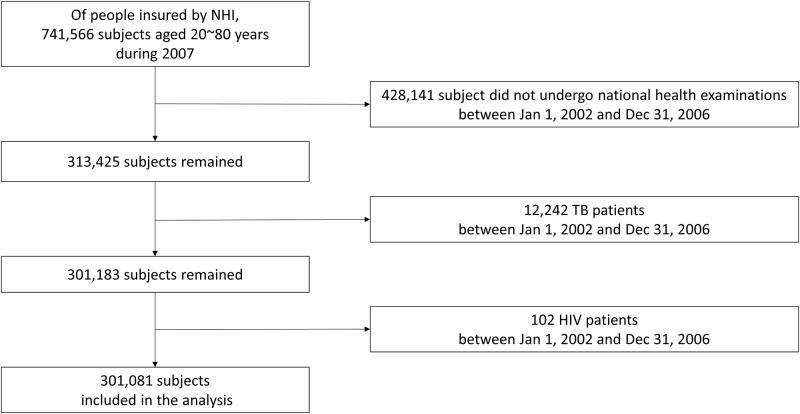
The National Health Insurance database was used. Eligible participants were individuals aged 20-89 years without history of TB before 2007, and who underwent national health examinations between January 2002 and December 2006. The latest record of BMI was used as the exposure and categorized as follows: <18.5, 18.5-23, 23-25, 25-30, and ≥30 kg/m2. TB was defined as the first recorded diagnosis of TB, using ICD-10 between January 2007 and December 2013.
Among 301,081 individuals, 3,772 (1.26%) incident TB cases were detected. The incidence rate of the event was 19.65 per 10,000 person-years. After adjusting age, sex, household income, smoking status, alcohol use, and diabetes, incident TB was decreased as BMI was increased in an inverse dose-response relationship. However, when stratified by age and sex, BMI >30 kg/m2 did not show protective effect of TB in female under 50 years. Additionally, BMI >30 kg/m2 did not decrease incident TB in diabetics.
Our study suggests that high BMI might be associated with decreased risk of TB. However, very high BMI did not reduce the risk of TB in young females or diabetics participants with in Korean population.
超重或肥胖可能是结核病(TB)的保护因素,但证据尚无定论。本研究旨在评估 BMI 与结核病发病风险之间的关联。
利用国家健康保险数据库。纳入标准为 20-89 岁、2007 年前无结核病病史、2002 年 1 月至 2006 年 12 月间参加过国家健康检查的个体。BMI 的最新记录用作暴露因素,并分为以下几类:<18.5、18.5-23、23-25、25-30 和≥30 kg/m2。结核病定义为 2007 年 1 月至 2013 年 12 月期间首次记录的结核病诊断,使用 ICD-10 编码。
在 301,081 名个体中,有 3,772 例(1.26%)结核病发病。发病率为 19.65/10,000 人年。在调整年龄、性别、家庭收入、吸烟状况、饮酒和糖尿病后,随着 BMI 的增加,呈负相关,事件发生率呈下降趋势。然而,按年龄和性别分层时,50 岁以下的女性 BMI >30 kg/m2 与结核病无保护作用。此外,在糖尿病患者中,BMI >30 kg/m2 并不能降低结核病的发病风险。
本研究表明,高 BMI 可能与结核病发病风险降低相关。然而,在韩国人群中,非常高的 BMI 并不能降低年轻女性或糖尿病患者结核病的发病风险。