Structural and Computational Biology Unit, European Molecular Biology Laboratory, Heidelberg, Germany.
Nestlé Institute of Health Sciences, Lausanne, Switzerland.
Microbiome. 2018 Apr 19;6(1):72. doi: 10.1186/s40168-018-0450-3.
Gut microbes influence their hosts in many ways, in particular by modulating the impact of diet. These effects have been studied most extensively in humans and mice. In this work, we used whole genome metagenomics to investigate the relationship between the gut metagenomes of dogs, humans, mice, and pigs.
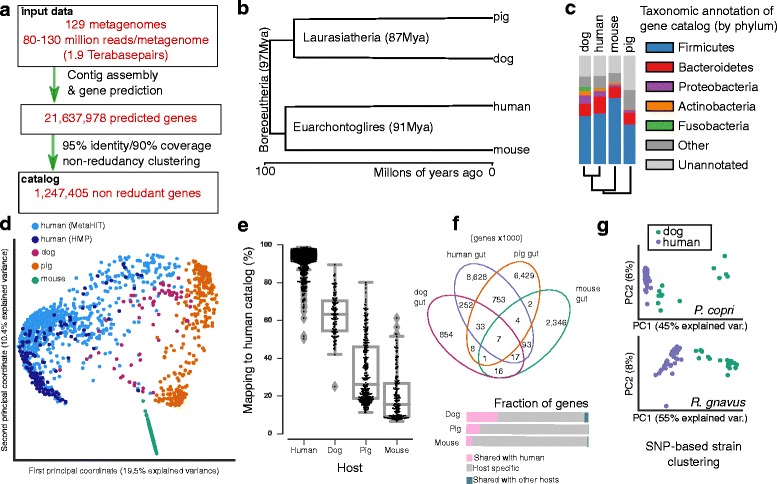
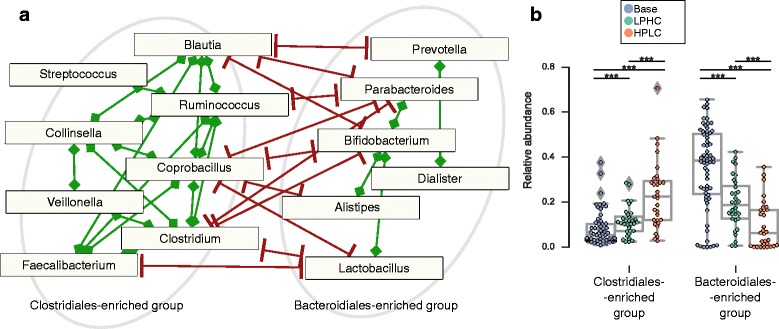
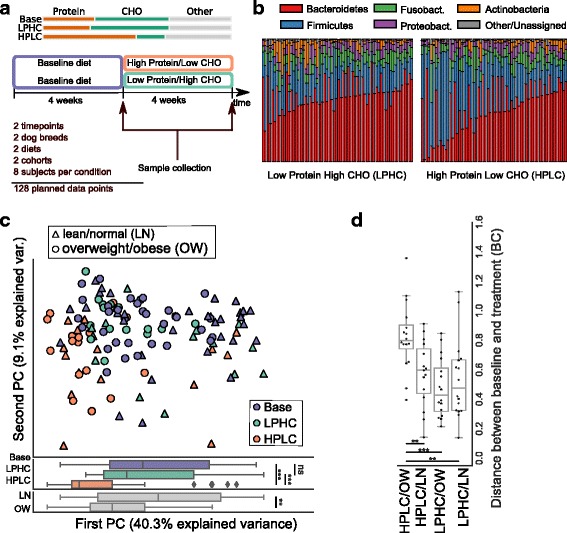
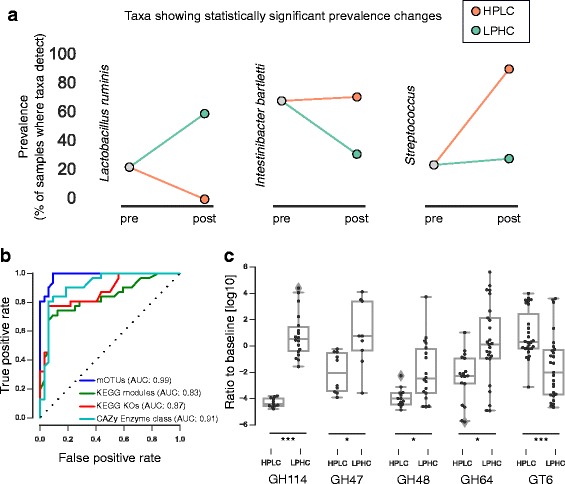
We present a dog gut microbiome gene catalog containing 1,247,405 genes (based on 129 metagenomes and a total of 1.9 terabasepairs of sequencing data). Based on this catalog and taxonomic abundance profiling, we show that the dog microbiome is closer to the human microbiome than the microbiome of either pigs or mice. To investigate this similarity in terms of response to dietary changes, we report on a randomized intervention with two diets (high-protein/low-carbohydrate vs. lower protein/higher carbohydrate). We show that diet has a large and reproducible effect on the dog microbiome, independent of breed or sex. Moreover, the responses were in agreement with those observed in previous human studies.
We conclude that findings in dogs may be predictive of human microbiome results. In particular, a novel finding is that overweight or obese dogs experience larger compositional shifts than lean dogs in response to a high-protein diet.
肠道微生物以多种方式影响其宿主,特别是通过调节饮食的影响。这些影响在人类和小鼠中研究得最为广泛。在这项工作中,我们使用全基因组宏基因组学来研究狗、人类、小鼠和猪的肠道宏基因组之间的关系。
我们提供了一个包含 1247405 个基因的狗肠道微生物组基因目录(基于 129 个宏基因组和总计 1.9 太字节的测序数据)。基于这个目录和分类丰度分析,我们表明狗微生物组与人类微生物组比猪或小鼠微生物组更接近。为了根据饮食变化的反应来研究这种相似性,我们报告了一项随机干预实验,使用两种饮食(高蛋白/低碳水化合物与低蛋白/高碳水化合物)。我们表明,饮食对狗微生物组有很大且可重复的影响,不受品种或性别影响。此外,这些反应与之前在人类研究中观察到的反应一致。
我们的结论是,狗身上的发现可能可以预测人类微生物组的结果。特别是一个新的发现是,超重或肥胖的狗在高蛋白饮食下比瘦狗经历更大的组成变化。