Kabwama Steven Ndugwa, Ssewanyana Derrick, Berg-Beckhoff Gabriele
Makerere University School of Public Health, Kampala, Uganda.
Utrecht Centre for Child and Adolescent Studies, Utrecht University.
Mater Sociomed. 2018 Mar;30(1):62-66. doi: 10.5455/msm.2018.30.62-66.
The protective benefit of male circumcision against spreading HIV is well established.
The objective of this Meta-analysis was to investigate behavioral risk compensation measured as the change in condom use behavior in light of knowledge of the benefits of circumcision.
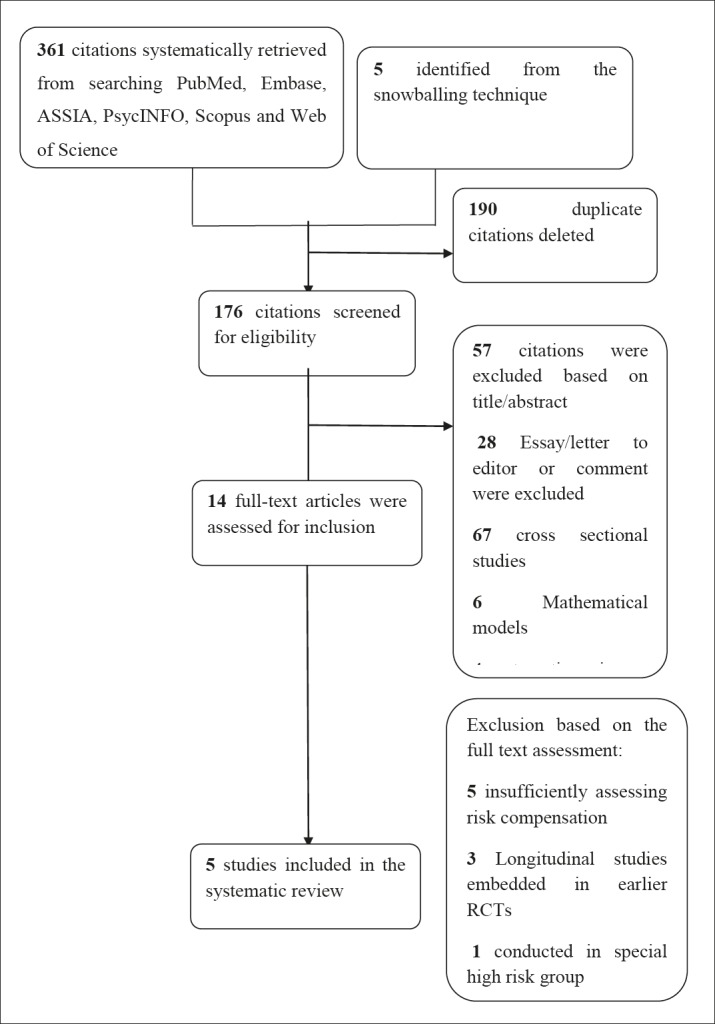
A systematic search was conducted from 6 bibliographic databases for studies that quantitatively assessed a link between male circumcision and condom use behavior. Pooled odd ratios (OR) of condom use during any sexual activity were generated from three cohort studies and two Randomized Control Trails (RCT) that were included in the review.
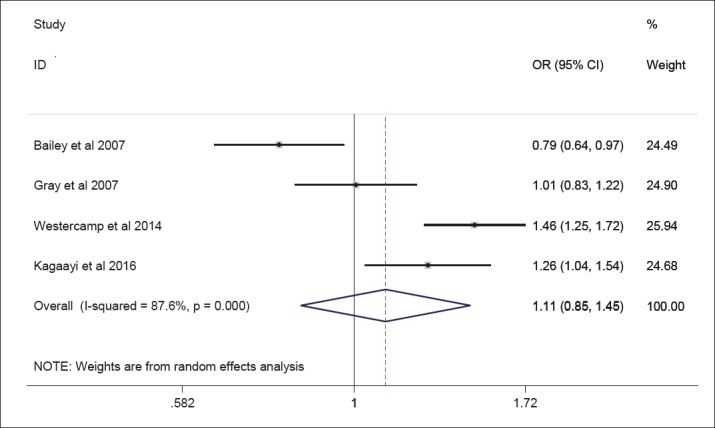
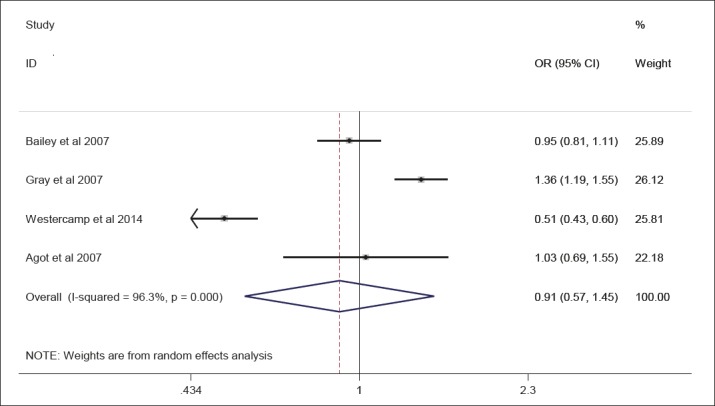
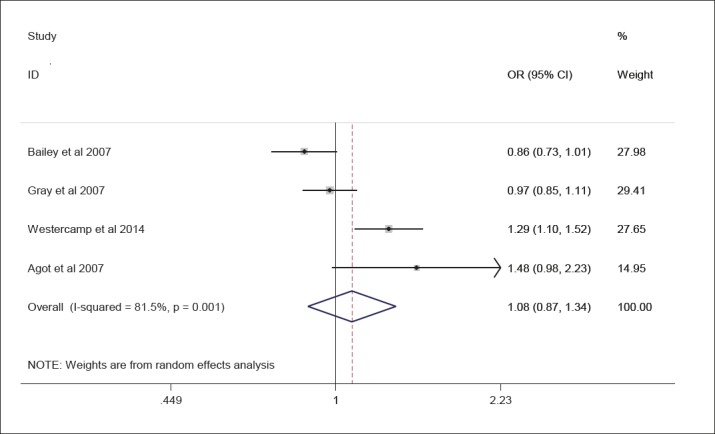
The pooled effects from cohort and RCTs were not statistically significant at 6 months follow-up (OR=0.91, 95% CI: 0.57-1.45), at 12 months (OR=1.08, 95% CI=0.87-1.34) and 24 or more months (OR=1.11, 95% CI: 0.85, 1.45).
Male circumcision does not influence condom use behavior in the medium and short term.
男性包皮环切术对预防艾滋病毒传播的保护作用已得到充分证实。
本荟萃分析的目的是研究行为风险补偿,即根据对包皮环切术益处的了解,以避孕套使用行为的变化来衡量。
从6个文献数据库中进行系统检索,以查找定量评估男性包皮环切术与避孕套使用行为之间联系的研究。本综述纳入的3项队列研究和2项随机对照试验得出了在任何性行为中使用避孕套的合并比值比(OR)。
在6个月随访时(OR = 0.91,95%置信区间:0.57 - 1.45)、12个月时(OR = 1.08,95%置信区间 = 0.87 - 1.34)以及24个月或更长时间时(OR = 1.11,95%置信区间:0.85,1.45),队列研究和随机对照试验的合并效应在统计学上均无显著意义。
男性包皮环切术在短期和中期不会影响避孕套的使用行为。