Chaurasiya Shyambabu, Chen Nanhai G, Warner Susanne G
Department of Surgery, Division of Surgical Oncology, City of Hope National Medical Center, Duarte, CA 91010, USA.
Center for Gene Therapy, Department of Hematologic and Hematopoietic Cell Transplantation, Beckman Research Institute, City of Hope National Medical Center, Duarte, CA 91010, USA.
Cancers (Basel). 2018 Apr 19;10(4):124. doi: 10.3390/cancers10040124.
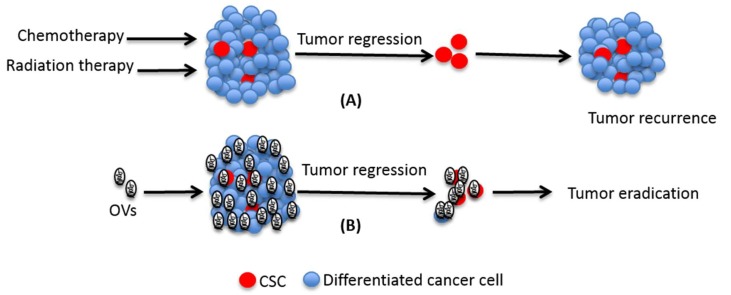
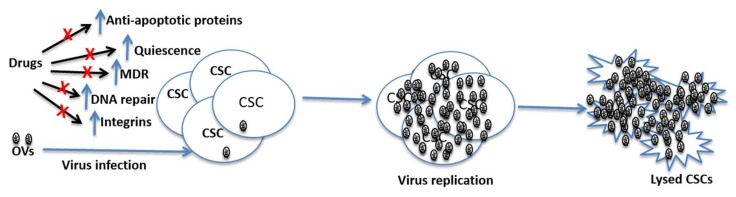
A growing body of evidence suggests that a subset of cells within tumors are resistant to conventional treatment modalities and may be responsible for disease recurrence. These cells are called cancer stem cells (CSC), which share properties with normal stem cells including self-renewal, pluripotency, drug resistance, and the ability to maintain quiescence. While most conventional therapies can efficiently destroy rapidly dividing cancer cells comprising the bulk of a tumor, they often fail to kill the less abundant and quiescent CSCs. Furthermore, killing of only differentiated cells in the tumor may actually allow for enrichment of CSCs and thereby portend a bad prognosis. Therefore, targeting of CSCs is important to achieve long-term success in cancer therapy. Oncolytic viruses represent a completely different class of therapeutics that can kill cancer cells in a variety of ways, which differ from those of conventional therapies. Hence, CSCs that are inherently resistant to conventional therapies may be susceptible to oncolytic virus-mediated killing. Recent studies have shown that oncolytic viruses can efficiently kill CSCs in many types of cancer. Here, we discuss the mechanism through which CSCs can escape conventional therapies and how they may still be susceptible to different classes of oncolytic viruses. Furthermore, we provide a summary of recent studies that have tested oncolytic viruses on CSCs of different origins and discuss possible future directions for this fascinating subset of oncolytic virus research.
越来越多的证据表明,肿瘤内的一部分细胞对传统治疗方式具有抗性,可能是疾病复发的原因。这些细胞被称为癌症干细胞(CSC),它们与正常干细胞具有共同特性,包括自我更新、多能性、耐药性以及维持静止状态的能力。虽然大多数传统疗法能够有效地破坏构成肿瘤主体的快速分裂癌细胞,但它们往往无法杀死数量较少且处于静止状态的癌症干细胞。此外,仅杀死肿瘤中的分化细胞实际上可能会使癌症干细胞富集,从而预示着预后不良。因此,靶向癌症干细胞对于癌症治疗取得长期成功至关重要。溶瘤病毒代表了一类完全不同的治疗方法,它可以通过多种方式杀死癌细胞,这与传统疗法不同。因此,对传统疗法具有固有抗性的癌症干细胞可能对溶瘤病毒介导的杀伤敏感。最近的研究表明,溶瘤病毒可以在多种癌症中有效地杀死癌症干细胞。在此,我们讨论癌症干细胞能够逃避传统疗法的机制,以及它们为何仍可能对不同类型的溶瘤病毒敏感。此外,我们总结了最近在不同来源的癌症干细胞上测试溶瘤病毒的研究,并讨论了这一引人入胜的溶瘤病毒研究领域未来可能的发展方向。