Clarke Ryan M, Jeen Tiffany, Rigo Serena, Thompson John R, Kaake Loren G, Thomas Fabrice, Storr Tim
Department of Chemistry , Simon Fraser University , V5A1S6 , Burnaby , BC , Canada . Email:
Départment de Chimie Moléculaire - Chimie Inorganique Redox (CIRE) - UMR CNRS 5250 , Université Grenoble-Alpes , B.P. 53 , 38041 Grenoble Cedex 9 , France.
Chem Sci. 2017 Dec 19;9(6):1610-1620. doi: 10.1039/c7sc04537a. eCollection 2018 Feb 14.
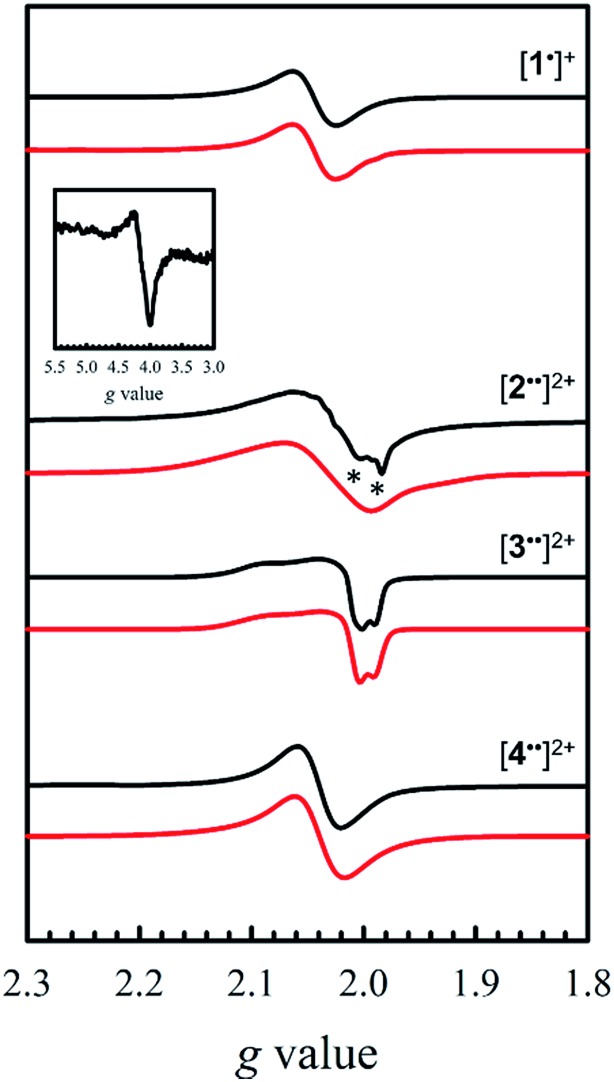
We detail the rational design of a series of bimetallic bis-ligand radical Ni salen complexes in which the relative orientation of the ligand radical chromophores provides a mechanism to tune the energy of intense intervalence charge transfer (IVCT) bands in the near infrared (NIR) region. Through a suite of experimental (electrochemistry, electron paramagnetic resonance spectroscopy, UV-vis-NIR spectroscopy) and theoretical (density functional theory) techniques, we demonstrate that bimetallic Ni salen complexes form bis-ligand radicals upon two-electron oxidation, whose NIR absorption energies depend on the geometry imposed in the bis-ligand radical complex. Relative to the oxidized monomer [] ( = 4500 cm, = 27 700 M cm), oxidation of the cofacially constrained analogue to [] results in a blue-shifted NIR band ( = 4830 cm, = 42 900 M cm), while oxidation of to [], with parallel arrangement of chromophores, results in a red-shifted NIR band ( = 4150 cm, = 46 600 M cm); the NIR bands exhibit double the intensity in comparison to the monomer. Oxidation of the intermediate orientations results in band splitting for [] ( = 4890 and 4200 cm; = 26 500 and 21 100 M cm), and a red-shift for [] using - and -phenylene linkers, respectively. This study demonstrates for the first time, the applicability of exciton coupling to ligand radical systems absorbing in the NIR region and shows that by simple geometry changes, it is possible to tune the energy of intense low energy absorption by nearly 400 nm.
我们详细介绍了一系列双金属双配体自由基镍席夫碱配合物的合理设计,其中配体自由基发色团的相对取向提供了一种机制,可用于调节近红外(NIR)区域中强的价间电荷转移(IVCT)带的能量。通过一系列实验(电化学、电子顺磁共振光谱、紫外可见近红外光谱)和理论(密度泛函理论)技术,我们证明双金属镍席夫碱配合物在双电子氧化后形成双配体自由基,其近红外吸收能量取决于双配体自由基配合物中所施加的几何结构。相对于氧化单体[ ]( = 4500 cm, = 27700 M cm),将共面受限类似物 氧化为[ ]会导致近红外带蓝移( = 4830 cm, = 42900 M cm),而将 氧化为[ ],发色团平行排列,则会导致近红外带红移( = 4150 cm, = 46600 M cm);与单体相比,近红外带的强度加倍。中间取向的氧化导致[ ]的带分裂( = 4890和4200 cm; = 26500和21100 M cm),以及分别使用 - 和 - 亚苯基连接基时[ ]的红移。这项研究首次证明了激子耦合在吸收近红外区域的配体自由基体系中的适用性,并表明通过简单的几何结构变化,可以将近红外区域强的低能量吸收的能量调节近400 nm。