Division of Nephrology, Department of Internal Medicine, Chungnam National University Hospital, Daejeon, Republic of Korea.
Department of Medical Science, Chungnam National University, Daejeon, Republic of Korea.
Dis Markers. 2018 Feb 22;2018:1463940. doi: 10.1155/2018/1463940. eCollection 2018.
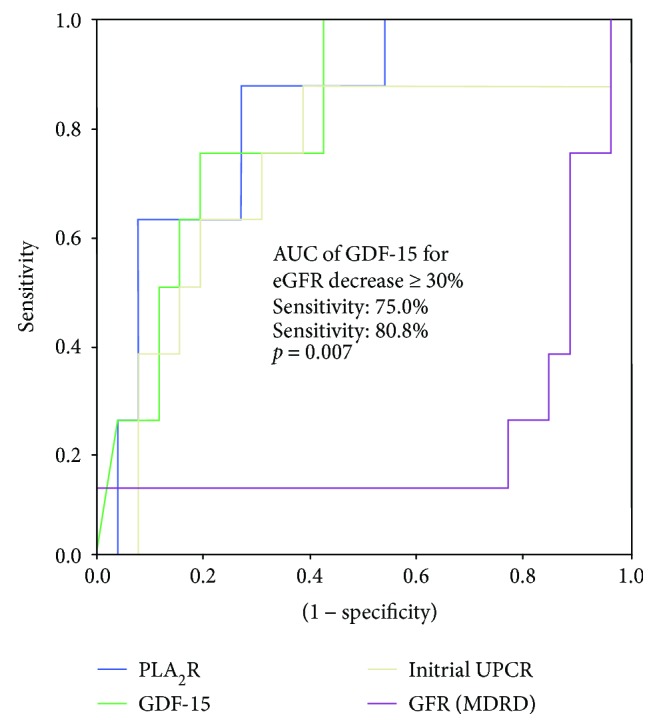
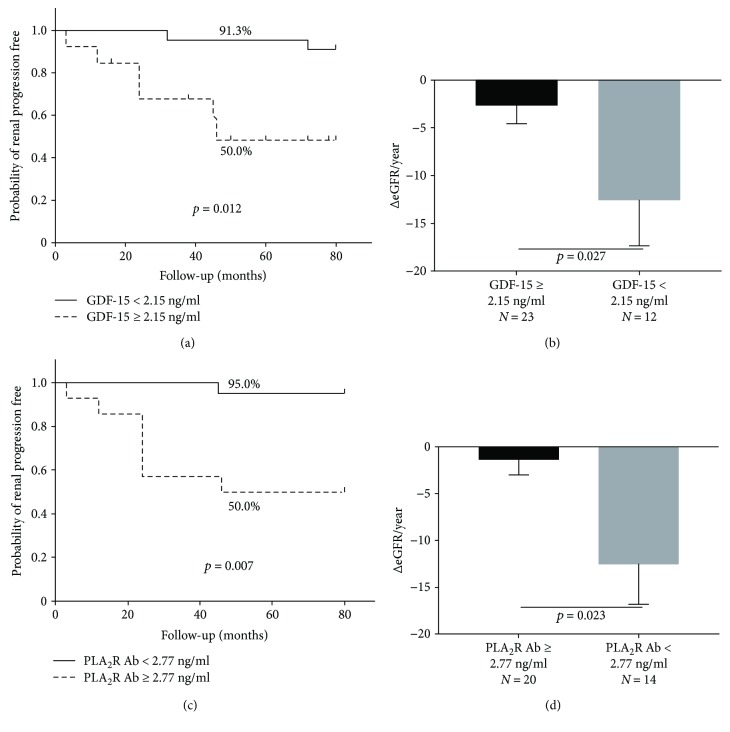
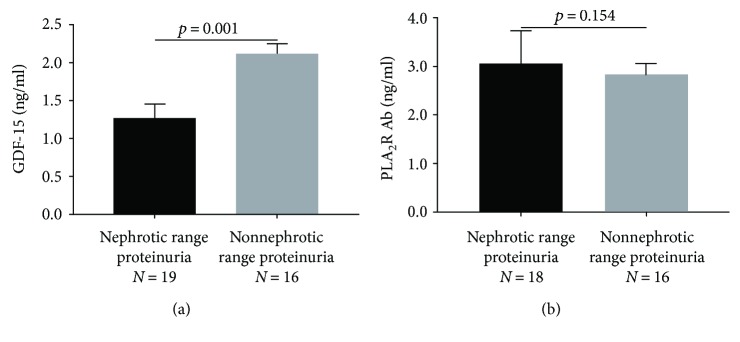
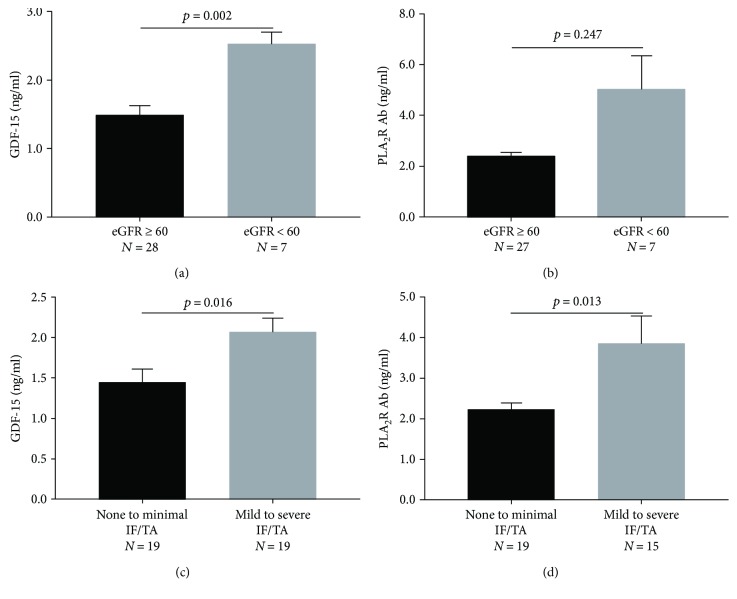
Idiopathic membranous nephropathy (IMN) is a major cause of nephrotic syndrome. No biomarker to predict the long-term prognosis of IMN is currently available. Growth differentiation factor-15 (GDF-15) is a member of the transforming growth factor- superfamily and has been associated with chronic inflammatory disease. It has the potential to be a useful prognostic marker in patients with renal diseases, such as diabetic nephropathy and IgA nephropathy. This study examined whether GDF-15 is associated with the clinical parameters in IMN and showed that GDF-15 can predict IMN disease progression. A total of 35 patients with biopsy-proven IMN, treated at Chungnam National University Hospital from January 2010 to December 2015, were included. Patients younger than 18 years, those with secondary membranous nephropathy, and those lost to follow-up before 12 months were excluded. Levels of GDF-15 at the time of biopsy were measured using enzyme-linked immunosorbent assays. Disease progression was defined as a ≥30% decline in estimated glomerular filtration rate (eGFR) or the development of end-stage renal disease. The mean follow-up was 44.1 months (range: 16-72 months). Using receiver operating curve analysis, the best serum GDF-15 cut-off value for predicting disease progression was 2.15 ng/ml (sensitivity: 75.0%, specificity: 82.1%, = 0.007). GDF-15 was significantly related to age and initial renal function. In the Kaplan-Meier analysis, the risk of disease progression increased in patients with GDF-15 ≥ 2.15 ng/ml when compared with those with GDF-15 < 2.15 ng/ml (50.0% versus 9.7%) ( = 0.012). In the multivariate Cox regression analysis adjusted for potential confounders, only GDF-15 was significantly associated with disease progression in IMN ( = 0.032). In conclusion, the GDF-15 level at the time of diagnosis has a significant negative correlation with initial renal function and is associated with a poor prognosis in IMN. Our results suggest that GDF-15 provides useful prognostic information in patients with IMN.
特发性膜性肾病(IMN)是肾病综合征的主要病因。目前尚无预测 IMN 长期预后的生物标志物。生长分化因子 15(GDF-15)是转化生长因子超家族的成员,与慢性炎症性疾病有关。它有可能成为糖尿病肾病和 IgA 肾病等肾脏疾病的有用预后标志物。本研究探讨了 GDF-15 是否与 IMN 的临床参数相关,并表明 GDF-15 可预测 IMN 疾病进展。共纳入 2010 年 1 月至 2015 年 12 月在忠南国立大学医院接受肾活检证实的特发性膜性肾病患者 35 例。排除年龄<18 岁、继发性膜性肾病及 12 个月前失访的患者。采用酶联免疫吸附试验检测活检时 GDF-15 水平。疾病进展定义为估算肾小球滤过率(eGFR)下降≥30%或终末期肾病的发生。平均随访时间为 44.1 个月(16-72 个月)。采用受试者工作特征曲线分析,预测疾病进展的最佳血清 GDF-15 截断值为 2.15ng/ml(敏感性:75.0%,特异性:82.1%,=0.007)。GDF-15 与年龄和初始肾功能显著相关。Kaplan-Meier 分析显示,与 GDF-15<2.15ng/ml 患者相比,GDF-15≥2.15ng/ml 患者疾病进展风险增加(50.0%比 9.7%,=0.012)。在调整潜在混杂因素的多变量 Cox 回归分析中,仅 GDF-15 与 IMN 疾病进展显著相关(=0.032)。结论:诊断时 GDF-15 水平与初始肾功能呈显著负相关,与 IMN 预后不良相关。我们的结果表明,GDF-15 在 IMN 患者中提供了有用的预后信息。