Kong Siyuan, Ruan Jinxue, Zhang Kaiyi, Hu Bingjun, Cheng Yuzhu, Zhang Yubo, Yang Shulin, Li Kui
State Key Laboratory of Animal Nutrition & Key Laboratory of Farm Animal Genetic Resource and Germplasm Innovation of Ministry of Agriculture, Institute of Animal Sciences, Chinese Academy of Agricultural Sciences, Beijing, Beijing, China.
Agricultural Genomics Institute at Shenzhen, Chinese Academy of Agricultural Sciences, Shenzhen, Guangdong, China.
PeerJ. 2018 Apr 17;6:e4542. doi: 10.7717/peerj.4542. eCollection 2018.
Type 2 diabetes is characterized by insulin resistance accompanied by defective insulin secretion. Transgenic mouse models play an important role in medical research. However, single transgenic mouse models may not mimic the complex phenotypes of most cases of type 2 diabetes.
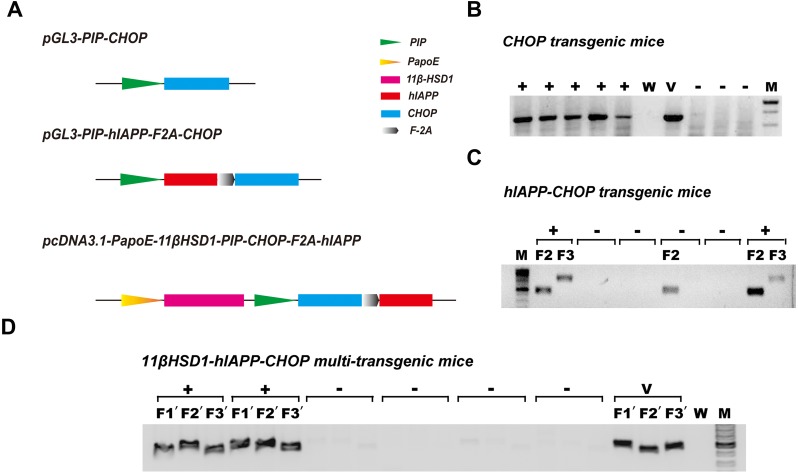
Focusing on genes related to pancreatic islet damage, peripheral insulin resistance and related environmental inducing factors, we generated single-transgenic (C/EBP homology protein, CHOP) mice (CHOP mice), dual-transgenic (human islet amyloid polypeptide, hIAPP; CHOP) mice (hIAPP-CHOP mice) and triple-transgenic (11β-hydroxysteroid dehydrogenase type 1, 11β-HSD1; hIAPP; CHOP) mice (11β-HSD1-hIAPP- CHOP mice). The latter two types of transgenic (Tg) animals were induced with high-fat high-sucrose diets (HFHSD). We analyzed the diabetes-related symptoms and histology features of the transgenic animals.
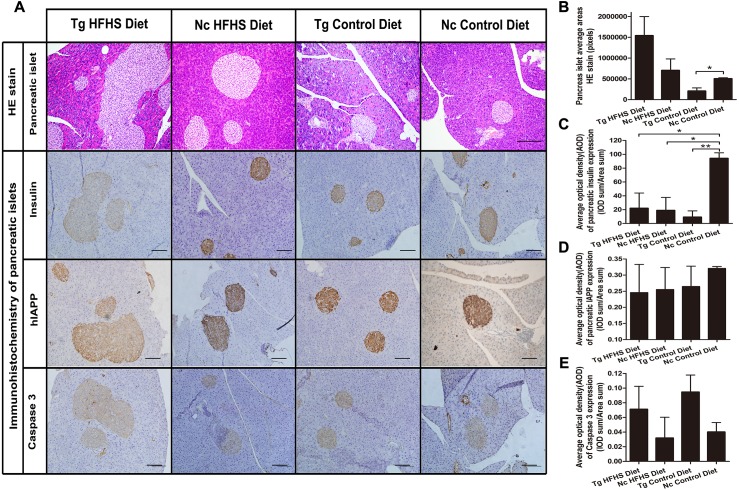
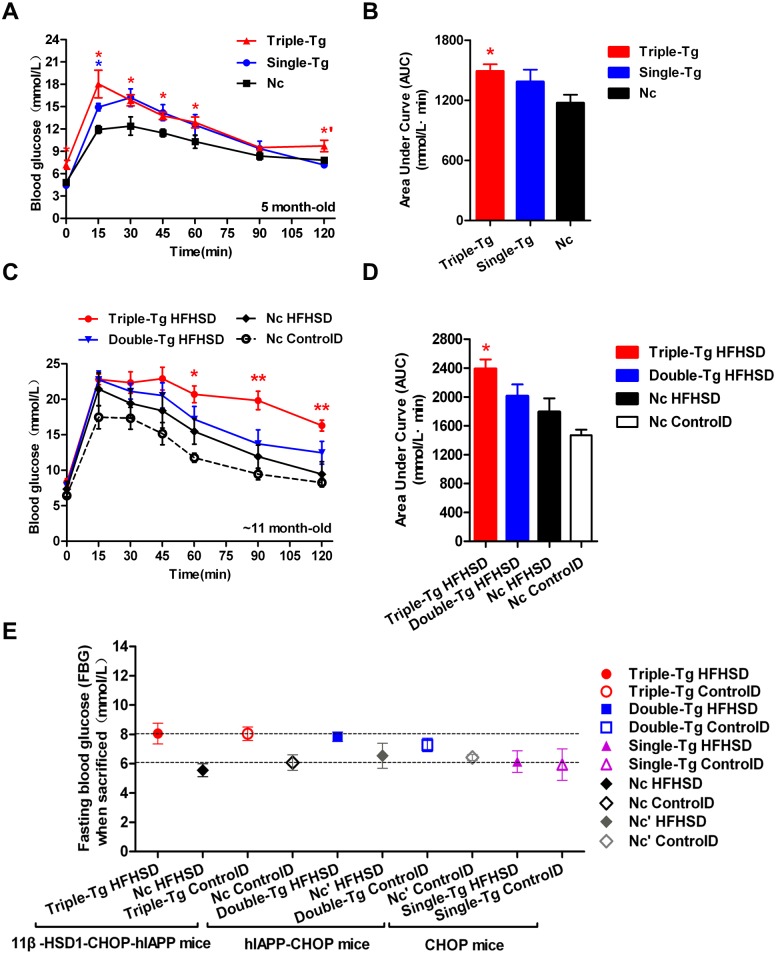
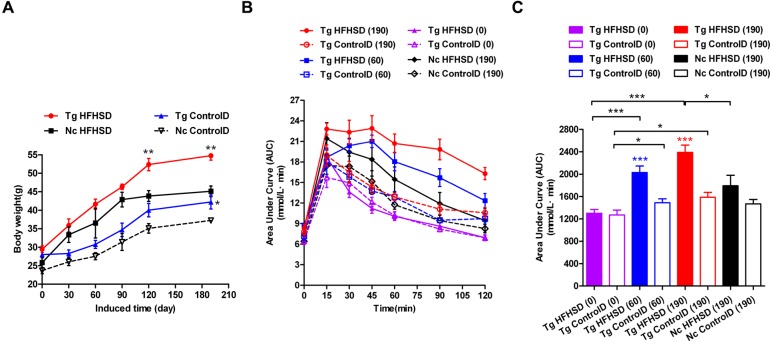
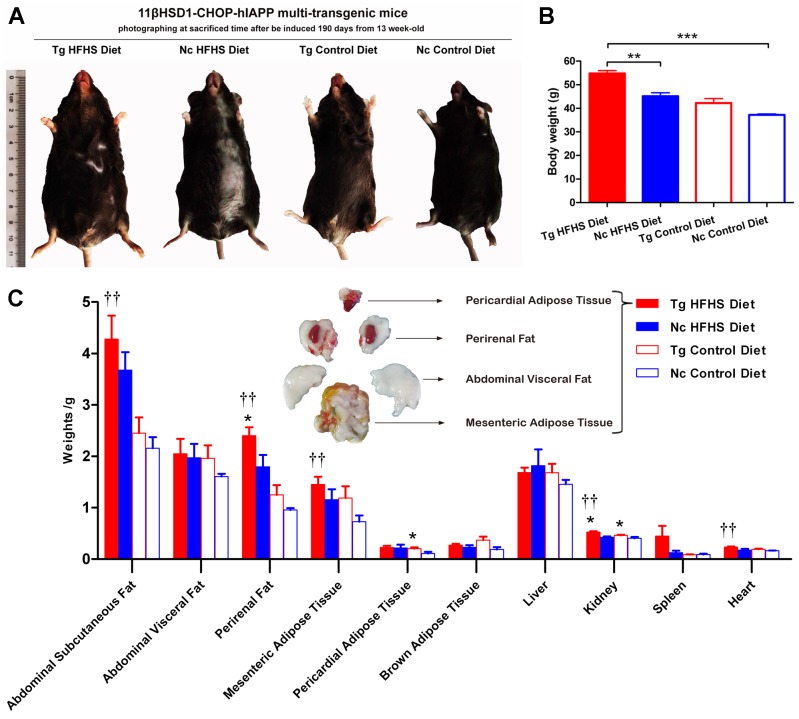
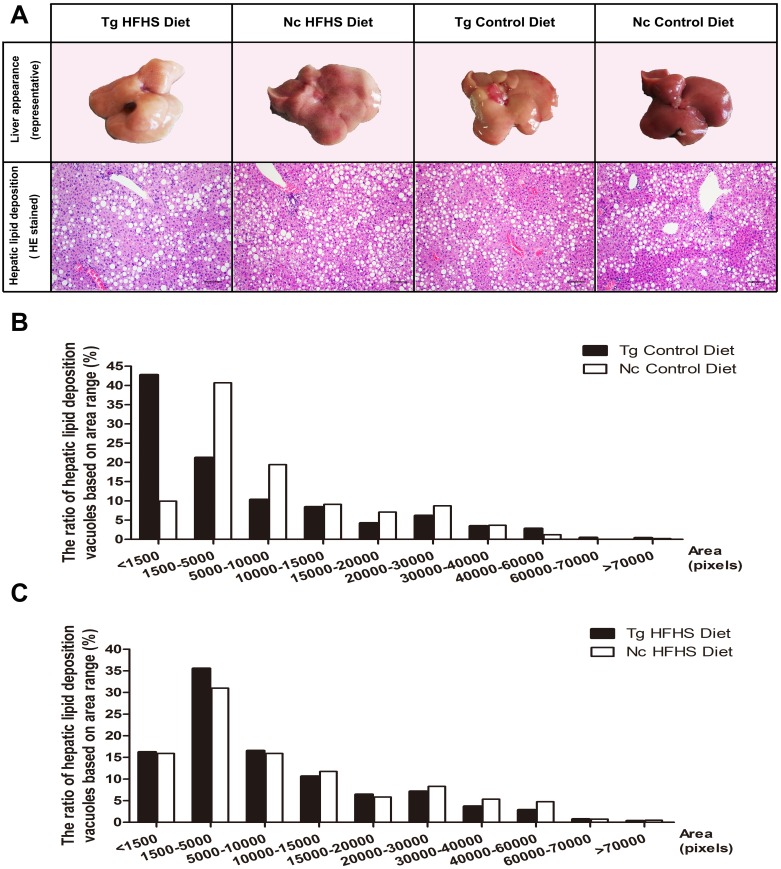
Comparing symptoms on the spot-checked points, we determined that the triple-transgene mice were more suitable for systematic study. The results of intraperitoneal glucose tolerance tests (IPGTT) of triple-transgene animals began to change 60 days after induction ( < 0.001). After 190 days of induction, the body weights ( < 0.01) and plasma glucose of the animals in Tg were higher than those of the animals in Negative Control (Nc). After sacrificed, large amounts of lipid were found deposited in adipose ( < 0.01) and ectopically deposited in the non-adipose tissues ( < 0.05 or 0.01) of the animals in the Tg HFHSD group. The weights of kidneys and hearts of Tg animals were significantly increased ( < 0.01). Serum C peptide (C-P) was decreased due to Tg effects, and insulin levels were increased due to the effects of the HFHSD in the Tg HFHSD group, indicating that damaged insulin secretion and insulin resistance hyperinsulinemia existed simultaneously in these animals. The serum corticosterone of Tg was slightly higher than those of Nc due to the effects of the 11βHSD-1 transgene and obesity. In Tg HFHSD, hepatic adipose deposition was more severe and the pancreatic islet area was enlarged under compensation, accompanying apoptosis. In the transgenic control diet (Tg ControlD) group, hepatic adipose deposition was also severe, pancreatic islets were damaged, and their areas were decreased ( < 0.05), and apoptosis of pancreatic cells occurred. Taken together, these data show the transgenes led to early-stage pathological changes characteristic of type 2 diabetes in the triple-transgene HFHSD group. The disease of triple-transgenic mice was more severe than that of dual or single-transgenic mice.
The use of multi-transgenes involved in insulin resistance and pancreatic apoptosis is a better way to generate polygene-related early-stage diabetes models.
2型糖尿病的特征是胰岛素抵抗并伴有胰岛素分泌缺陷。转基因小鼠模型在医学研究中发挥着重要作用。然而,单一转基因小鼠模型可能无法模拟大多数2型糖尿病病例的复杂表型。
聚焦于与胰岛损伤、外周胰岛素抵抗及相关环境诱导因素相关的基因,我们构建了单转基因(C/EBP同源蛋白,CHOP)小鼠(CHOP小鼠)、双转基因(人胰岛淀粉样多肽,hIAPP;CHOP)小鼠(hIAPP-CHOP小鼠)和三转基因(11β-羟基类固醇脱氢酶1型,11β-HSD1;hIAPP;CHOP)小鼠(11β-HSD1-hIAPP-CHOP小鼠)。后两种转基因(Tg)动物用高脂高糖饮食(HFHSD)诱导。我们分析了转基因动物的糖尿病相关症状和组织学特征。
通过比较抽查点的症状,我们确定三转基因小鼠更适合进行系统研究。三转基因动物的腹腔内葡萄糖耐量试验(IPGTT)结果在诱导60天后开始变化(<0.001)。诱导190天后,Tg组动物的体重(<0.01)和血糖高于阴性对照组(Nc)动物。处死动物后,发现Tg HFHSD组动物的脂肪组织中有大量脂质沉积(<0.01),并异位沉积在非脂肪组织中(<0.05或0.01)。Tg动物的肾脏和心脏重量显著增加(<0.01)。由于Tg效应,血清C肽(C-P)降低,而由于HFHSD的作用,Tg HFHSD组动物的胰岛素水平升高,表明这些动物同时存在胰岛素分泌受损和胰岛素抵抗性高胰岛素血症。由于11βHSD-1转基因和肥胖的影响,Tg组的血清皮质酮略高于Nc组。在Tg HFHSD组中,肝脏脂肪沉积更严重,胰岛面积在代偿性增大的同时伴有凋亡。在转基因对照饮食(Tg ControlD)组中,肝脏脂肪沉积也很严重,胰岛受损,其面积减小(<0.05),并且发生胰腺细胞凋亡。综上所述,这些数据表明转基因导致了三转基因HFHSD组出现2型糖尿病的早期病理变化。三转基因小鼠的疾病比双转基因或单转基因小鼠更严重。
使用涉及胰岛素抵抗和胰腺凋亡的多转基因是生成多基因相关早期糖尿病模型的更好方法。