Santos João Gustavo Rocha Peixoto Dos, Zaninotto Ana Luiza Costa, Zângaro Renato Amaro, Carneiro Ana Maria Costa, Neville Iuri Santana, de Andrade Almir Ferreira, Teixeira Manoel Jacobsen, Paiva Wellingson Silva
Department of Neurological Surgery, University of São Paulo School of Medicine, 255 Dr. Enéas de Carvalho Aguiar Av., São Paulo, SP, 05403-010, Brazil.
Division of Neuropsychology, University of São Paulo General Hospital, São Paulo, Brazil.
Trials. 2018 Apr 24;19(1):249. doi: 10.1186/s13063-018-2632-5.
Photobiomodulation describes the use of red or near-infrared light to stimulate or regenerate tissue. It was discovered that near-infrared wavelengths (800-900 nm) and red (600 nm) light-emitting diodes (LED) are able to penetrate through the scalp and skull and have the potential to improve the subnormal cellular activity of compromised brain tissue. Different experimental and clinical studies were performed to test LED therapy for traumatic brain injury (TBI) with promising results. One of the proposals of this present study is to develop different approaches to maximize the positive effects of this therapy and improve the quality of life of TBI patients.
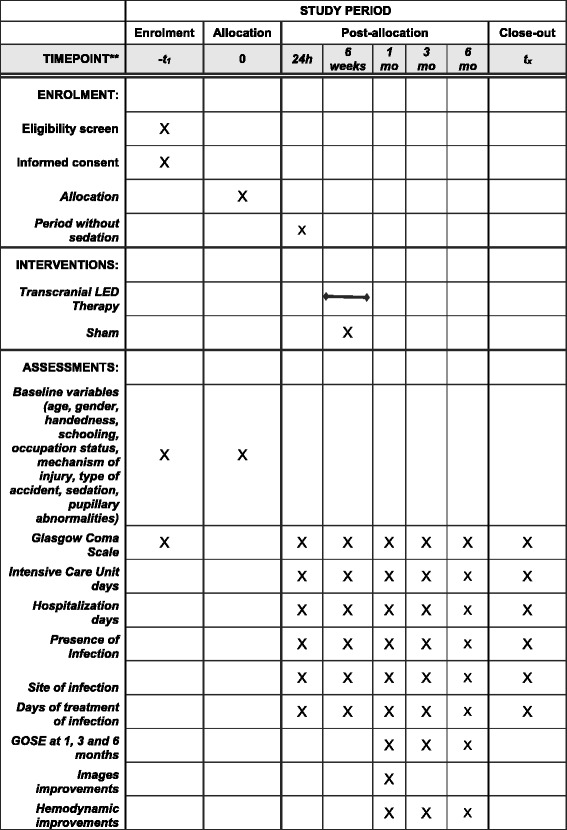
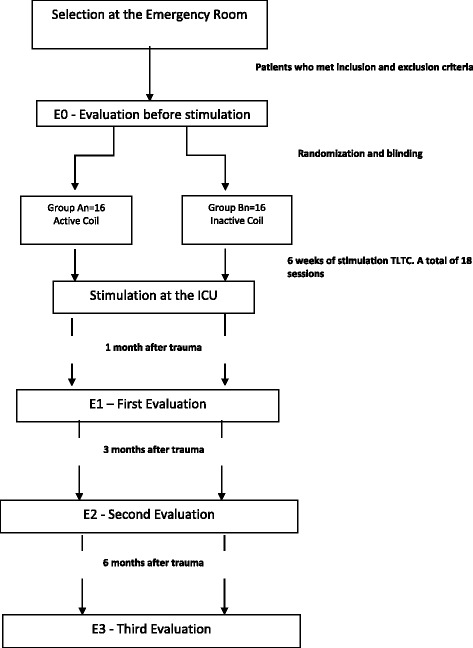
METHODS/DESIGN: This is a double-blinded, randomized, controlled trial of patients with diffuse axonal injury (DAI) due to a severe TBI in an acute stage (less than 8 h). Thirty two patients will be randomized to active coil helmet and inactive coil (sham) groups in a 1:1 ratio. The protocol includes 18 sessions of transcranial LED stimulation (627 nm, 70 mW/cm, 10 J/cm) at four points of the frontal and parietal regions for 30 s each, totaling 120 s, three times per week for 6 weeks, lasting 30 min. Patients will be evaluated with the Glasgow Outcome Scale Extended (GOSE) before stimulation and 1, 3, and 6 months after the first stimulation. The study hypotheses are as follows: (1) transcranial LED therapy (TCLT) will improve the cognitive function of DAI patients and (2) TCLT will promote beneficial hemodynamic changes in cerebral circulation.
This study evaluates early and delayed effects of TCLT on the cognitive rehabilitation for DAI following severe acute TBI. There is a paucity of studies regarding the use of this therapy for cognitive improvement in TBI. There are some experimental studies and case series presenting interesting results for TBI cognitive improvement but no clinical trials.
ClinicalTrials.gov, NCT03281759 . Registered on 13 September 2017.
光生物调节是指利用红光或近红外光来刺激或再生组织。研究发现,近红外波长(800 - 900纳米)和红色(600纳米)发光二极管(LED)能够穿透头皮和颅骨,并有可能改善受损脑组织的异常细胞活性。人们进行了不同的实验和临床研究来测试LED疗法对创伤性脑损伤(TBI)的疗效,结果令人鼓舞。本研究的其中一个提议是开发不同的方法,以最大化这种疗法的积极效果,并改善TBI患者的生活质量。
方法/设计:这是一项针对急性期(少于8小时)因严重TBI导致弥漫性轴索损伤(DAI)患者的双盲、随机、对照试验。32名患者将按1:1的比例随机分为有源线圈头盔组和无源线圈(假手术)组。方案包括在额叶和顶叶区域的四个点进行18次经颅LED刺激(627纳米,70毫瓦/平方厘米,10焦耳/平方厘米),每次30秒,共120秒,每周三次,持续6周,每次持续30分钟。在刺激前以及首次刺激后的1、3和6个月,将使用格拉斯哥扩展预后量表(GOSE)对患者进行评估。研究假设如下:(1)经颅LED疗法(TCLT)将改善DAI患者的认知功能;(2)TCLT将促进脑循环中有益的血流动力学变化。
本研究评估了TCLT对严重急性TBI后DAI认知康复的早期和延迟影响。关于这种疗法用于改善TBI认知功能的研究很少。有一些实验研究和病例系列呈现了TBI认知改善的有趣结果,但没有临床试验。
ClinicalTrials.gov,NCT03281759。于2017年9月13日注册。