Kumar B Vinodh, Mohan Thuthi
Department of Biochemistry, ESIC Medical College Hospital and PGIMSR, Chennai, Tamil Nadu, India.
J Lab Physicians. 2018 Apr-Jun;10(2):194-199. doi: 10.4103/JLP.JLP_102_17.
Six Sigma is one of the most popular quality management system tools employed for process improvement. The Six Sigma methods are usually applied when the outcome of the process can be measured. This study was done to assess the performance of individual biochemical parameters on a Sigma Scale by calculating the sigma metrics for individual parameters and to follow the Westgard guidelines for appropriate Westgard rules and levels of internal quality control (IQC) that needs to be processed to improve target analyte performance based on the sigma metrics.
This is a retrospective study, and data required for the study were extracted between July 2015 and June 2016 from a Secondary Care Government Hospital, Chennai. The data obtained for the study are IQC - coefficient of variation percentage and External Quality Assurance Scheme (EQAS) - Bias% for 16 biochemical parameters.
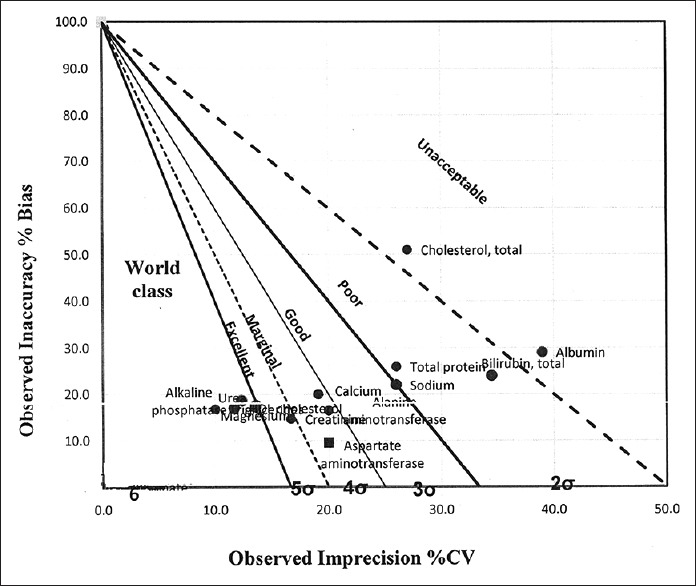
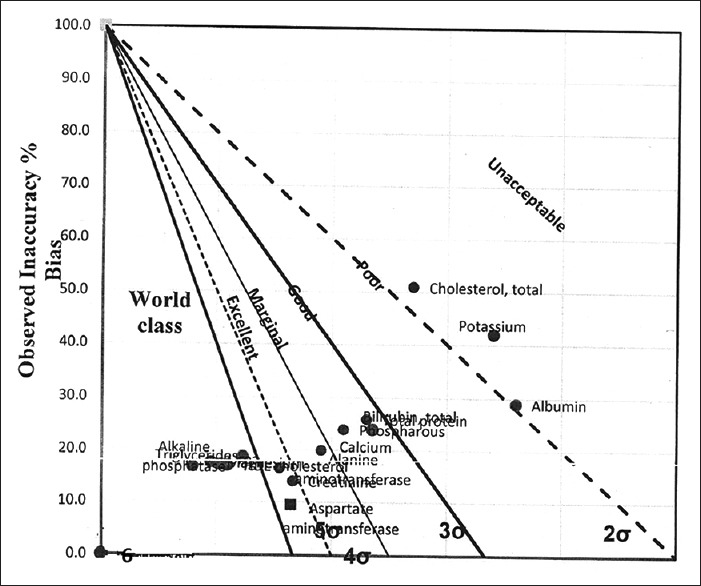
For the level 1 IQC, four analytes (alkaline phosphatase, magnesium, triglyceride, and high-density lipoprotein-cholesterol) showed an ideal performance of ≥6 sigma level, five analytes (urea, total bilirubin, albumin, cholesterol, and potassium) showed an average performance of <3 sigma level and for level 2 IQCs, same four analytes of level 1 showed a performance of ≥6 sigma level, and four analytes (urea, albumin, cholesterol, and potassium) showed an average performance of <3 sigma level. For all analytes <6 sigma level, the quality goal index (QGI) was <0.8 indicating the area requiring improvement to be imprecision except cholesterol whose QGI >1.2 indicated inaccuracy.
This study shows that sigma metrics is a good quality tool to assess the analytical performance of a clinical chemistry laboratory. Thus, sigma metric analysis provides a benchmark for the laboratory to design a protocol for IQC, address poor assay performance, and assess the efficiency of existing laboratory processes.
六西格玛是用于流程改进的最流行的质量管理体系工具之一。六西格玛方法通常在流程结果可测量时应用。本研究旨在通过计算各个参数的西格玛指标来评估单个生化参数在西格玛量表上的性能,并遵循韦斯特加德指南,确定适当的韦斯特加德规则以及为基于西格玛指标改善目标分析物性能而需要处理的内部质量控制(IQC)水平。
这是一项回顾性研究,研究所需数据于2015年7月至2016年6月从钦奈的一家二级护理政府医院提取。研究获得的数据是16个生化参数的IQC - 变异系数百分比和外部质量保证计划(EQAS) - 偏差百分比。
对于1级IQC,四种分析物(碱性磷酸酶、镁、甘油三酯和高密度脂蛋白胆固醇)显示出≥6西格玛水平的理想性能,五种分析物(尿素、总胆红素、白蛋白、胆固醇和钾)显示出<3西格玛水平的平均性能;对于2级IQC,1级的相同四种分析物显示出≥6西格玛水平的性能,四种分析物(尿素、白蛋白、胆固醇和钾)显示出<3西格玛水平的平均性能。对于所有<6西格玛水平的分析物,质量目标指数(QGI)<0.8表明需要改进的领域是不精密度,除了胆固醇,其QGI>1.2表明存在不准确性。
本研究表明,西格玛指标是评估临床化学实验室分析性能的良好质量工具。因此,西格玛指标分析为实验室设计IQC方案、解决检测性能不佳问题以及评估现有实验室流程的效率提供了一个基准。