
使用四种尺寸粉末的竹炭/TiO₂复合材料的合成、表征及光催化性能
Synthesis, Characterization, and Photocatalytic Properties of Bamboo Charcoal/TiO₂ Composites Using Four Sizes Powder.
作者信息
Wang Bin, Liu Bo, Ji Xing-Xiang, Ma Ming-Guo
机构信息
Engineering Research Center of Forestry Biomass Materials and Bioenergy, Beijing Key Laboratory of Lignocellulosic Chemistry, College of Materials Science and Technology, Beijing Forestry University, Beijing 100083, China.
State Key Laboratory of Biobased Material and Green papermaking, Qilu University of Technology (Shandong Academy of Sciences), Jinan 250353, China.
出版信息
Materials (Basel). 2018 Apr 25;11(5):670. doi: 10.3390/ma11050670.
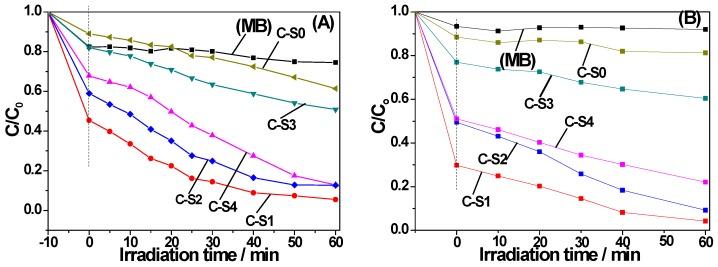
Visible-light-active bamboo biochar/TiO₂ composites were fabricated by the calcination method using CHO₄Ti as the titanium source and bamboo powder with different sizes as the carbon source. The TiO₂ nanoparticles were observed to disperse onto the surface of bamboo biochar fiber. The sizes of the bamboo powder played an important role in the microstructures and the properties of bamboo biochar/TiO₂ composites. The bamboo biochar/TiO₂ composites displayed the photocatalytic activities both under visible light irradiation and UV irradiation. The adsorption isotherms better fitted Freundlich isotherm models and the photodegradation reactions followed pseudo-first-order kinetics. Bamboo charcoal/TiO₂ composites exhibited high stability after up to four cycles. This research could pave the way for high-value applications of biomass in the environmental field.
采用煅烧法,以四钛酸酯为钛源、不同粒径的竹粉为碳源,制备了可见光活性竹炭/TiO₂复合材料。观察到TiO₂纳米颗粒分散在竹炭纤维表面。竹粉的粒径对竹炭/TiO₂复合材料的微观结构和性能起着重要作用。竹炭/TiO₂复合材料在可见光照射和紫外光照射下均表现出光催化活性。吸附等温线更符合Freundlich等温线模型,光降解反应遵循准一级动力学。竹炭/TiO₂复合材料在经过多达四个循环后仍表现出高稳定性。该研究可为生物质在环境领域的高价值应用铺平道路。






 Zotero 插件