Park Kyung Mee, Kim Tae Ho, Kim Woo Jung, An Suk Kyoon, Namkoong Kee, Lee Eun
Institute of Behavioral Science in Medicine and Department of Psychiatry, Yonsei University College of Medicine, Seoul, Republic of Korea.
Department of Psychiatry, Seonam University College of Medicine, Myongji Hospital, Goyang, Republic of Korea.
Psychiatry Investig. 2018 May;15(5):499-504. doi: 10.30773/pi.2017.11.20. Epub 2018 Apr 27.
This study determined whether cognitive behavioral therapy for insomnia (CBT-i) decreased the need for sleep medications and produced better treatment outcomes than pharmacotherapy alone.
We reviewed data from patients with insomnia in the outpatient clinic of a general hospital between 2009 and 2015. We compared 41 patients who received five sessions of CBT-i with 100 age- and sex-matched patients who received pharmacotherapy only. We evaluated the change in prescription for sleep (i.e., antidepressants, hypnotics, and others) between the first and last visits using repeated measures analysis of variance (ANOVA). Clinical global impressions and completion status at the last visit were assessed using the chisquare test.
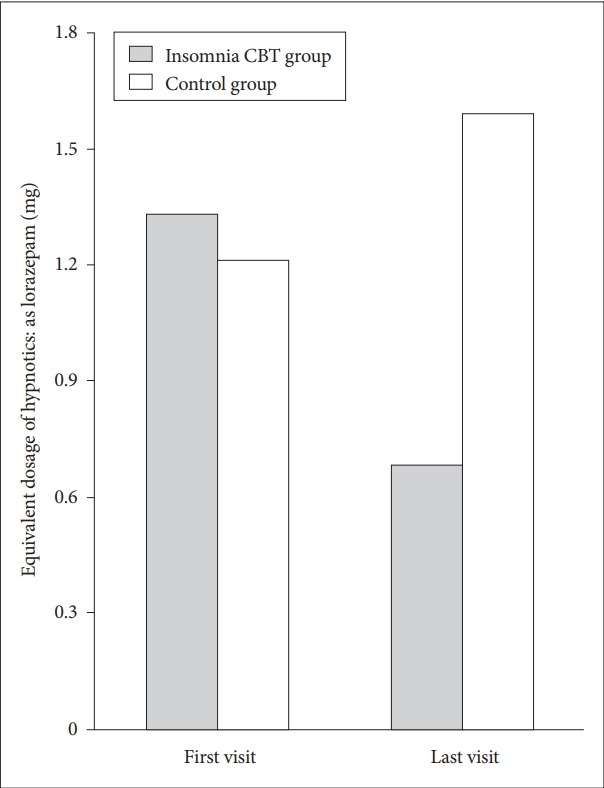
We found a significant decrease in the prescription rate and the dosage of hypnotics among patients who received CBT-i when compared with control patients. There was no significant change in the dosage of antidepressants between the two groups. Achievement of case closure was better in the CBT-i group at the trend level. Clinical global impression at the last visit was not significantly different.
These results show that CBT-i reduces the need for hypnotics among insomnia patients. Our results indicate that CBT-i offers additional benefits beyond improving sleep characteristics and thus provides another reason for recommending CBT-i as a first-line treatment for insomnia.
本研究旨在确定失眠认知行为疗法(CBT-i)是否比单纯药物治疗减少了睡眠药物的使用需求,并产生更好的治疗效果。
我们回顾了2009年至2015年期间一家综合医院门诊失眠患者的数据。我们将41名接受了5次CBT-i治疗的患者与100名年龄和性别匹配、仅接受药物治疗的患者进行了比较。我们使用重复测量方差分析(ANOVA)评估了首次就诊和末次就诊之间睡眠药物(即抗抑郁药、催眠药和其他药物)处方的变化。使用卡方检验评估末次就诊时的临床总体印象和完成状态。
我们发现,与对照组患者相比,接受CBT-i治疗的患者中催眠药的处方率和剂量显著降低。两组之间抗抑郁药的剂量没有显著变化。在趋势水平上,CBT-i组的病例结束情况更好。末次就诊时的临床总体印象没有显著差异。
这些结果表明,CBT-i减少了失眠患者对催眠药的需求。我们的结果表明,CBT-i除了改善睡眠特征外还提供了额外的益处,因此为推荐CBT-i作为失眠的一线治疗提供了另一个理由。