Gu Xiao, Xie Yaojie
School of Nursing, The Hong Kong Polytechnic University, Hong Kong.
Intensive Care Unit, Suzhou Municipal Hospital, Suzhou, China.
J Pain Res. 2018 Apr 12;11:771-781. doi: 10.2147/JPR.S156227. eCollection 2018.
Migraine is one of the most common primary headache disorders and is burdensome to both the individual and society, influencing the academic performance and quality of daily lives of medical students worldwide. This study aimed to investigate the migraine prevalence in a sample of university medical students in China and to examine the features and typical trigger factors of migraine among these students.
From May 2016 to August 2016, a total of 1,060 medical students who were enrolled in Soochow University in Jiangsu Province in China were chosen through stratified random sampling. A self-administered questionnaire that included the ID Migraine™ for screening of migraine cases was used to collect data. The frequency, severity, duration of migraine attacks, and relevant trigger factors were measured for migraine cases. In total, 986 students completed the questionnaire.
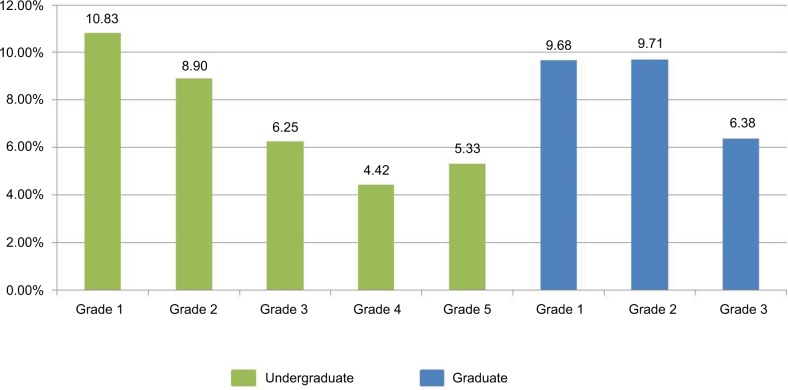
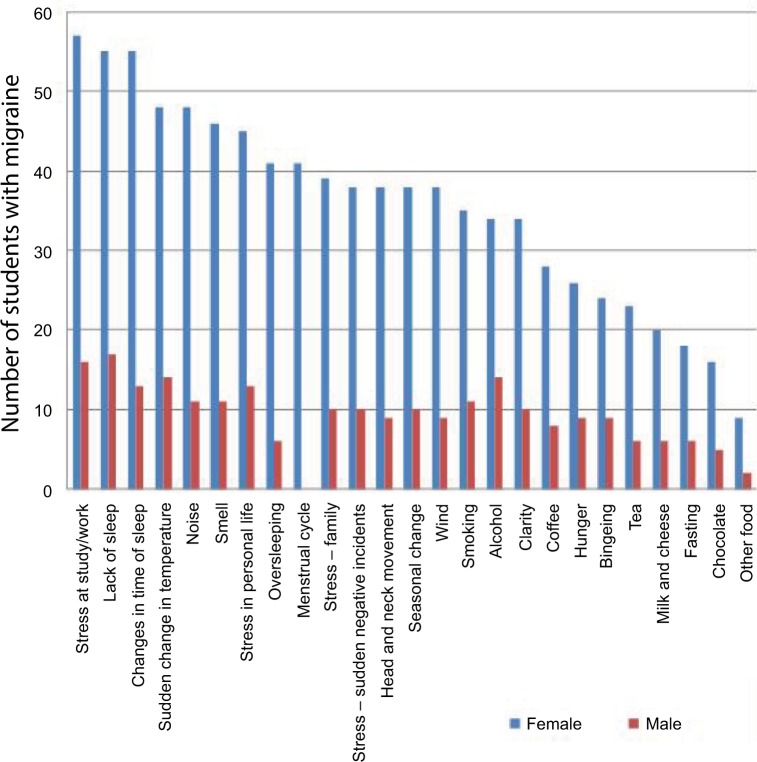
The overall migraine prevalence among students was 7.91%, with 4.64% in male and 9.84% in female students. Junior-grade students had a higher migraine prevalence than senior students (prevalence of migraine of year 1 to year 5 undergraduates: 10.83%, 8.9% vs. 6.25%, 4.42%, 5.33%, <0.05; prevalence of migraine of year 1 to year 3 graduates: 9.68%, 9.71% vs. 6.38%, <0.05). Students with a positive family history were more likely to suffer migraine than those without (OR=8.48, 95% CI: 4.33-16.59). Stress (n=73, 93.59%), lack of sleep (n=72, 92.31%), and change of sleeping time (n=68, 87.18%) were the top three trigger factors among the students.
Migraine was common among medical students from a university in China, and especially higher in female and junior-grade students, and those with a family history of migraine. Reducing stress and improving sleep quality might be effective to reduce migraine attacks in this population.
偏头痛是最常见的原发性头痛疾病之一,对个人和社会都造成负担,影响着全球医学生的学业成绩和日常生活质量。本研究旨在调查中国某大学医学生样本中的偏头痛患病率,并研究这些学生中偏头痛的特征和典型诱发因素。
2016年5月至8月,通过分层随机抽样选取了中国江苏省苏州大学的1060名医学生。使用一份包括ID Migraine™偏头痛筛查问卷的自填式问卷收集数据。对偏头痛病例测量了偏头痛发作的频率、严重程度、持续时间以及相关诱发因素。共有986名学生完成了问卷。
学生中偏头痛的总体患病率为7.91%,男生为4.64%,女生为9.84%。低年级学生的偏头痛患病率高于高年级学生(本科1至5年级学生的偏头痛患病率:10.83%、8.9% 对比 6.25%、4.42%、5.33%,P<0.05;研究生1至3年级学生的偏头痛患病率:9.68%、9.71% 对比 6.38%,P<0.05)。有偏头痛家族史的学生比没有家族史的学生更容易患偏头痛(比值比=8.48,95%置信区间:4.33 - 16.59)。压力(n=73,93.59%)、睡眠不足(n=72,92.31%)和睡眠时间改变(n=68,87.18%)是学生中偏头痛的前三大诱发因素。
偏头痛在中国某大学的医学生中很常见,在女生、低年级学生以及有偏头痛家族史的学生中尤其高发。减轻压力和改善睡眠质量可能有助于减少该人群的偏头痛发作。