Baart Martijn, Vroomen Jean
Department of Cognitive Neuropsychology, Tilburg University, P.O. Box 90153, 5000 LE, Tilburg, The Netherlands.
BCBL, Basque Center on Cognition, Brain and Language, Donostia, Spain.
Exp Brain Res. 2018 Jul;236(7):1911-1918. doi: 10.1007/s00221-018-5270-y. Epub 2018 Apr 25.
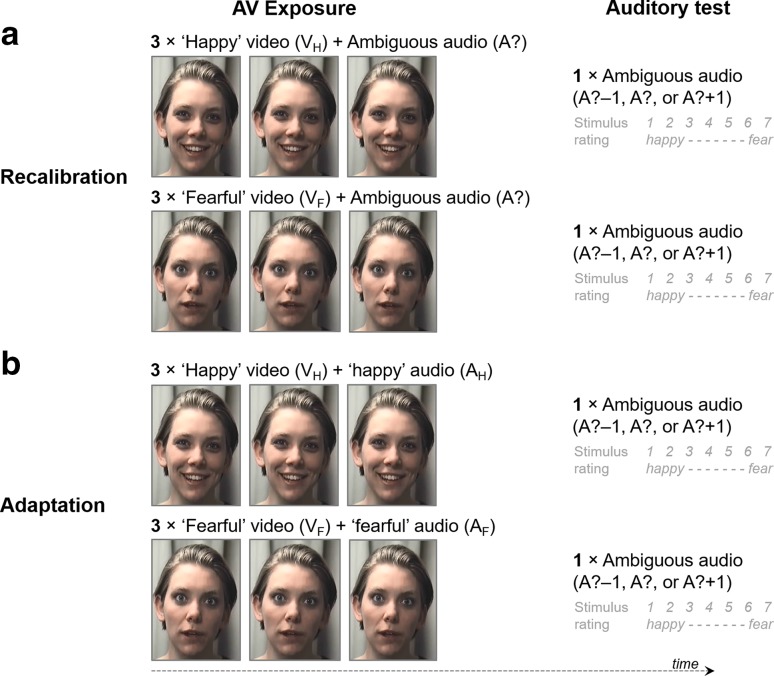
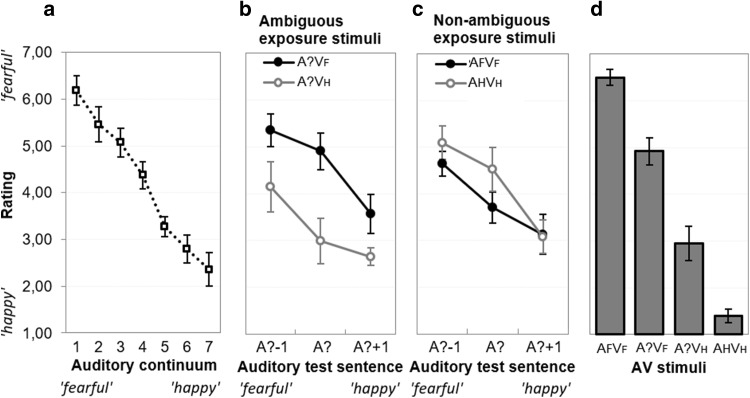
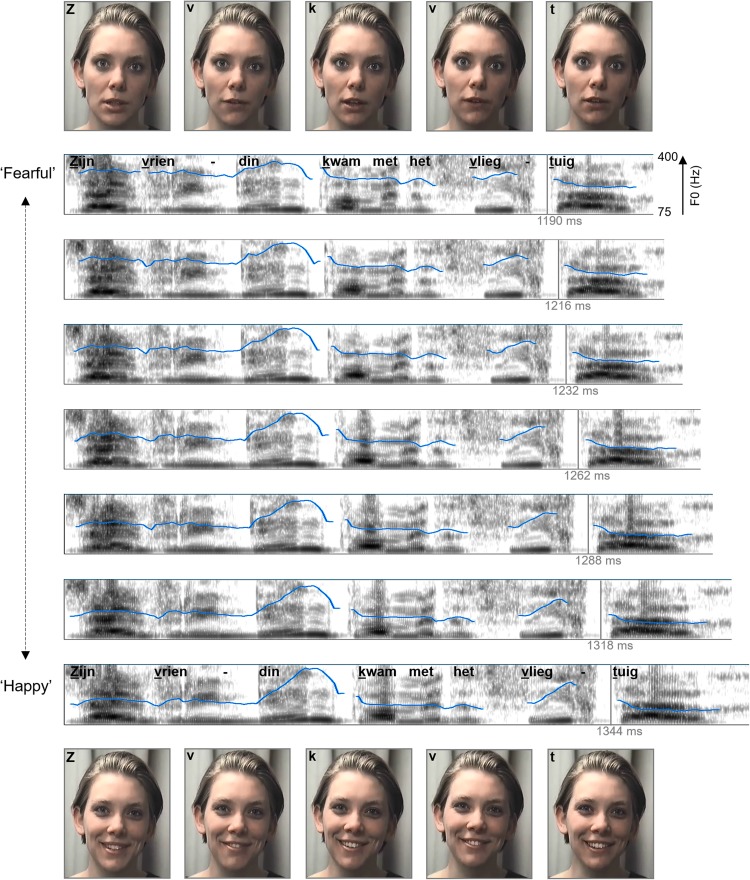
Perception of vocal affect is influenced by the concurrent sight of an emotional face. We demonstrate that the sight of an emotional face also can induce recalibration of vocal affect. Participants were exposed to videos of a 'happy' or 'fearful' face in combination with a slightly incongruous sentence with ambiguous prosody. After this exposure, ambiguous test sentences were rated as more 'happy' when the exposure phase contained 'happy' instead of 'fearful' faces. This auditory shift likely reflects recalibration that is induced by error minimization of the inter-sensory discrepancy. In line with this view, when the prosody of the exposure sentence was non-ambiguous and congruent with the face (without audiovisual discrepancy), aftereffects went in the opposite direction, likely reflecting adaptation. Our results demonstrate, for the first time, that perception of vocal affect is flexible and can be recalibrated by slightly discrepant visual information.
对声音情感的感知会受到同时看到的情绪化面部表情的影响。我们证明,看到情绪化的面部表情也会引发对声音情感的重新校准。参与者观看了“快乐”或“恐惧”的面部视频,并搭配了一个韵律模糊且稍有不协调的句子。在这种接触之后,当接触阶段呈现的是“快乐”而非“恐惧”的面部时,模糊的测试句子被评定为更“快乐”。这种听觉上的转变可能反映了由跨感觉差异的误差最小化所引发的重新校准。与此观点一致的是,当接触句子的韵律不模糊且与面部一致(不存在视听差异)时,后效则朝着相反的方向发展,这可能反映了适应性。我们的研究结果首次表明,对声音情感的感知是灵活的,并且可以通过稍有差异的视觉信息进行重新校准。