Division of Cardiology, Department of Medicine, University of Colorado School of Medicine, Aurora, CO, USA.
, 1055 Clermont Street (111B), Denver, CO, 80220, USA.
J Nucl Cardiol. 2019 Dec;26(6):1878-1885. doi: 10.1007/s12350-018-1275-y. Epub 2018 Apr 25.
Reporting standards promote clarity and consistency of stress myocardial perfusion imaging (MPI) reports, but do not require an assessment of post-test risk. Natural Language Processing (NLP) tools could potentially help estimate this risk, yet it is unknown whether reports contain adequate descriptive data to use NLP.
Among VA patients who underwent stress MPI and coronary angiography between January 1, 2009 and December 31, 2011, 99 stress test reports were randomly selected for analysis. Two reviewers independently categorized each report for the presence of critical data elements essential to describing post-test ischemic risk.
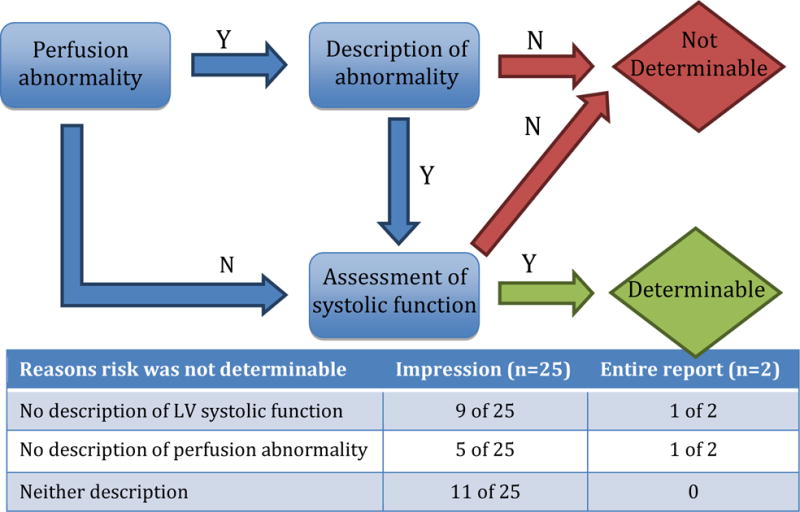
Few stress MPI reports provided a formal assessment of post-test risk within the impression section (3%) or the entire document (4%). In most cases, risk was determinable by combining critical data elements (74% impression, 98% whole). If ischemic risk was not determinable (25% impression, 2% whole), inadequate description of systolic function (9% impression, 1% whole) and inadequate description of ischemia (5% impression, 1% whole) were most commonly implicated.
Post-test ischemic risk was determinable but rarely reported in this sample of stress MPI reports. This supports the potential use of NLP to help clarify risk. Further study of NLP in this context is needed.
报告标准可提高应激心肌灌注成像(MPI)报告的清晰度和一致性,但不要求评估测试后风险。自然语言处理(NLP)工具可能有助于评估此风险,但目前尚不清楚报告中是否包含足够的描述性数据来使用 NLP。
在 2009 年 1 月 1 日至 2011 年 12 月 31 日期间接受应激 MPI 和冠状动脉造影的 VA 患者中,随机选择 99 份应激测试报告进行分析。两名审查员独立对每份报告进行分类,以确定是否存在描述测试后缺血风险所需的关键数据元素。
很少有应激 MPI 报告在印象部分(3%)或整个文件中(4%)对测试后风险进行正式评估。在大多数情况下,可以通过组合关键数据元素(印象的 74%,整体的 98%)来确定风险。如果无法确定缺血风险(印象的 25%,整体的 2%),则最常涉及到收缩功能描述不足(印象的 9%,整体的 1%)和缺血描述不足(印象的 5%,整体的 1%)。
在这个应激 MPI 报告样本中,可以确定测试后缺血风险,但很少报告。这支持了使用 NLP 来帮助阐明风险的潜力。需要进一步研究 NLP 在这种情况下的应用。