Department of Molecular and Human Genetics, Baylor College of Medicine, Houston, Texas.
Department of Neuroscience, Friedman Brain Institute, Icahn School of Medicine at Mount Sinai, New York, New York.
Hum Mutat. 2018 Jul;39(7):939-946. doi: 10.1002/humu.23537. Epub 2018 May 11.
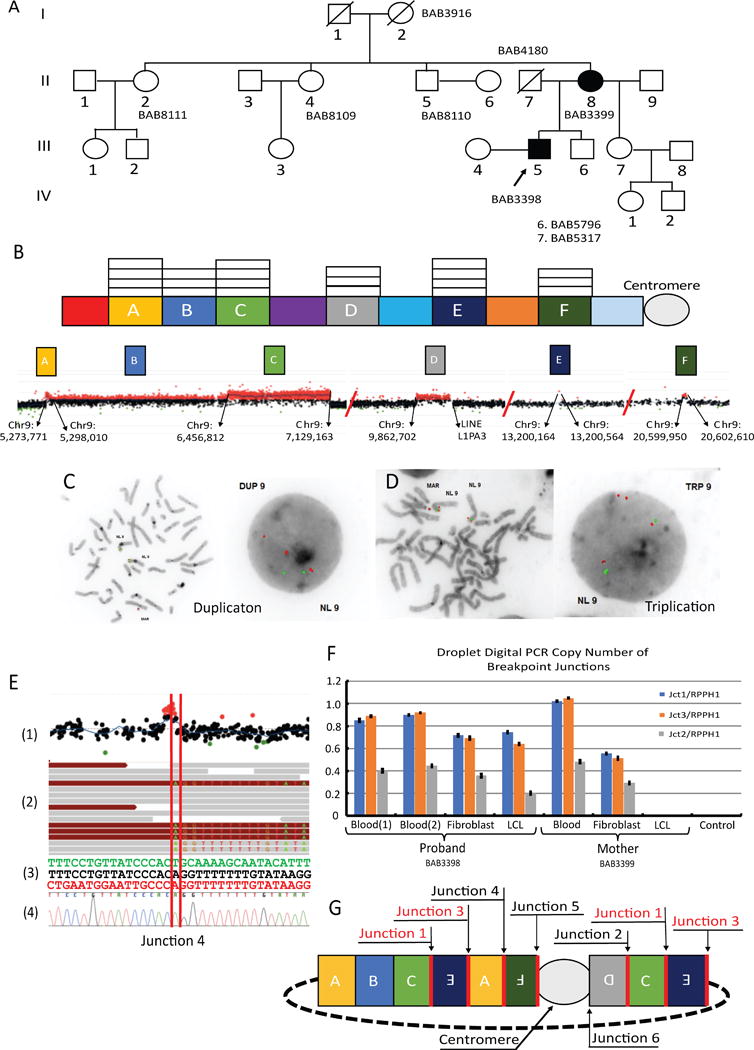
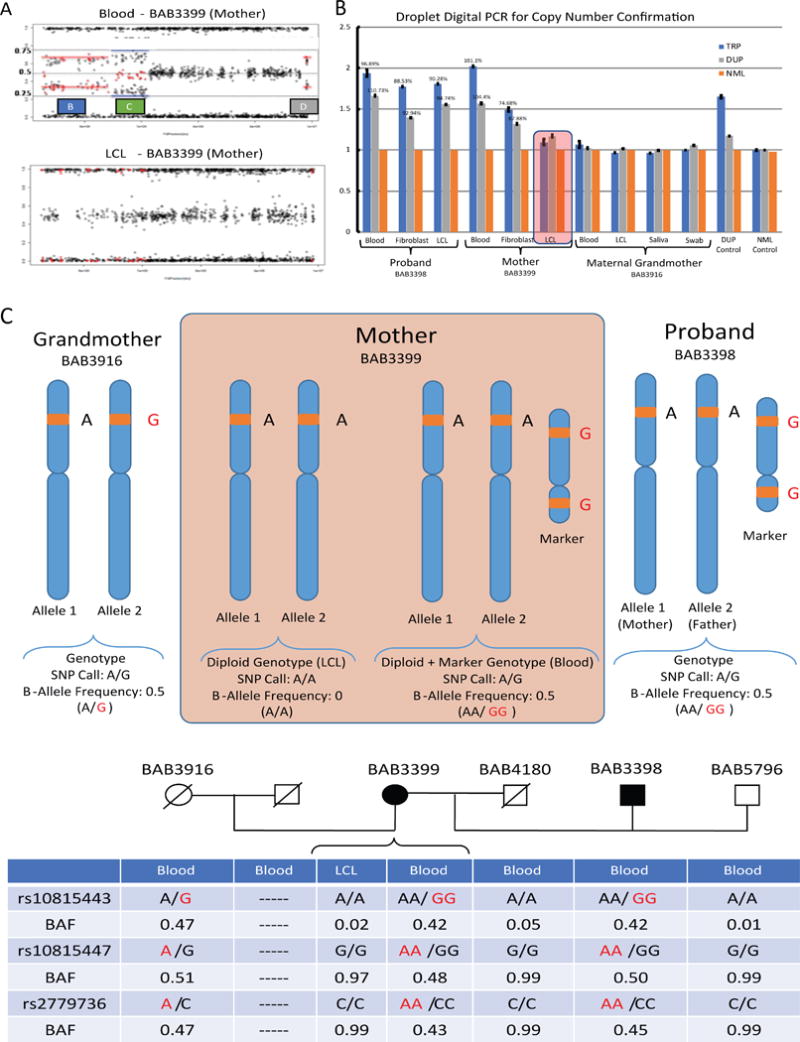
Small supernumerary marker chromosomes (sSMC) are chromosomal fragments difficult to characterize genomically. Here, we detail a proband with schizoaffective disorder and a mother with bipolar disorder with psychotic features who present with a marker chromosome that segregates with disease. We explored the architecture of this marker and investigated its temporal origin. Array comparative genomic hybridization (aCGH) analysis revealed three duplications and three triplications that spanned the short arm of chromosome 9, suggestive of a chromoanasynthesis-like event. Segregation of marker genotypes, phased using sSMC mosaicism in the mother, provided evidence that it was generated during a germline-level event in the proband's maternal grandmother. Whole-genome sequencing (WGS) was performed to resolve the structure and junctions of the chromosomal fragments, revealing further complexities. While structural variations have been previously associated with neuropsychiatric disorders and marker chromosomes, here we detail the precise architecture, human life-cycle genesis, and propose a DNA replicative/repair mechanism underlying formation.
小型额外标记染色体(sSMC)是难以在基因组水平上进行特征分析的染色体片段。本文详细介绍了一名精神分裂情感障碍患者和一名有精神病特征的双相情感障碍患者的先证者,他们均携带与疾病共分离的标记染色体。我们探究了该标记的结构并调查了其时间起源。阵列比较基因组杂交(aCGH)分析显示,有三个重复和三个三倍体跨越了 9 号染色体的短臂,提示类似于染色体重排事件。使用母亲的 sSMC 嵌合体对标记基因型进行相位分离,提供了证据表明它是在先证者的外祖母的种系水平事件中产生的。进行全基因组测序(WGS)以解析染色体片段的结构和连接,揭示了进一步的复杂性。虽然结构变异先前与神经精神疾病和标记染色体有关,但在这里,我们详细描述了其精确的结构、人类生命周期起源,并提出了形成该标记的 DNA 复制/修复机制。