Lavdaniti Maria, Fradelos Evangelos C, Troxoutsou Konstantina, Zioga Efrosini, Mitsi Dimitroula, Alikari Victoria, Zyga Sofia
Research Laboratory “Care in Adult Cancer Patients”, Department of Nursing, Alexander Technological Educational Institute, Thessaloniki, Sparta, Greece. Email:
Asian Pac J Cancer Prev. 2018 Apr 27;19(4):1047-1052. doi: 10.22034/APJCP.2018.19.4.1047.
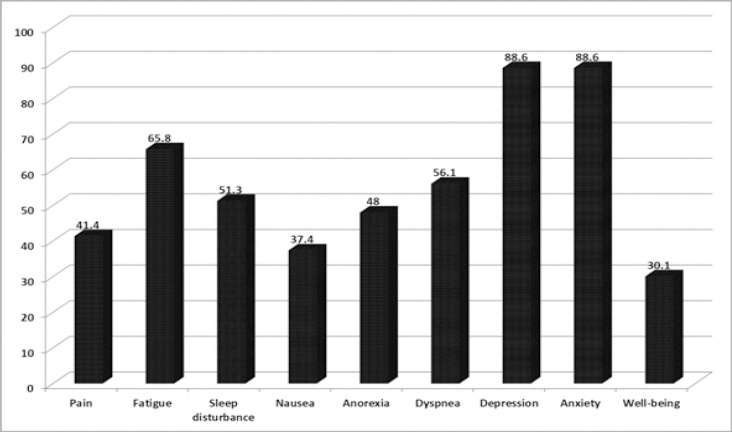
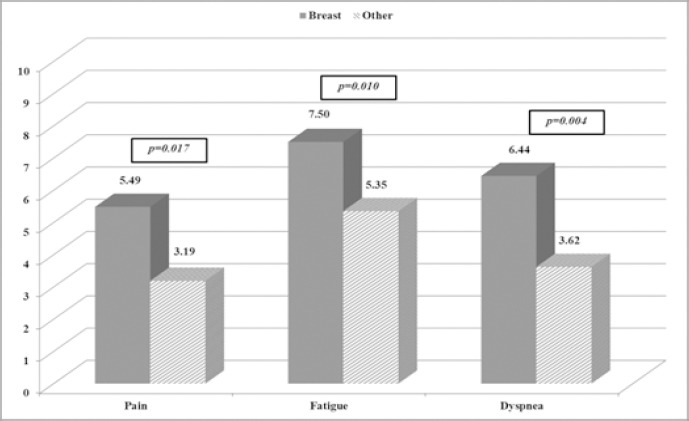
Background: Advanced cancer patients experience several physical or psychological symptoms which require palliative care for alleviation. Purpose: To assess the prevalence and intensity of symptoms among cancer patients receiving palliative care in a Greek hospital and to examine the association between reported symptoms and social clinical and demographic characteristics. Material-methods: This descriptive research was conducted during a sixmonth period using a convenient sample of 123 advanced cancer patients. All participants were assessed for their symptoms using the Edmonton Symptom Assessment System (ESAS) with a questionnaire covering demographic and clinical characteristics. Results: The mean age was 63.8± 10.8 years, with lung and breast (58.5% and 11.4%, respectively) as the most common primary cancer types. The most severe symptoms were fatigue, sleep disturbance, dyspnea, depression and anxiety. Negative correlations were revealed between age and the following symptoms: pain (r = -0.354, p = 0.001), fatigue (r = -0.280, p = 0.002), nausea (r = -0.178, p = 0.049), anorexia (r = -0.188, p = 0.038), dyspnea (r = -0.251, p = 0.005), and depression (r = -0.223, p = 0.013). Advanced breast cancer patients scored higher in pain, fatigue and dyspnea compared to those with other cancers. Conclusions: Hospitalized cancer patients in Greece experience several symptoms during the last months of their life. These are influenced by demographic characteristics. Appropriate interventions are strongly advised with appropriate recognition and evaluation of symptoms by health professionals.
晚期癌症患者会经历多种身体或心理症状,需要姑息治疗来缓解。目的:评估希腊一家医院接受姑息治疗的癌症患者中症状的发生率和严重程度,并研究报告的症状与社会、临床和人口统计学特征之间的关联。材料与方法:本描述性研究在六个月期间进行,采用方便抽样法选取了123例晚期癌症患者。所有参与者均使用埃德蒙顿症状评估系统(ESAS)进行症状评估,并通过一份涵盖人口统计学和临床特征的问卷进行调查。结果:平均年龄为63.8±10.8岁,最常见的原发性癌症类型是肺癌和乳腺癌(分别为58.5%和11.4%)。最严重的症状是疲劳、睡眠障碍、呼吸困难、抑郁和焦虑。年龄与以下症状之间存在负相关:疼痛(r = -0.354,p = 0.001)、疲劳(r = -0.280,p = 0.002)、恶心(r = -0.178,p = 0.049)、厌食(r = -0.188,p = 0.038)、呼吸困难(r = -0.251,p = 0.005)和抑郁(r = -0.223,p = 0.013)。与其他癌症患者相比,晚期乳腺癌患者在疼痛、疲劳和呼吸困难方面得分更高。结论:希腊住院癌症患者在生命的最后几个月会经历多种症状。这些症状受人口统计学特征影响。强烈建议卫生专业人员进行适当的症状识别和评估,并采取适当的干预措施。