Division of Nephrology, Department of Internal Medicine, Chi Mei Medical Center, Liouying, Tainan, Taiwan.
NSARF group (National Taiwan University Hospital Study Group of ARF), Taipei, Taiwan.
Crit Care. 2018 Apr 26;22(1):108. doi: 10.1186/s13054-018-2035-8.
Acute kidney injury (AKI) after cardiovascular surgery is a serious complication. Little is known about the ability of novel biomarkers in combination with clinical risk scores for prediction of advanced AKI.
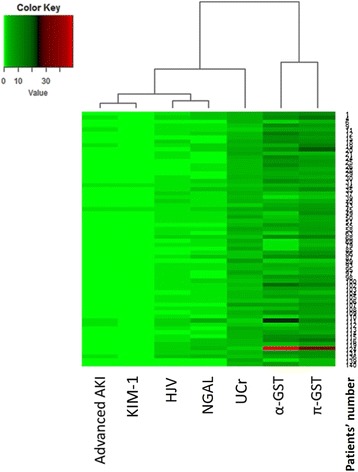
In this prospectively conducted multicenter study, urine samples were collected from 149 adults at 0, 3, 6, 12 and 24 h after cardiovascular surgery. We measured urinary hemojuvelin (uHJV), kidney injury molecule-1 (uKIM-1), neutrophil gelatinase-associated lipocalin (uNGAL), α-glutathione S-transferase (uα-GST) and π-glutathione S-transferase (uπ-GST). The primary outcome was advanced AKI, under the definition of Kidney Disease: Improving Global Outcomes (KDIGO) stage 2, 3 and composite outcomes were KDIGO stage 2, 3 or 90-day mortality after hospital discharge.
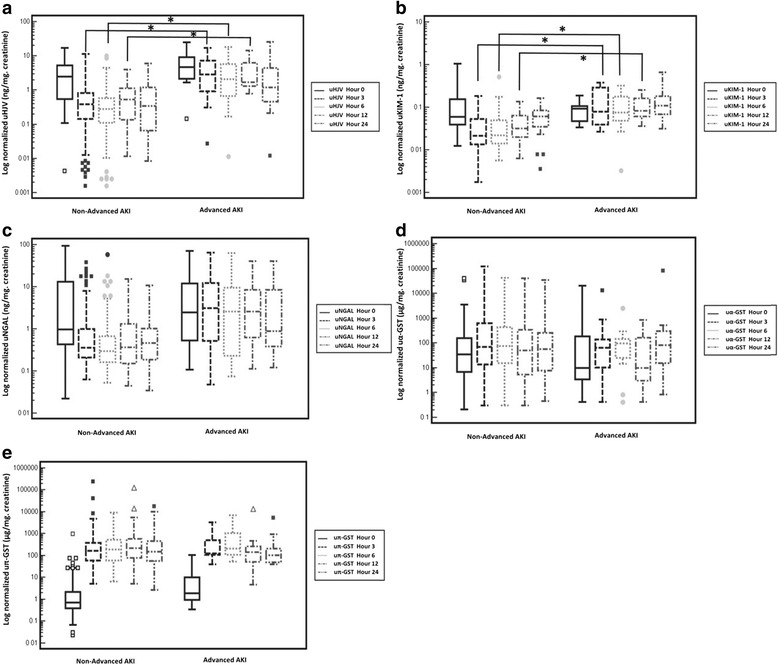
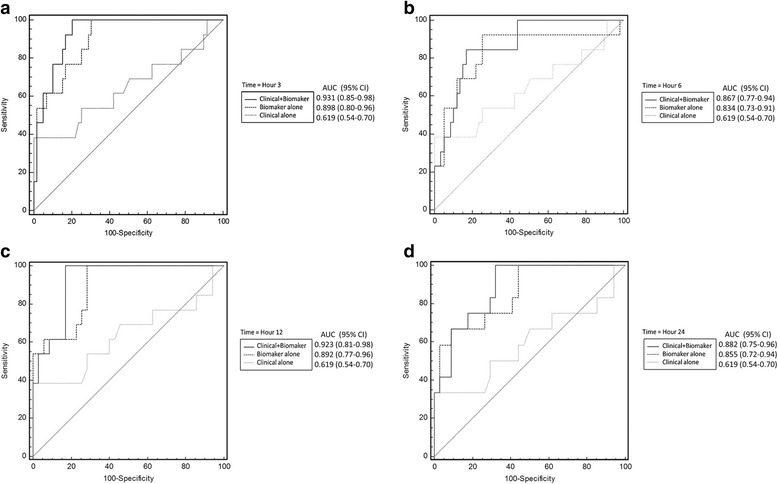
Patients with advanced AKI had significantly higher levels of uHJV and uKIM-1 at 3, 6 and 12 h after surgery. When normalized by urinary creatinine level, uKIM-1 in combination with uHJV at 3 h post-surgery had a high predictive ability for advanced AKI and composite outcome (AUC = 0.898 and 0.905, respectively). The combination of this biomarker panel (normalized uKIM-1, uHJV at 3 h post-operation) and Liano's score was superior in predicting advanced AKI (AUC = 0.931, category-free net reclassification improvement of 1.149, and p < 0.001).
When added to Liano's score, normalized uHJV and uKIM-1 levels at 3 h after cardiovascular surgery enhanced the identification of patients at higher risk of progression to advanced AKI and composite outcomes.
心血管手术后急性肾损伤(AKI)是一种严重的并发症。关于新型生物标志物与临床风险评分相结合预测晚期 AKI 的能力,目前知之甚少。
在这项前瞻性多中心研究中,在心血管手术后 0、3、6、12 和 24 小时采集 149 名成年人的尿液样本。我们测量尿液血红素结合蛋白(uHJV)、肾损伤分子-1(uKIM-1)、中性粒细胞明胶酶相关脂质运载蛋白(uNGAL)、α-谷胱甘肽 S-转移酶(uα-GST)和 π-谷胱甘肽 S-转移酶(uπ-GST)。主要结局为晚期 AKI,定义为肾脏病:改善全球结果(KDIGO)第 2 期、第 3 期和复合结局为 KDIGO 第 2 期、第 3 期或住院后 90 天死亡率。
晚期 AKI 患者术后 3、6 和 12 小时 uHJV 和 uKIM-1 水平显著升高。术后 3 小时,当用尿肌酐水平校正时,uKIM-1 与 uHJV 联合具有预测晚期 AKI 和复合结局的高能力(AUC 分别为 0.898 和 0.905)。该生物标志物组合(术后 3 小时校正 uKIM-1、uHJV)与 Liano 评分联合在预测晚期 AKI 方面更具优势(AUC 为 0.931,无分类净重新分类改善 1.149,p<0.001)。
当添加到 Liano 评分中时,心血管手术后 3 小时校正后的 uHJV 和 uKIM-1 水平增强了识别进展为晚期 AKI 和复合结局风险较高的患者的能力。