Chair of Biomedical Physics, Department of Physics & Munich School of BioEngineering, Technical University of Munich, 85748, Garching, Germany.
MITOS GmbH, 85748, Garching, Germany.
Sci Rep. 2018 Apr 26;8(1):6608. doi: 10.1038/s41598-018-25075-7.
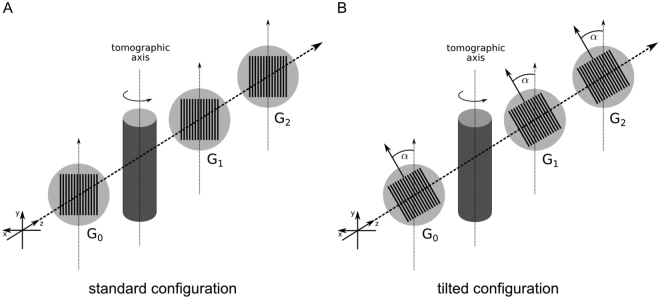
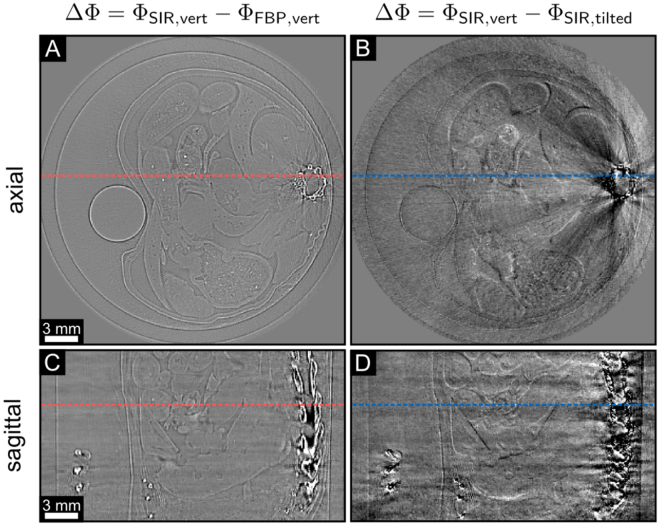
Grating-based phase-contrast computed tomography (GBPC-CT) enables increased soft tissue differentiation, but often suffers from streak artifacts when performing high-sensitivity GBPC-CT of biomedical samples. Current GBPC-CT setups consist of one-dimensional gratings and hence allow to measure only the differential phase-contrast (DPC) signal perpendicular to the direction of the grating lines. Having access to the full two-dimensional DPC signal can strongly reduce streak artefacts showing up as characteristic horizontal lines in the reconstructed images. GBPC-CT with gratings tilted by 45° around the optical axis, combining opposed projections, and reconstructing with filtered backprojection is one method to retrieve the full three-dimensional DPC signal. This approach improves the quality of the tomographic data as already demonstrated at a synchrotron facility. However, additional processing and interpolation is necessary, and the approach fails when dealing with cone-beam geometry setups. In this work, we employ the tilted grating configuration with a laboratory GBPC-CT setup with cone-beam geometry and use statistical iterative reconstruction (SIR) with a forward model accounting for diagonal grating alignment. Our results show a strong reduction of streak artefacts and significant increase in image quality. In contrast to the prior approach our proposed method can be used in a laboratory environment due to its cone-beam compatibility.
基于光栅的相衬计算机断层扫描(GBPC-CT)可以提高软组织的分辨力,但在对生物医学样本进行高灵敏度 GBPC-CT 时,往往会出现条纹伪影。目前的 GBPC-CT 设备由一维光栅组成,因此只能测量与光栅线垂直的差分相衬(DPC)信号。获取完整的二维 DPC 信号可以大大减少条纹伪影,这些伪影在重建图像中表现为特征性的水平线。通过将光栅围绕光轴倾斜 45°,结合对向投影,并使用滤波反投影进行重建,是一种获取全三维 DPC 信号的方法。这种方法已经在同步辐射设施中证明可以提高层析数据的质量。然而,需要额外的处理和插值,并且当处理锥束几何设置时,该方法会失败。在这项工作中,我们在具有锥束几何形状的实验室 GBPC-CT 设备中采用倾斜光栅配置,并使用考虑到对角线光栅对准的正向模型进行统计迭代重建(SIR)。我们的结果表明,条纹伪影得到了很大的减少,图像质量得到了显著提高。与之前的方法相比,由于我们提出的方法与锥束几何兼容,因此可以在实验室环境中使用。