Department of Surgical Oncology, Erasmus MC Cancer Institute, Groene Hilledijk 301, 3075 EA, Rotterdam, The Netherlands.
Department of Radiology, Erasmus MC Cancer Institute, Groene Hilledijk 301, 3075EA, Rotterdam, The Netherlands.
Eur J Nucl Med Mol Imaging. 2018 Oct;45(11):1926-1933. doi: 10.1007/s00259-018-4014-3. Epub 2018 Apr 26.
Sentinel lymph node biopsy (SLNB) was introduced as a minimally invasive technique for nodal staging. Since associated morbidity is not negligible, it is highly relevant to pursue a more minimally invasive alternative. The purpose of this study was to prospectively evaluate the sensitivity of fine needle aspiration cytology (FNAC) with combined gamma probe and ultrasound (US) guidance in comparison with the gold standard histology of the sentinel node (SN) after SLNB for detecting metastasis.
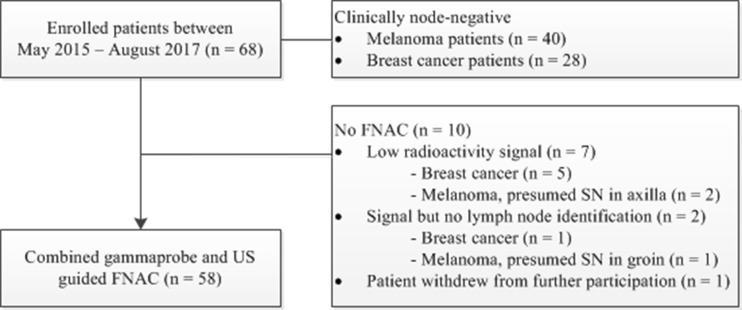
The study was designed as a prospective, multicentre, open-label, single-arm trial enrolling patients with newly diagnosed cutaneous melanoma or breast cancer between May 2015 and August 2017. Sample radioactivity was measured using a Mini 900 scintillation monitor. After FNAC, all patients underwent SLNB. Sensitivity, specificity, positive predictive value (PPV) and negative predictive value (NPV) were estimated.
Accrual was terminated early following an unplanned interim analysis indicating that a FNAC sensitivity of at least 80% could not be achieved. In total 58 patients of the originally planned 116 patients underwent FNAC with gamma probe and US guidance. There were no true-positive FNAC results, 14 false-negative results and one false-positive result, and thus the sensitivity, specificity, PPV and NPV of FNAC were 0%, 98%, 0% and 75%, respectively. At least 75% of the FNAC samples had a radioactivity signal higher than the background signal.
FNAC with gamma probe and US guidance is not able to correctly detect metastases in the SN and is therefore not able to replace SLNB. Gamma probe-guided US is a highly accurate method for correctly identifying the SN, which offers possibilities for future research.
前哨淋巴结活检(SLNB)作为一种用于淋巴结分期的微创技术被引入。由于相关的发病率不容忽视,因此追求一种更微创的替代方法非常重要。本研究的目的是前瞻性评估细针抽吸细胞学(FNAC)联合伽马探针和超声(US)引导与 SLNB 后前哨淋巴结(SN)组织学金标准相比检测转移的敏感性。
该研究设计为一项前瞻性、多中心、开放标签、单臂试验,招募 2015 年 5 月至 2017 年 8 月期间新诊断为皮肤黑色素瘤或乳腺癌的患者。使用 Mini 900 闪烁监测器测量样本放射性。FNAC 后,所有患者均进行 SLNB。估计了敏感性、特异性、阳性预测值(PPV)和阴性预测值(NPV)。
在计划的中期分析表明 FNAC 敏感性至少 80%无法实现后,提前终止了入组。共有 58 名原计划的 116 名患者接受了伽马探针和 US 引导的 FNAC。没有真正的阳性 FNAC 结果,14 个假阴性结果和 1 个假阳性结果,因此 FNAC 的敏感性、特异性、PPV 和 NPV 分别为 0%、98%、0%和 75%。至少 75%的 FNAC 样本的放射性信号高于背景信号。
伽马探针和 US 引导的 FNAC 不能正确检测 SN 中的转移,因此不能替代 SLNB。伽马探针引导的 US 是一种准确识别 SN 的高度准确方法,为未来的研究提供了可能性。