Wright Mitchell H, Geszvain Kati, Oldham Véronique E, Luther George W, Tebo Bradley M
Division of Environmental and Biomolecular Systems, Oregon Health & Science University, Portland, OR, United States.
Department of Biology, Lynchburg College, Lynchburg, VA, United States.
Front Microbiol. 2018 Apr 12;9:560. doi: 10.3389/fmicb.2018.00560. eCollection 2018.
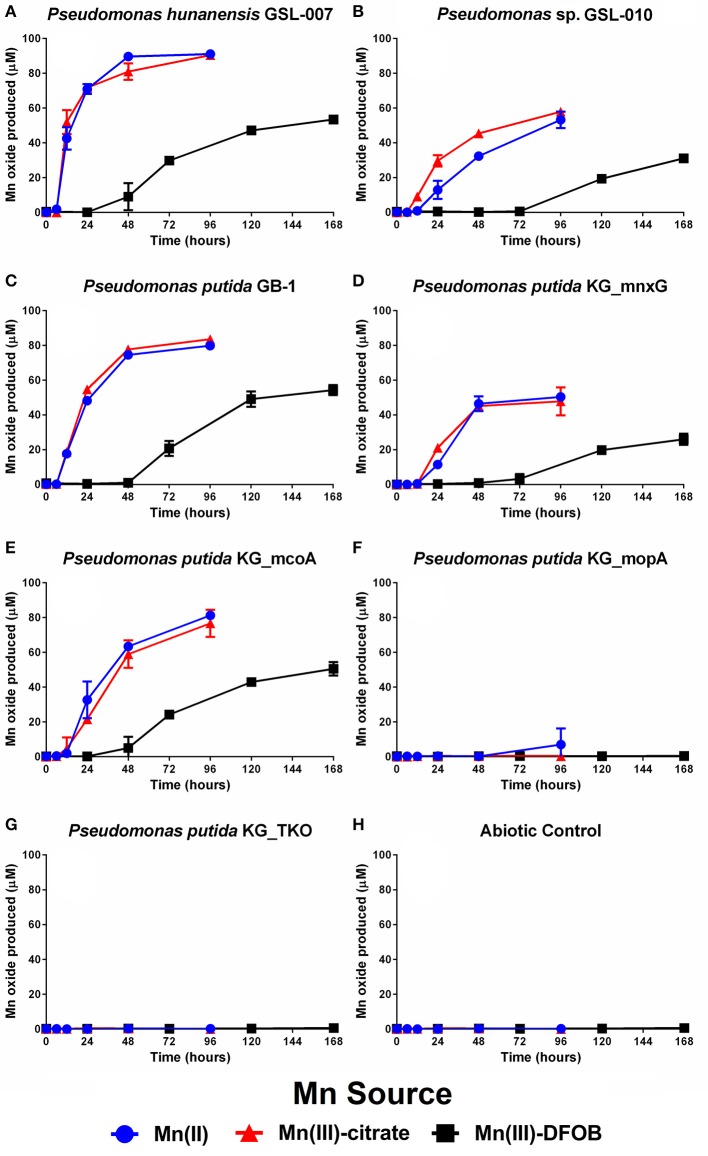
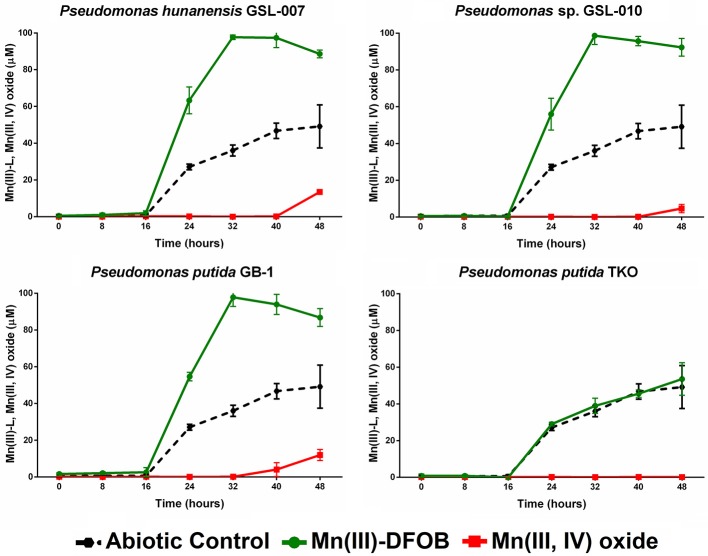
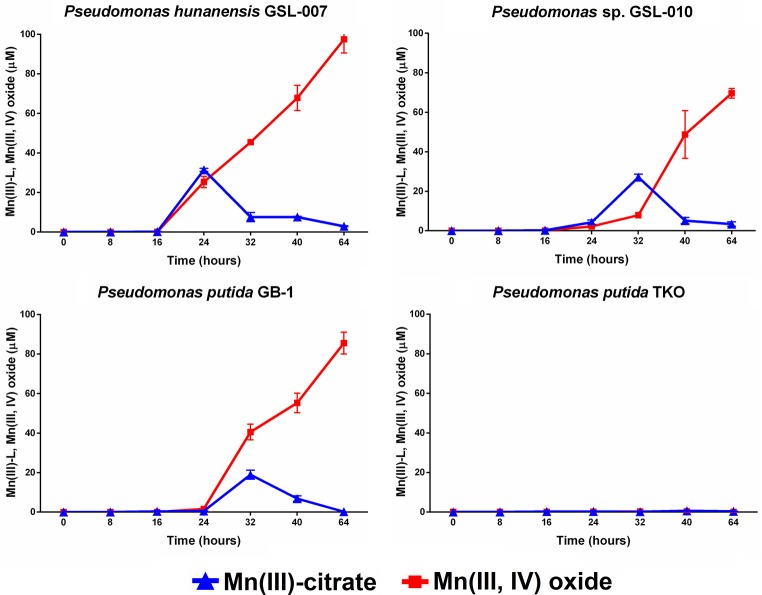
The observation of significant concentrations of soluble Mn(III) complexes in oxic, suboxic, and some anoxic waters has triggered a re-evaluation of the previous Mn paradigm which focused on the cycling between soluble Mn(II) and insoluble Mn(III,IV) species as operationally defined by filtration. Though Mn(II) oxidation in aquatic environments is primarily bacterially-mediated, little is known about the effect of Mn(III)-binding ligands on Mn(II) oxidation nor on the formation and removal of Mn(III). GB-1 is one of the most extensively investigated of all Mn(II) oxidizing bacteria, encoding genes for three Mn oxidases (McoA, MnxG, and MopA). GB-1 and associated Mn oxidase mutants were tested alongside environmental isolates GSL-007 and sp. GSL-010 for their ability to both directly oxidize weakly and strongly bound Mn(III), and to form these complexes through the oxidation of Mn(II). Using Mn(III)-citrate (weak complex) and Mn(III)-DFOB (strong complex), it was observed that GB-1, GSL-007 and sp. GSL-010 and mutants expressing only MnxG and McoA were able to directly oxidize both species at varying levels; however, no oxidation was detected in cultures of a mutant expressing only MopA. During cultivation in the presence of Mn(II) and citrate or DFOB, GB-1, GSL-007 and sp. GSL-010 formed Mn(III) complexes transiently as an intermediate before forming Mn(III/IV) oxides with the overall rates and extents of Mn(III,IV) oxide formation being greater for Mn(III)-citrate than for Mn(III)-DFOB. These data highlight the role of bacteria in the oxidative portion of the Mn cycle and suggest that the oxidation of strong Mn(III) complexes can occur through enzymatic mechanisms involving multicopper oxidases. The results support the observations from field studies and further emphasize the complexity of the geochemical cycling of manganese.
在有氧、缺氧和一些无氧水体中观察到高浓度的可溶性锰(III)络合物,这引发了对先前锰范式的重新评估,该范式侧重于可溶性锰(II)和不溶性锰(III,IV)物种之间的循环,这种循环是通过过滤操作定义的。虽然水生环境中锰(II)的氧化主要由细菌介导,但关于锰(III)结合配体对锰(II)氧化以及锰(III)的形成和去除的影响知之甚少。GB-1是所有锰(II)氧化细菌中研究最广泛的之一,它编码三种锰氧化酶(McoA、MnxG和MopA)的基因。将GB-1和相关的锰氧化酶突变体与环境分离株GSL-007和GSL-010菌一起测试它们直接氧化弱结合和强结合锰(III)以及通过锰(II)氧化形成这些络合物的能力。使用柠檬酸锰(III)(弱络合物)和二乙基三胺五乙酸铁(III)(强络合物),观察到GB-1、GSL-007和GSL-010菌以及仅表达MnxG和McoA的突变体能够在不同程度上直接氧化这两种物质;然而,在仅表达MopA的突变体培养物中未检测到氧化。在存在锰(II)和柠檬酸盐或二乙基三胺五乙酸铁(III)的情况下培养期间,GB-1、GSL-007和GSL-010菌会短暂形成锰(III)络合物作为中间体,然后再形成锰(III/IV)氧化物,柠檬酸锰(III)形成锰(III,IV)氧化物的总体速率和程度大于二乙基三胺五乙酸铁(III)。这些数据突出了细菌在锰循环氧化部分中的作用,并表明强锰(III)络合物的氧化可以通过涉及多铜氧化酶的酶促机制发生。结果支持了现场研究的观察结果,并进一步强调了锰地球化学循环的复杂性。