Salvadori Emilia, Poggesi Anna, Pracucci Giovanni, Chiti Alberto, Ciolli Laura, Cosottini Mirco, Del Bene Alessandra, De Stefano Nicola, Diciotti Stefano, Di Donato Ilaria, Ginestroni Andrea, Marini Sandro, Mascalchi Mario, Nannucci Serena, Orlandi Giovanni, Pasi Marco, Pescini Francesca, Valenti Raffaella, Federico Antonio, Dotti Maria Teresa, Bonuccelli Ubaldo, Inzitari Domenico, Pantoni Leonardo
NEUROFARBA Department, Neuroscience Section, University of Florence, Florence, Italy.
Department of Clinical and Experimental Medicine, University of Pisa, Pisa, Italy.
Dement Geriatr Cogn Dis Extra. 2018 Mar 29;8(1):104-116. doi: 10.1159/000487130. eCollection 2018 Jan-Apr.
The DSM-5 introduced the term "major neurocognitive disorders" (NCDs) to replace the previous term "dementia." However, psychometric and functional definitions of NCDs are missing. We aimed to apply the DSM-5 criteria for diagnosing the transition to NCD to patients with mild cognitive impairment (MCI) and small vessel disease (SVD), and to define clinically significant thresholds for this transition.
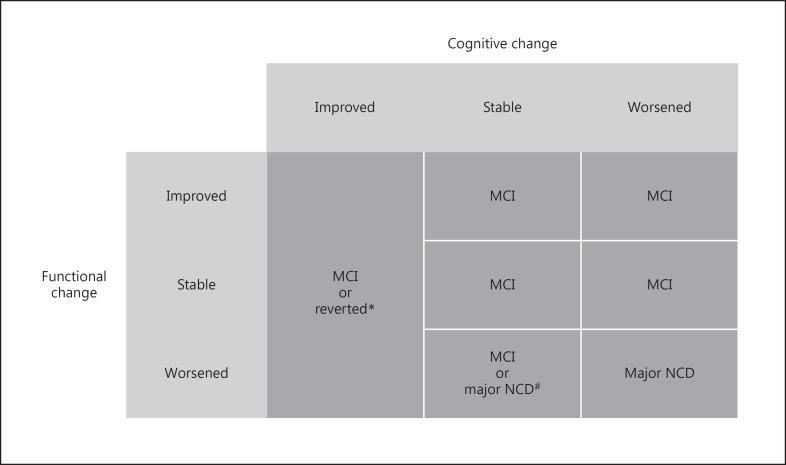
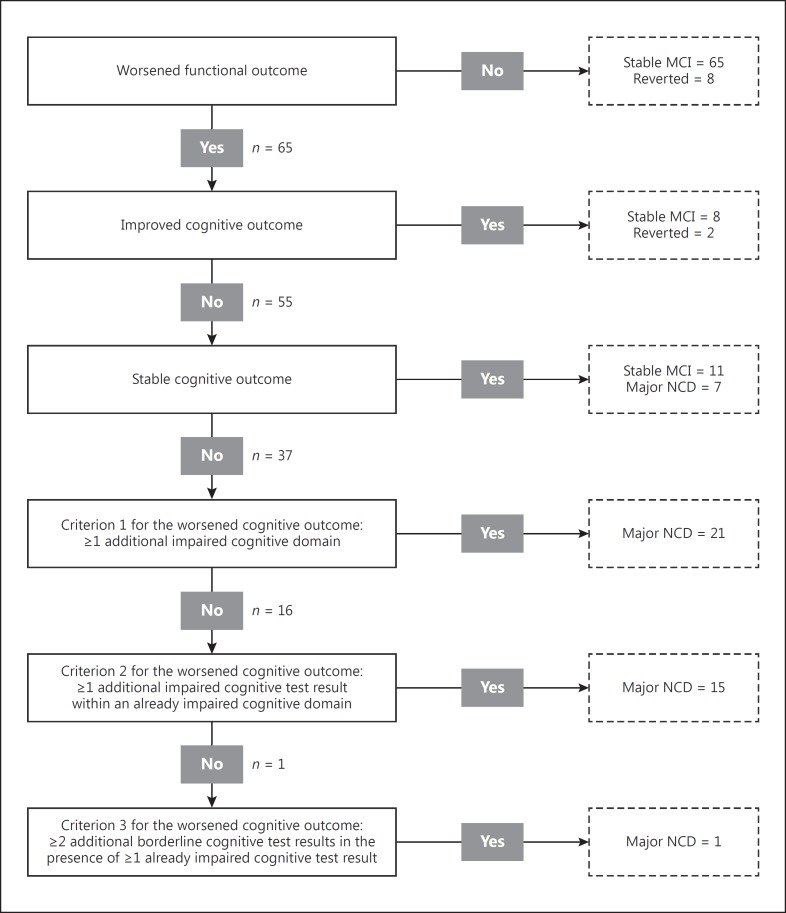
The functional and cognitive features of the NCD criteria were evaluated as change from baseline and operationalized according to hierarchically ordered psychometric rules.
According to the applied criteria, out of 138 patients, 44 were diagnosed with major NCD (21 with significant cognitive worsening in ≥1 additional cognitive domain), 84 remained stable, and 10 reverted to normal. Single-domain MCI patients were the most likely to revert to normal, and none progressed to major NCD. The amnestic multiple-domain MCI patients had the highest rate of progression to NCD.
We provide rules for the DSM-5 criteria for major NCD based on cognitive and functional changes over time, and define psychometric thresholds for clinically significant worsening to be used in longitudinal studies. According to these operationalized criteria, one-third of the MCI patients with SVD progressed to major NCD after 2 years, but only within the multiple-domain subtypes.
《精神疾病诊断与统计手册》第5版(DSM - 5)引入了“重度神经认知障碍”(NCDs)这一术语来取代之前的“痴呆”一词。然而,NCDs的心理测量学和功能定义尚缺失。我们旨在将DSM - 5中用于诊断向NCD转变的标准应用于轻度认知障碍(MCI)和小血管疾病(SVD)患者,并确定这一转变具有临床意义的阈值。
NCD标准的功能和认知特征被评估为相对于基线的变化,并根据分层排序的心理测量学规则进行操作化。
根据应用的标准,在138名患者中,44名被诊断为重度NCD(21名在至少1个其他认知领域有显著认知恶化),84名病情稳定,10名恢复正常。单领域MCI患者最有可能恢复正常,且无人进展为重度NCD。遗忘型多领域MCI患者进展为NCD的比例最高。
我们基于随时间的认知和功能变化为重度NCD的DSM - 5标准提供了规则,并定义了用于纵向研究的具有临床意义的恶化的心理测量学阈值。根据这些操作化标准,三分之一的患有SVD的MCI患者在2年后进展为重度NCD,但仅在多领域亚型中出现这种情况。