Ponce de León Beatriz, Andersen Søren, Karstoft Karen-Inge, Elklit Ask
Danish National Centre of Psychotraumatology, Department of Psychology, University of Southern Denmark, Odense, Denmark.
Psychiatry, Afdeling for Traume- og Torturoverlevere, Region of Southern Denmark,Vejle, Denmark.
Eur J Psychotraumatol. 2018 Mar 9;9(1):1443672. doi: 10.1080/20008198.2018.1443672. eCollection 2018.
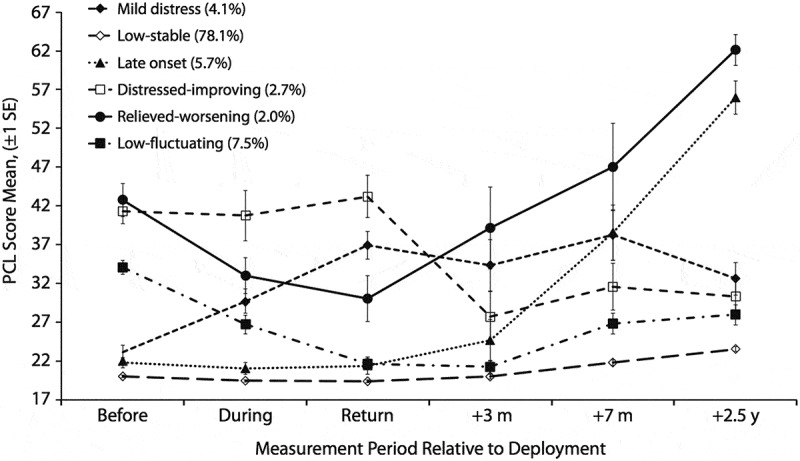
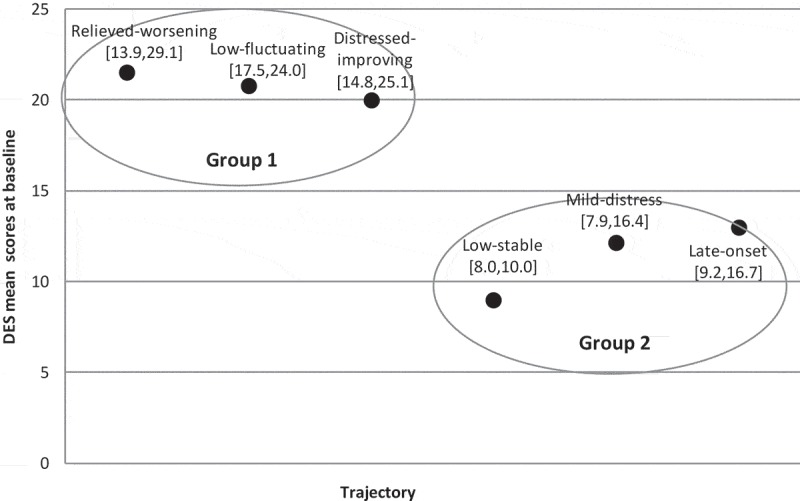
: This study investigated whether pre-deployment dissociation was associated with previously identified post-traumatic stress disorder (PTSD) symptom trajectories from before to 2.5 years after military deployment. Furthermore, it examined whether the tendency to dissociate, pre-deployment personality factors, conceptualized by the Big Five model, and previous trauma represented independent risk factors for post-deployment PTSD symptoms. : This prospective study included the entire team of 743 soldiers from the Danish Contingent of the International Security Assistance Force 7 deployed to Afghanistan in 2009. Data consisted of self-report measures and were collected six times: before deployment; during deployment; and 1-3 weeks, 2 months, 7 months and 2.5 years after homecoming. : The findings indicate significant associations between pre-deployment dissociation and six PTSD trajectories (< 0.001, = 0.120). Based on mean differences in dissociation for the six trajectories, two main groups emerged: a group with high dissociation scores at pre-deployment, which had moderate PTSD symptom levels at pre-deployment and fluctuated over time; and a group with low dissociation scores at pre-deployment, which had low initial PTSD symptom levels and diverged over time. Our study also confirmed previous findings of a positive association between neuroticism and dissociation ( = 0.31, < 0.001). This suggests that negative emotionality may be a vulnerability that enhances dissociative experiences, although a causal link cannot be concluded from the findings. Finally, pre-deployment dissociation, pre-deployment neuroticism and a history of traumatic events, as independent factors, were significant predictors of post-deployment PTSD ( < 0.001, = 0.158). : The study emphasizes the multiplicity of factors involved in the development of PTSD, and group differences in dissociative symptoms support the heterogeneity in PTSD. Further, this study points to specific aspects of personality that may be targeted in a clinical setting and in pre-deployment assessments in the military.
本研究调查了部署前的解离是否与先前确定的从军事部署前到部署后2.5年的创伤后应激障碍(PTSD)症状轨迹相关。此外,研究还考察了解离倾向、部署前的人格因素(由大五人格模型概念化)以及既往创伤是否代表部署后PTSD症状的独立危险因素。本前瞻性研究纳入了2009年部署到阿富汗的国际安全援助部队7丹麦特遣队的743名士兵组成的整个团队。数据由自我报告测量组成,共收集了六次:部署前;部署期间;回国后1 - 3周、2个月、7个月和2.5年。研究结果表明,部署前的解离与六种PTSD轨迹之间存在显著关联(<0.001, =0.120)。根据六种轨迹在解离方面的平均差异,出现了两个主要组:一组在部署前解离得分高,在部署前PTSD症状水平中等且随时间波动;另一组在部署前解离得分低,初始PTSD症状水平低且随时间分化。我们的研究还证实了先前关于神经质与解离之间存在正相关的发现( =0.31, <0.001)。这表明消极情绪可能是一种增强解离体验的易感性因素,尽管从这些发现中无法得出因果关系。最后,部署前的解离、部署前的神经质和创伤事件史作为独立因素,是部署后PTSD的显著预测因素(<0.001, =0.158)。该研究强调了PTSD发展过程中涉及的因素的多样性,解离症状的组间差异支持了PTSD的异质性。此外,本研究指出了在临床环境和军事部署前评估中可能针对的人格特定方面。