Assaram Shirelle, Mashamba-Thompson Tivani P, Magula Nombulelo P
Department of Internal Medicine, Nelson R. Mandela School of Medicine, University of KwaZulu-Natal, South Africa.
Department of Public Health Medicine, School of Nursing and Public Health, University of KwaZulu-Natal, South Africa.
South Afr J HIV Med. 2018 Apr 12;19(1):770. doi: 10.4102/sajhivmed.v19i1.770. eCollection 2018.
Our systematic scoping review has demonstrated a research gap in antiretroviral treatment (ART) nephrotoxicity as well as in the long-term outcomes of renal function for patients on ART in South Africa. Bearing in mind the high prevalence of human immunodeficiency virus (HIV) in South Africa, this is of great concern.
To determine the risk factors and co-morbidities associated with changes in renal function in HIV-infected adults in South Africa.
We conducted a retrospective study of 350 ART-naïve adult patients attending the King Edward VIII HIV clinic, Durban, South Africa. Data were collected at baseline (pre-ART) and at six, 12, 18 and 24 months on ART. Renal function was assessed in the 24-month period using the Modification of Diet in Renal Disease equation and was categorised into normal renal function (estimated glomerular filtration rate [eGFR] ≥ 60), moderate renal impairment (eGFR 30-59), severe renal impairment (eGFR 15-29) and kidney failure (eGFR < 15 mL/min/1.73 m). Generalised linear models for binary data were used to model the probability of renal impairment over the five time periods, controlling for repeated measures within participants over time. Risk ratios and 95% confidence intervals (CI) were reported for each time point versus baseline.
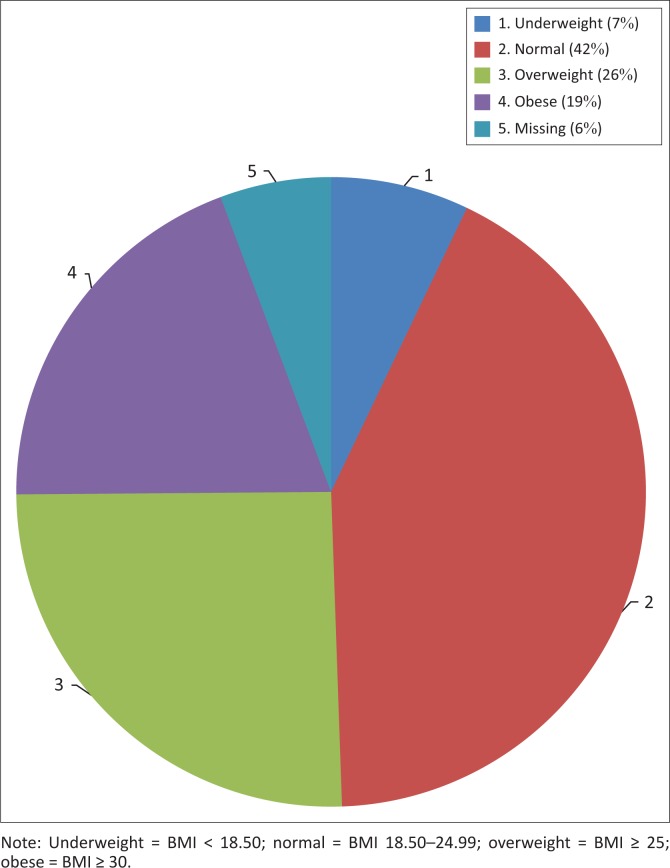
The cohort was 64% female, and 99% were Black. The median age was 36 years. At baseline, 10 patients had hypertension (HPT), six had diabetes, 61 were co-infected with tuberculosis (TB) and 157 patients had a high body mass index (BMI) with 25.4% being categorised as overweight and 19.4% as obese. The majority of the patients (59.3%) were normotensive. At baseline, the majority of the patients (90.4%) had normal renal function (95% CI: 86% - 93%), 7.0% (CI: 5% - 10%) had moderate renal impairment, 1.3% (CI: 0% - 3%) had severe renal impairment and 1.3% (CI: 0% - 3%) had renal failure. As BMI increased by one unit, the risk of renal impairment increased by 1.06 (CI: 1.03-1.10) times. The association of HPT with abnormal renal function was found to be insignificant, > 0.05. The vast majority of patients were initiated on tenofovir disoproxil fumarate (TDF) (90.6%), in combination with lamivudine (3TC) (100%) and either efavirenz (EFV) (56.6%) or nevirapine (NVP) (43.4%).
This study reports a low prevalence of baseline renal impairment in HIV-infected ART-naïve outpatients. An improvement in renal function after the commencement of ART has been demonstrated in this population. However, the long-term outcomes of patients with HIV-related renal disease are not known.
我们的系统综述表明,在南非,抗逆转录病毒治疗(ART)的肾毒性以及接受ART治疗患者的肾功能长期转归方面存在研究空白。鉴于南非人类免疫缺陷病毒(HIV)的高流行率,这令人深感担忧。
确定南非HIV感染成人肾功能变化的危险因素和合并症。
我们对南非德班爱德华八世国王HIV诊所的350例未接受过ART治疗的成年患者进行了一项回顾性研究。在基线(ART治疗前)以及ART治疗6个月、12个月、18个月和24个月时收集数据。在24个月期间,使用肾脏病饮食改良公式评估肾功能,并将其分为肾功能正常(估计肾小球滤过率[eGFR]≥60)、中度肾功能损害(eGFR 30 - 59)、重度肾功能损害(eGFR 15 - 29)和肾衰竭(eGFR < 15 mL/min/1.73 m²)。使用二元数据的广义线性模型对五个时间段内肾功能损害的概率进行建模,同时控制参与者随时间的重复测量。报告每个时间点与基线相比的风险比和95%置信区间(CI)。
该队列中64%为女性,99%为黑人。中位年龄为36岁。基线时,10例患者患有高血压(HPT),6例患有糖尿病,61例合并感染结核病(TB),157例患者体重指数(BMI)较高,其中25.4%被归类为超重,19.4%为肥胖。大多数患者(59.3%)血压正常。基线时,大多数患者(90.4%)肾功能正常(95% CI:86% - 93%),7.0%(CI:5% - 10%)有中度肾功能损害,1.3%(CI:0% - 3%)有重度肾功能损害,1.3%(CI:0% - 3%)有肾衰竭。随着BMI每增加一个单位,肾功能损害的风险增加1.06(CI:1.03 - 1.10)倍。发现HPT与肾功能异常的关联不显著,P>0.05。绝大多数患者开始使用富马酸替诺福韦二吡呋酯(TDF)(90.6%),联合拉米夫定(3TC)(100%)以及依非韦伦(EFV)(56.6%)或奈韦拉平(NVP)(43.4%)。
本研究报告了未接受过ART治疗的HIV感染门诊患者基线肾功能损害的低患病率。该人群在开始ART治疗后肾功能有所改善。然而,HIV相关肾病患者的长期转归尚不清楚。