Tirado-Hurtado Indira, Fajardo Williams, Pinto Joseph A
Unidad de Investigación Básica y Traslacional, Oncosalud-AUNA, Lima, Peru.
Escuela de Medicina Humana, Universidad Privada San Juan Bautista, Lima, Peru.
Front Oncol. 2018 Apr 12;8:106. doi: 10.3389/fonc.2018.00106. eCollection 2018.
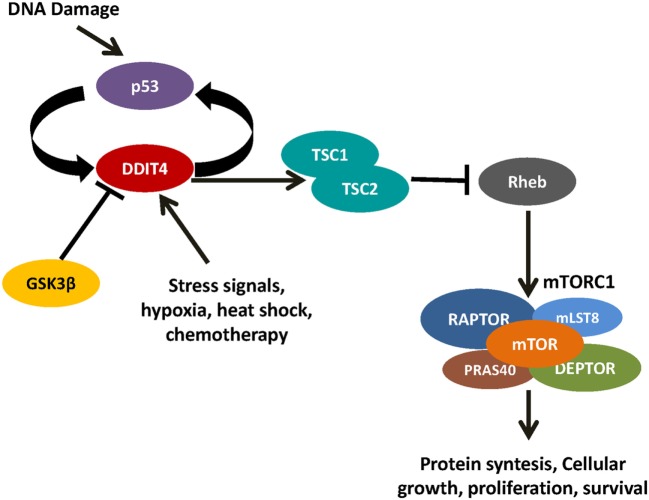
DNA damage inducible transcript 4 () gene is expressed under stress situations turning off the metabolic activity triggered by the mammalian target of rapamycin (mTOR). Several and works have demonstrated the ability of to generate resistance to cancer therapy. The link between the metabolism suppression and aggressiveness features of cancer cells remains poorly understood since anti-mTOR agents who are part of the repertoire of drugs used for systemic treatment of cancer achieving variable results. Interestingly, the high expression is associated with worse outcomes compared to tumors with low expression, seen in a wide variety of solid and hematological tumors, which suggests the driver role of this gene and provide the basis to target it as part of a new therapeutic strategy. In this review, we highlight our current knowledge about the biology of and its role as a prognostic biomarker, encompassing the motives for the development of target drugs against as a better target than mTOR inhibitors.
DNA损伤诱导转录本4()基因在应激情况下表达,可关闭由雷帕霉素哺乳动物靶点(mTOR)触发的代谢活性。多项和研究表明,能够产生对癌症治疗的抗性。由于作为用于癌症全身治疗的药物库一部分的抗mTOR药物取得了不同的结果,癌细胞代谢抑制与侵袭性特征之间的联系仍知之甚少。有趣的是,与低表达的肿瘤相比,高表达与更差的预后相关,这在多种实体瘤和血液肿瘤中都有发现,这表明该基因的驱动作用,并为将其作为新治疗策略的一部分进行靶向治疗提供了依据。在这篇综述中,我们重点介绍了我们目前关于的生物学知识及其作为预后生物标志物的作用,包括开发针对的靶向药物作为比mTOR抑制剂更好靶点的动机。