Institute for Atmospheric and Earth System Research/Physics, Faculty of Science, University of Helsinki, P.O. Box 64, FIN-00014 Helsinki, Finland.
Institute of Physics, University of Tartu, Ülikooli 18, EE-50090 Tartu, Estonia.
Sci Adv. 2018 Apr 25;4(4):eaar5218. doi: 10.1126/sciadv.aar5218. eCollection 2018 Apr.
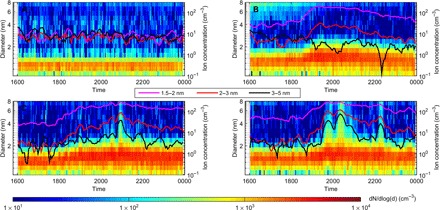
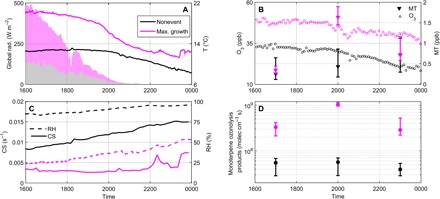
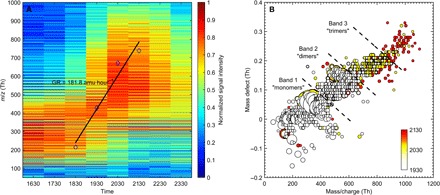
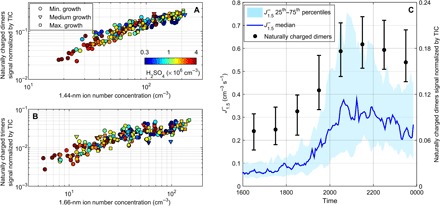
A substantial fraction of aerosols, which affect air quality and climate, is formed from gaseous precursors. Highly oxygenated organic molecules (HOMs) are essential to grow the newly formed particles and have been evidenced to initiate ion-induced nucleation in chamber experiments in the absence of sulfuric acid. We investigate this phenomenon in the real atmosphere using an extensive set of state-of-the-art ion and mass spectrometers deployed in a boreal forest environment. We show that within a few hours around sunset, HOMs resulting from the oxidation of monoterpenes are capable of forming and growing ion clusters even under low sulfuric acid levels. In these conditions, we hypothesize that the lack of photochemistry and essential vapors prevents the organic clusters from growing past 6 nm. However, this phenomenon might have been a major source of particles in the preindustrial atmosphere and might also contribute to particle formation in the future and consequently affect the climate.
大量影响空气质量和气候的气溶胶是由气体前体形成的。高度氧化的有机分子(HOMs)对于新形成颗粒的生长至关重要,并且已经在没有硫酸的腔室实验中证明可以引发离子诱导成核。我们使用一系列先进的离子和质谱仪在北方森林环境中进行了广泛的研究,以研究这一现象。我们表明,在日落前后的几个小时内,即使在低硫酸水平下,由单萜氧化产生的 HOMs 也能够形成和生长离子簇。在这些条件下,我们假设缺乏光化学和必要的蒸气会阻止有机团簇生长超过 6nm。然而,这种现象可能是前工业化大气中颗粒的主要来源,也可能对未来的颗粒形成做出贡献,并因此影响气候。