Riccò M, Vezzosi L, Gualerzi G, Signorelli C
Provincial Agency for Health Services of the Autonomous Province of Trento, Department of Prevention, Occupational Health and Safety Unit (UOPSAL).
Local Health Unit of Reggio Emilia, Department of Public Health; Occupational Health and Safety Service.
J Prev Med Hyg. 2017 Dec 30;58(4):E266-E278. doi: 10.15167/2421-4248/jpmh2017.58.4.673. eCollection 2017 Dec.
Past researches have shown that schoolteachers' (STs) interventions maximize the consent for vaccination programs. European data regarding knowledge, attitudes and practices of STs towards vaccination are otherwise lacking.
The aim of this study was therefore to evaluate knowledge and attitudes of STs regarding vaccinations in a sample from North Italy.
In this cross sectional study, 154 STs from Lombardy region (Northern Italy) responded to a specific questionnaire assessing their attitude towards vaccination and vaccine related knowledge.
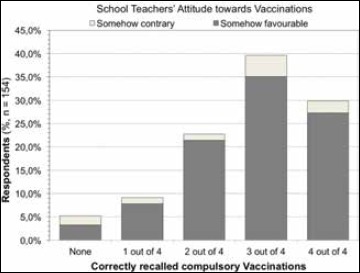
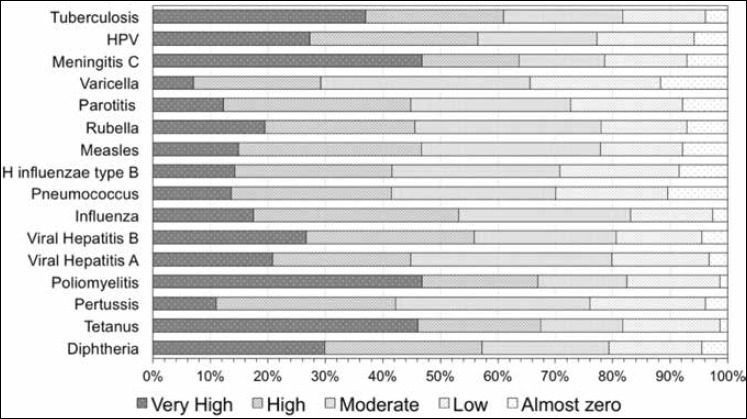
In general, 88.3% of subjects were somehow favourable to vaccinations. The main reason for declining vaccination was the risk of side effects whereas the main reason to be vaccinated was to avoid to be infected by VPDs (67.6%). Main information sources were health professionals (75.3%), and new media (13.1%), and the latter were STs more frequently associated with a negative attitude towards vaccinations (p < 0.001). Eventually, regression analysis identified risk perception as positively associated with propensity towards vaccinations, both for Students- and STs-recommended vaccinations (B = 0.372, 95% CI 0.247 to 0.496 and B = 0.005, 95%CI 0.004 to 0.006, respectively).
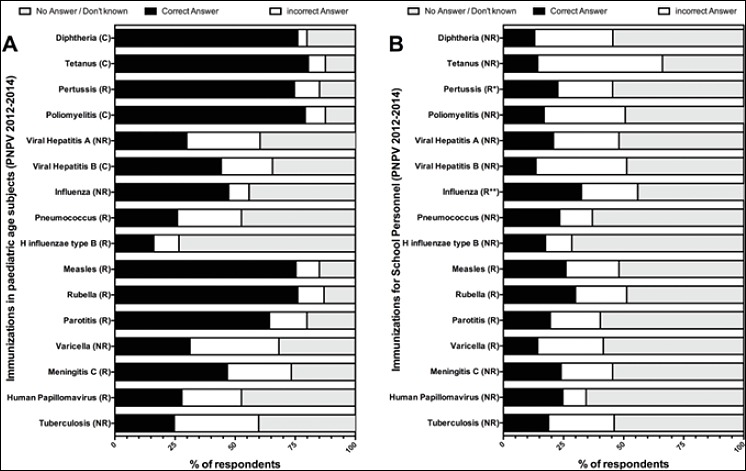
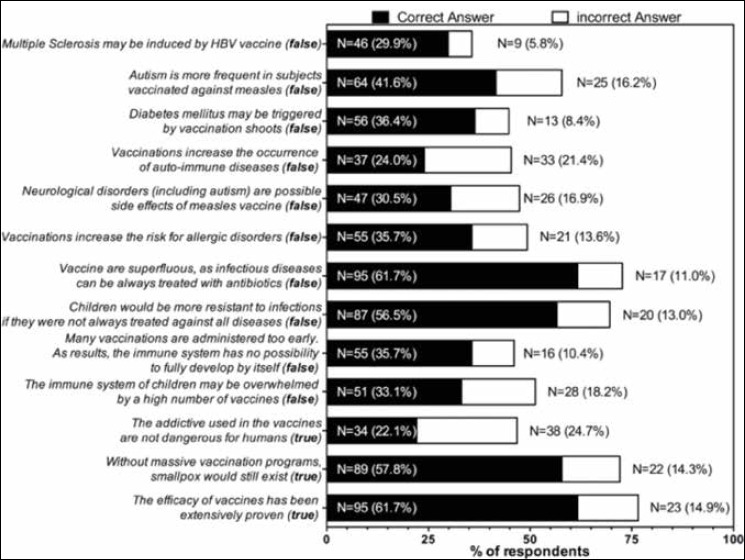
Our results are consistent with previous reports suggesting a significant knowledge gap in STs, with the risk perception of infectious diseases as the main predictor for vaccine propensity. Moreover, the better knowledge of official vaccination recommendations and policies among STs identifying Health Professionals as information source enlightens the role of the School Physicians and Occupational Physicians, whose intervention may ultimately increase the vaccination acceptance and vaccination rates.
过去的研究表明,学校教师的干预能最大限度地提高疫苗接种计划的同意率。然而,欧洲缺乏关于学校教师对疫苗接种的知识、态度和做法的数据。
因此,本研究的目的是评估意大利北部一个样本中学校教师对疫苗接种的知识和态度。
在这项横断面研究中,来自伦巴第地区(意大利北部)的154名学校教师回答了一份特定问卷,评估他们对疫苗接种的态度和与疫苗相关的知识。
总体而言,88.3%的受试者在某种程度上支持疫苗接种。拒绝接种疫苗的主要原因是副作用风险,而接种疫苗的主要原因是避免感染疫苗可预防疾病(VPDs,67.6%)。主要信息来源是卫生专业人员(75.3%)和新媒体(13.1%),后者与学校教师对疫苗接种的负面态度更为频繁相关(p<0.001)。最终,回归分析确定风险认知与学生和学校教师推荐的疫苗接种倾向呈正相关(B = 0.372,95%CI 0.247至0.496;B = 0.005,95%CI 0.004至0.006)。
我们的结果与之前的报告一致,表明学校教师存在显著的知识差距,传染病的风险认知是疫苗接种倾向的主要预测因素。此外,将卫生专业人员作为信息来源的学校教师对官方疫苗接种建议和政策的更好了解,凸显了学校医生和职业医生的作用,他们的干预最终可能会提高疫苗接种的接受度和接种率。