Ruijin Hospital, Shanghai Jiao Tong University, Shanghai, China.
Chung Shan Medical University Hospital, Taichung City, Taiwan.
Diabetes Obes Metab. 2018 Sep;20(9):2121-2130. doi: 10.1111/dom.13340. Epub 2018 Jun 5.
To compare the efficacy and safety of once-weekly glucagon-like peptide-1 receptor agonist dulaglutide 1.5 and 0.75 mg with glimepiride in East-Asian patients with type 2 diabetes (T2D).
In this phase III, multinational, multicentre, double-blind, randomized, parallel-arm, 26-week study, patients with inadequate glycaemic control were randomized 1:1:1 to once-weekly dulaglutide 1.5 or 0.75 mg or daily glimepiride (1-3 mg/d). The primary endpoint was assessment of the non-inferiority of dulaglutide (1.5 mg), as measured by change in glycated haemoglobin (HbA1c), compared with glimepiride using a 0.4% non-inferiority margin.
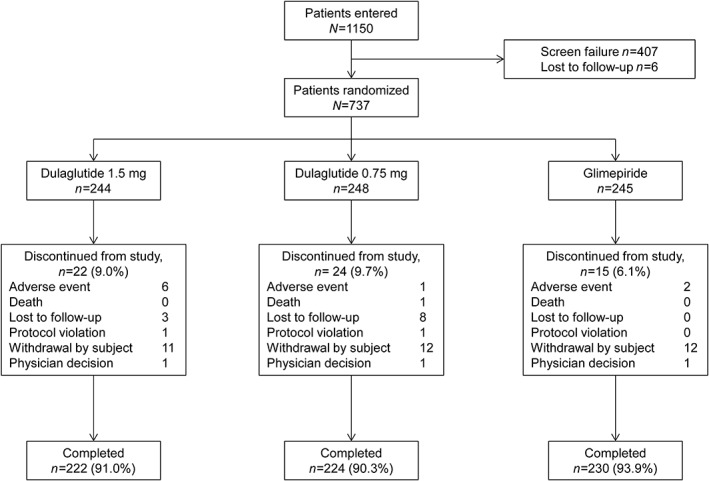
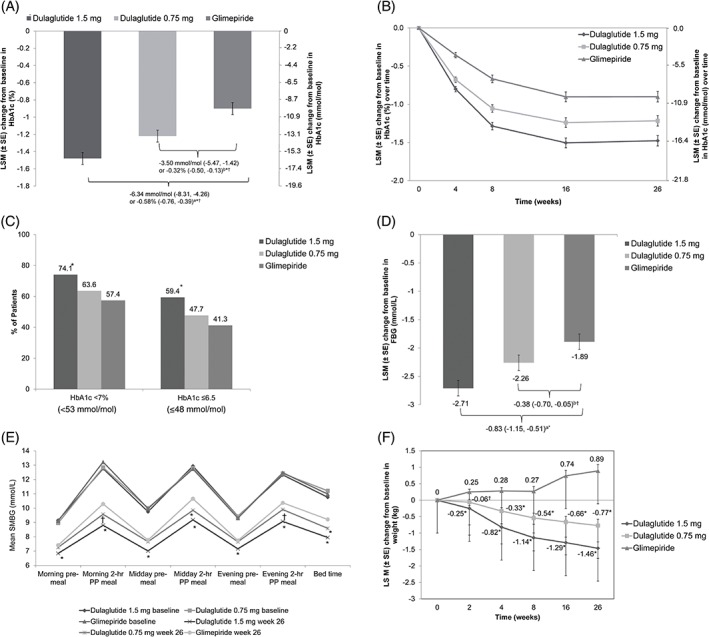
A total of 737 patients were randomized (dulaglutide 1.5 mg, n = 244; dulaglutide 0.75 mg, n = 248; glimepiride, n = 245). At week 26, both doses of dulaglutide were non-inferior and also superior to glimepiride for HbA1c reduction from baseline with a least squares mean difference of -6.34 mmol/mol (95% confidence interval [CI] -8.31, -4.26) or -0.58% (95% CI -0.76, -0.39) for dulaglutide 1.5 mg and -3.50 mmol/mol (95% CI -5.47, -1.42) or -0.32% (95% CI -0.50, -0.13) for dulaglutide 0.75 mg (P < .001). A greater proportion of patients in the dulaglutide 1.5 mg group achieved the HbA1c target of <53 mmol/mol (<7.0%) compared with the glimepiride group (74.1% vs 57.4%; P < .001). The mean body weight decreased (P < .005) and total hypoglycaemia rates were lower (P < .001) in the dulaglutide groups compared with the glimepiride group. The most common drug-related adverse events in both dulaglutide groups (≥5% of patients) included diarrhoea, nausea, increased lipase, decreased appetite, abdominal distension and vomiting.
Dulaglutide (both doses) demonstrated superior glycaemic control vs glimepiride, with a favourable tolerability and safety profile in East-Asian patients with T2D.
比较每周一次胰高血糖素样肽-1 受体激动剂度拉鲁肽 1.5mg 和 0.75mg 与格列美脲在东亚 2 型糖尿病(T2D)患者中的疗效和安全性。
在这项为期 26 周、多中心、多国、双盲、随机、平行分组的 III 期研究中,血糖控制不佳的患者按 1:1:1 的比例随机分配至每周一次度拉鲁肽 1.5mg 或 0.75mg 或每日格列美脲(1-3mg/d)组。主要终点是评估度拉鲁肽(1.5mg)的非劣效性,以糖化血红蛋白(HbA1c)的变化为衡量标准,与格列美脲相比使用 0.4%的非劣效性边界。
共纳入 737 例患者(度拉鲁肽 1.5mg 组 n=244;度拉鲁肽 0.75mg 组 n=248;格列美脲组 n=245)。在第 26 周时,两种剂量的度拉鲁肽均较格列美脲非劣效,且 HbA1c 较基线降低,度拉鲁肽 1.5mg 组最小二乘均数差值为-6.34mmol/mol(95%CI-8.31,-4.26)或-0.58%(95%CI-0.76,-0.39),度拉鲁肽 0.75mg 组为-3.50mmol/mol(95%CI-5.47,-1.42)或-0.32%(95%CI-0.50,-0.13)(P<0.001)。与格列美脲组相比,度拉鲁肽 1.5mg 组达到 HbA1c<53mmol/mol(<7.0%)目标的患者比例更高(74.1% vs. 57.4%;P<0.001)。与格列美脲组相比,度拉鲁肽组的平均体重下降(P<0.005)和总低血糖发生率更低(P<0.001)。在度拉鲁肽两组中(≥5%的患者)最常见的药物相关不良事件包括腹泻、恶心、脂肪酶升高、食欲下降、腹胀和呕吐。
在东亚 2 型糖尿病患者中,度拉鲁肽(两种剂量)均显示出优于格列美脲的血糖控制效果,且具有良好的耐受性和安全性。