Department of Rheumatology, Leiden University Medical Center, PO Box 9600, Leiden, 2300RC, the Netherlands.
Department of Rheumatology, Erasmus Medical Center, Rotterdam, The Netherlands.
Arthritis Res Ther. 2018 May 3;20(1):89. doi: 10.1186/s13075-018-1574-3.
Anti-citrullinated protein antibodies (ACPA) are associated with more severe joint erosions in rheumatoid arthritis (RA), but the underlying mechanism is unclear. Recent in vitro and murine studies indicate that ACPAs can directly activate osteoclasts leading to bone erosions and pain. This study sought evidence for this hypothesis in humans and evaluated whether in patients with arthralgia who are at risk of RA, ACPA is associated with erosions (detected by magnetic resonance imaging (MRI)) independent of inflammation, and also independent of the presence of rheumatoid factor (RF).
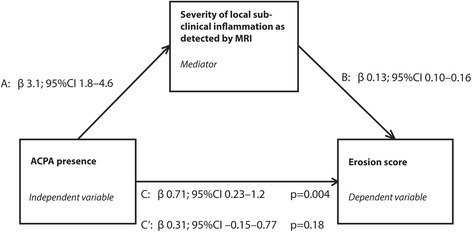
Patients with Clinically Suspect Arthralgia (n = 507) underwent determination of ACPA and RF and 1.5 T contrast-enhanced MRI of the metacarpophalangeal, wrist and metatarsophalangeal joints at baseline. MRIs were scored for presence of local inflammation and erosions. Comparisons of erosion scores were performed using the Kruskal-Wallis test. To evaluate if inflammation is, in statistical terms, intermediary in the causal path of ACPA and erosions, three-step mediation analysis was performed using linear regression.
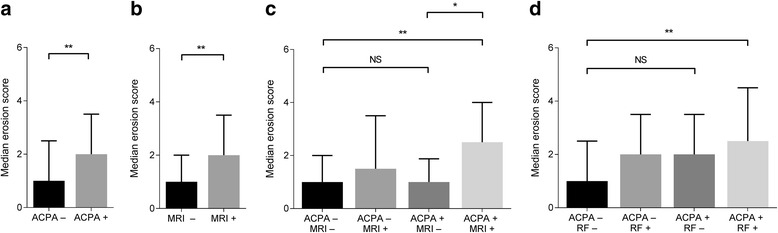
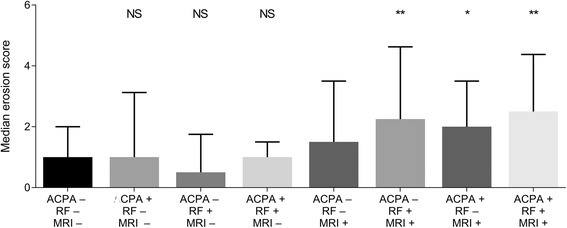
ACPA-positive patients had higher erosion scores than ACPA-negative patients (p = 0.006). ACPA-positive patients without subclinical inflammation did not have higher erosion scores than ACPA-negative patients (p = 0.68), in contrast to ACPA-positive patients with local inflammation (p < 0.001). Mediation analyses suggested that local inflammation is in the causal path of ACPA leading to higher erosion scores. Compared to ACPA-negative/RF-negative patients, ACPA-positive/RF-negative patients did not differ (p = 0.30), but ACPA-positive/RF-positive patients had higher erosion scores (p = 0.006).
The effect of ACPA on erosions is mediated by inflammation and is not independent of RF.
抗瓜氨酸化蛋白抗体(ACPA)与类风湿关节炎(RA)更严重的关节侵蚀有关,但潜在机制尚不清楚。最近的体外和小鼠研究表明,ACPA 可直接激活破骨细胞,导致骨质侵蚀和疼痛。本研究旨在为这一假说提供人类证据,并评估在有发生 RA 风险的关节痛患者中,ACPA 是否与侵蚀(通过磁共振成像(MRI)检测)相关,且与炎症和类风湿因子(RF)的存在无关。
507 例临床可疑关节炎患者接受 ACPA 和 RF 检测,并在基线时进行 1.5 T 对比增强的掌指、腕和跖趾关节 MRI。对 MRI 进行局部炎症和侵蚀的评分。使用 Kruskal-Wallis 检验比较侵蚀评分。为评估炎症是否在 ACPA 和侵蚀的因果关系中处于中间位置,我们采用线性回归进行了三步中介分析。
ACPA 阳性患者的侵蚀评分高于 ACPA 阴性患者(p=0.006)。无亚临床炎症的 ACPA 阳性患者的侵蚀评分并不高于 ACPA 阴性患者(p=0.68),而有局部炎症的 ACPA 阳性患者则高于 ACPA 阴性患者(p<0.001)。中介分析表明,局部炎症处于 ACPA 导致侵蚀评分升高的因果关系中。与 ACPA 阴性/RF 阴性患者相比,ACPA 阳性/RF 阴性患者的侵蚀评分无差异(p=0.30),但 ACPA 阳性/RF 阳性患者的侵蚀评分更高(p=0.006)。
ACPA 对侵蚀的影响是通过炎症介导的,并且与 RF 无关。