Codron Daryl, Clauss Marcus, Codron Jacqueline, Tütken Thomas
Institut für Geowissenschaften AG für Angewandte und Analytische Paläontologie Johannes Gutenberg-Universität Mainz Mainz Germany.
Florisbad Quaternary Research Department National Museum Bloemfontein South Africa.
Ecol Evol. 2018 Mar 25;8(8):3983-3995. doi: 10.1002/ece3.3786. eCollection 2018 Apr.
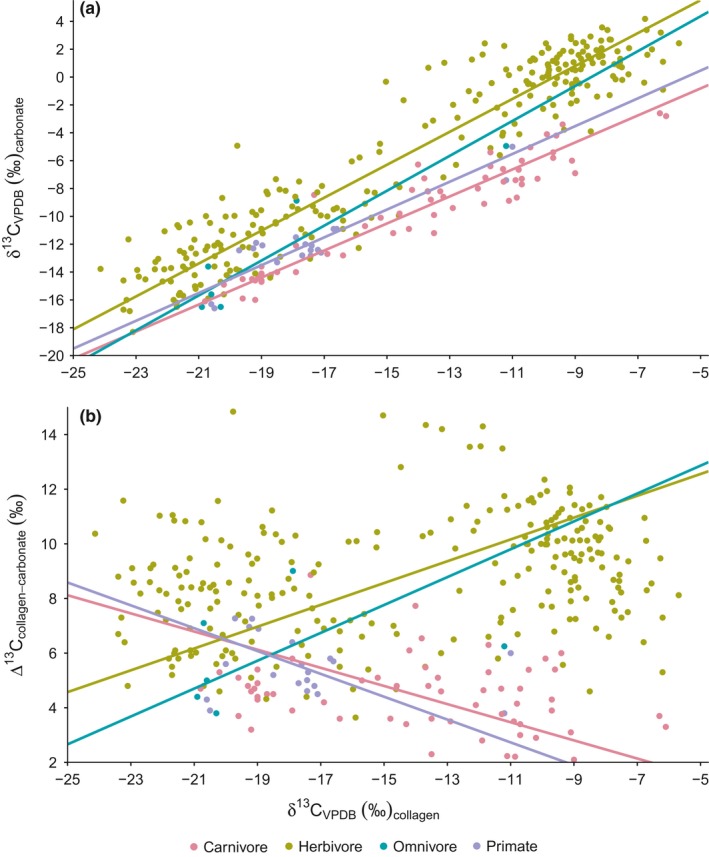
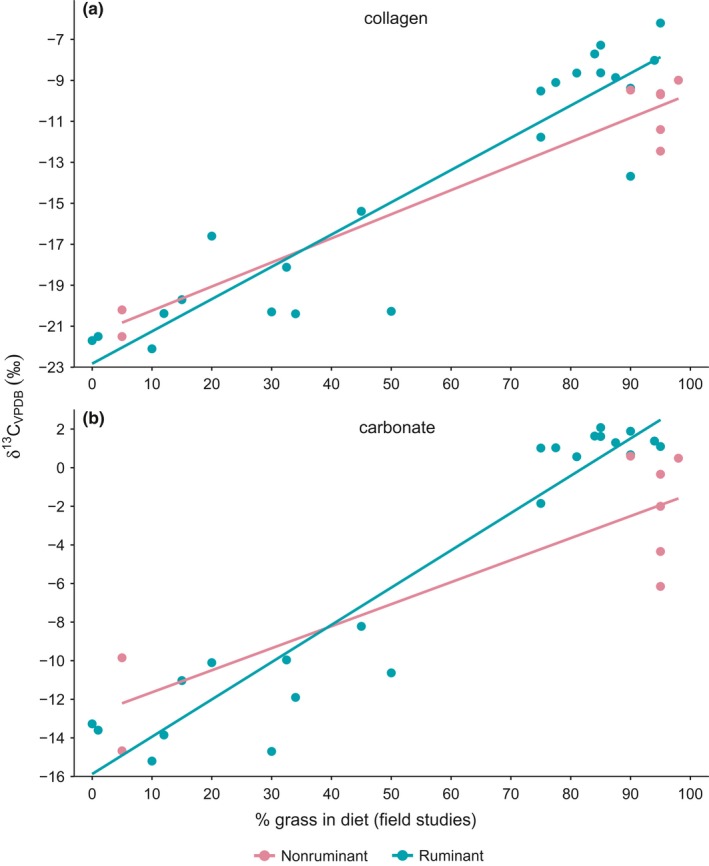
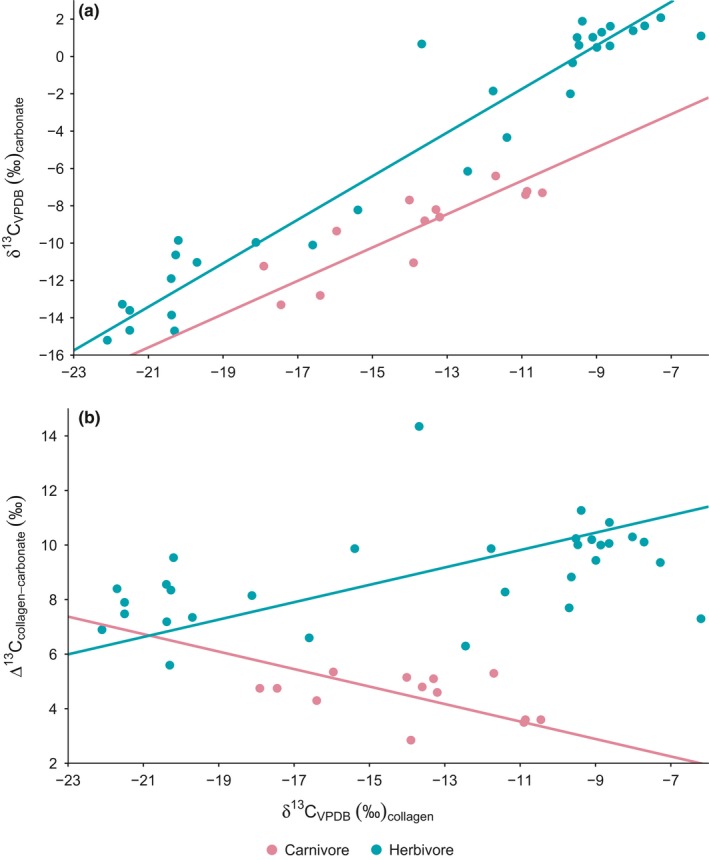
Stable carbon isotope analyses of vertebrate hard tissues such as bones, teeth, and tusks provide information about animal diets in ecological, archeological, and paleontological contexts. There is debate about how carbon isotope compositions of collagen and apatite carbonate differ in terms of their relationship to diet, and to each other. We evaluated relationships between δC and δC among free-ranging southern African mammals to test predictions about the influences of dietary and physiological differences between species. Whereas the slopes of δC-δC relationships among carnivores are ≤1, herbivore δC increases with increasing dietary δC at a slower rate than does δC, resulting in regression slopes >1. This outcome is consistent with predictions that herbivore δC is biased against low protein diet components (C-enriched C grasses in these environments), and δC is C-enriched due to release of C-depleted methane as a by-product of microbial fermentation in the digestive tract. As methane emission is constrained by plant secondary metabolites in browse, the latter effect becomes more pronounced with higher levels of C grass in the diet. Increases in δC are also larger in ruminants than nonruminants. Accordingly, we show that ΔC- spacing is not constant within herbivores, but increases by up to 5 ‰ across species with different diets and physiologies. Such large variation, often assumed to be negligible within trophic levels, clearly cannot be ignored in carbon isotope-based diet reconstructions.
对骨骼、牙齿和獠牙等脊椎动物硬组织进行的稳定碳同位素分析,能在生态、考古和古生物学背景下提供有关动物饮食的信息。关于胶原蛋白和磷灰石碳酸盐的碳同位素组成在与饮食的关系以及它们彼此之间的差异方面存在争议。我们评估了自由放养的南部非洲哺乳动物中δC与δC之间的关系,以检验关于物种间饮食和生理差异影响的预测。食肉动物中δC - δC关系的斜率≤1,而食草动物的δC随着饮食中δC的增加而增加,但速度比δC慢,导致回归斜率>1。这一结果与以下预测一致:食草动物的δC对低蛋白饮食成分(这些环境中富含碳的C草)存在偏差,并且由于消化道中微生物发酵产生的贫碳甲烷作为副产品释放,δC富含碳。由于甲烷排放受树叶中植物次生代谢物的限制,随着饮食中C草含量的增加,后一种效应变得更加明显。反刍动物中δC的增加也比非反刍动物更大。因此,我们表明,食草动物体内的ΔC间距并非恒定不变,而是在具有不同饮食和生理特征的物种间增加了高达5‰。这种通常被认为在营养级内可忽略不计的巨大差异,在基于碳同位素的饮食重建中显然不能被忽视。