a Centre for Atherothrombosis and Metabolic Disease, Hull-York Medical School , Faculty of Health Sciences, University of Hull , Hull , UK.
c Department of Internal Medicine 1 , University Hospital RWTH Aachen , Aachen , Germany.
Platelets. 2019;30(4):467-472. doi: 10.1080/09537104.2018.1466386. Epub 2018 May 7.
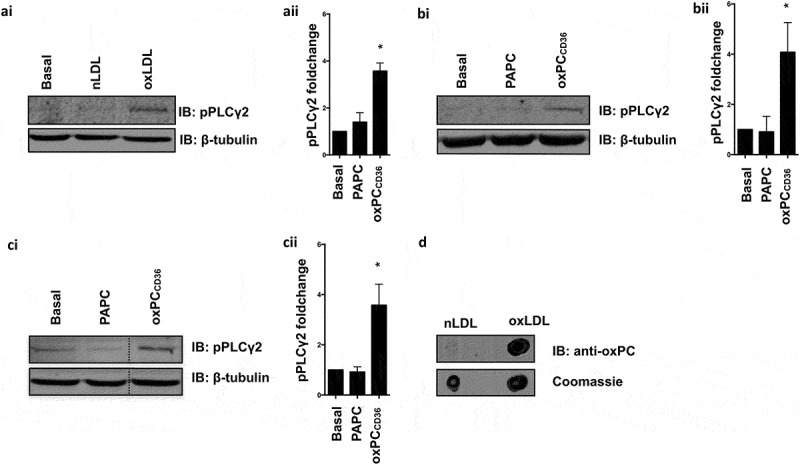
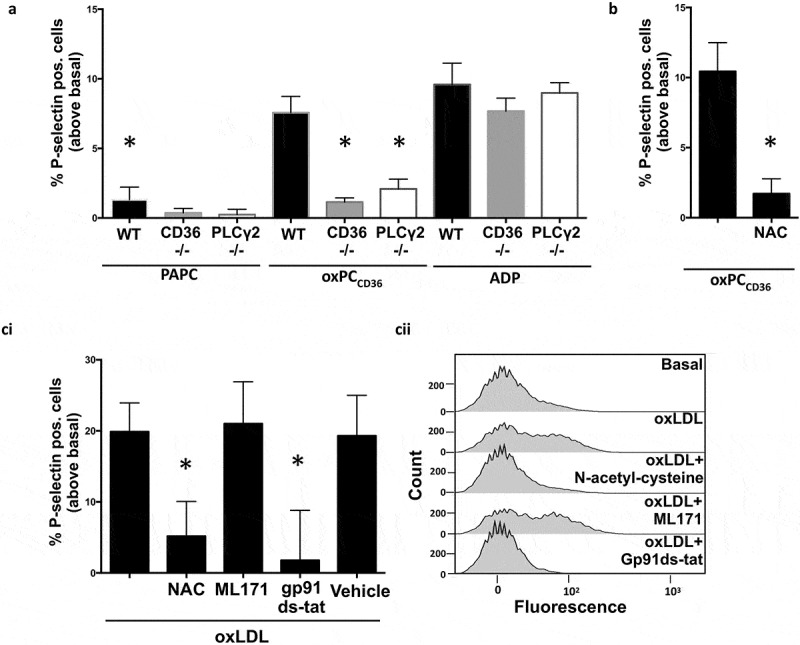
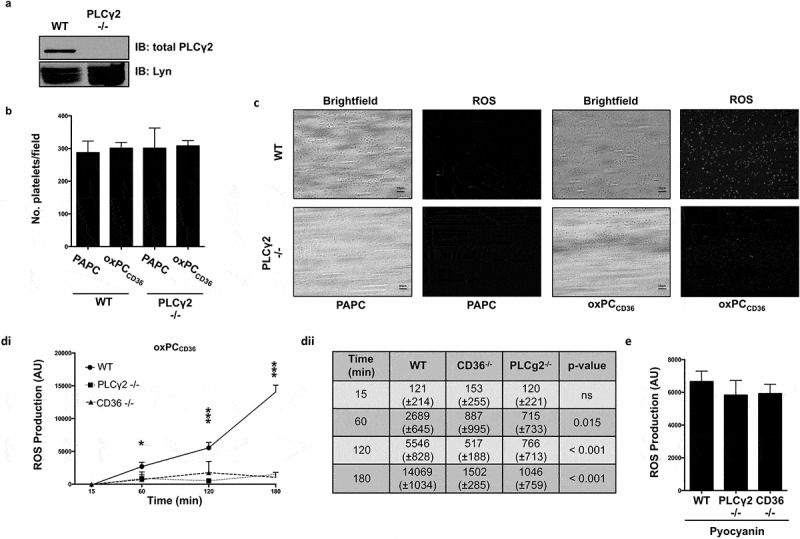
Oxidized low-density lipoprotein (oxLDL) and associated oxidized phosphocholine-headgroup phospholipids (oxPCs) activate blood platelets through ligation of the scavenger receptor CD36. Previously, we found that oxLDL stimulated phosphorylation of phospholipase Cγ2 (PLCγ2). However, the functional relevance of PLCγ2 phosphorylation in oxLDL-mediated platelet hyperactivity remained elusive. Here, we set out to explore the functional importance of PLCγ2 in oxLDL-mediated platelet activation using human and genetically modified murine platelets. The CD36-specific oxidized phospholipid (oxPC) triggered the generation of reactive oxygen species (ROS) in platelets under static and arterial flow conditions. The ROS generation in response to oxPC was sustained for up to 3 h but ablated in CD36- and PLCγ2-deficient platelets. The functional importance of ROS generation in response to atherogenic lipid stress was examined through measurement of P-selectin expression. OxPC induced P-selectin expression, but required up to 60 min incubation, consistent with the timeline for ROS generation. P-selectin expression was not observed in CD36- and PLCγ2-deficient mice. The ability of oxPC and oxLDL to stimulate P-selectin expression was prevented by incubation of platelets with the ROS scavenger N-acetyl-cysteine (NAC) and the NOX-2 inhibitor gp91ds-tat, but not with the NOX-1 inhibitor ML171. In summary, we provide evidence that prolonged exposure to oxLDL-associated oxidized phospholipids induces platelet activation via NOX-2-mediated ROS production in a CD36- and PLCγ2-dependent manner.
氧化型低密度脂蛋白 (oxLDL) 及其相关的氧化膦酰胆碱头部基团磷脂 (oxPC) 通过清道夫受体 CD36 激活血小板。先前,我们发现 oxLDL 刺激磷脂酶 Cγ2 (PLCγ2) 的磷酸化。然而,在 oxLDL 介导的血小板过度激活中,PLCγ2 磷酸化的功能相关性仍然难以捉摸。在这里,我们使用人和基因修饰的鼠血小板来探索 PLCγ2 在 oxLDL 介导的血小板激活中的功能重要性。在静态和动脉流动条件下,CD36 特异性氧化磷脂 (oxPC) 触发血小板中活性氧 (ROS) 的产生。对 oxPC 的 ROS 生成可持续长达 3 小时,但在 CD36 和 PLCγ2 缺陷血小板中被消除。通过测量 P-选择素表达来检查对动脉粥样硬化脂质应激的 ROS 生成的功能重要性。oxPC 诱导 P-选择素表达,但需要长达 60 分钟的孵育,与 ROS 生成的时间一致。在 CD36 和 PLCγ2 缺陷小鼠中未观察到 P-选择素表达。通过用 ROS 清除剂 N-乙酰半胱氨酸 (NAC) 和 NOX-2 抑制剂 gp91ds-tat 孵育血小板,可以防止 oxPC 和 oxLDL 刺激 P-选择素表达,但不能用 NOX-1 抑制剂 ML171 防止。总之,我们提供的证据表明,长时间暴露于 oxLDL 相关的氧化磷脂通过 CD36 和 PLCγ2 依赖性方式诱导血小板激活,通过 NOX-2 介导的 ROS 产生。