Department of Neuroscience, KU Leuven, Leuven, Belgium.
Sci Rep. 2018 May 8;8(1):7175. doi: 10.1038/s41598-018-25723-y.
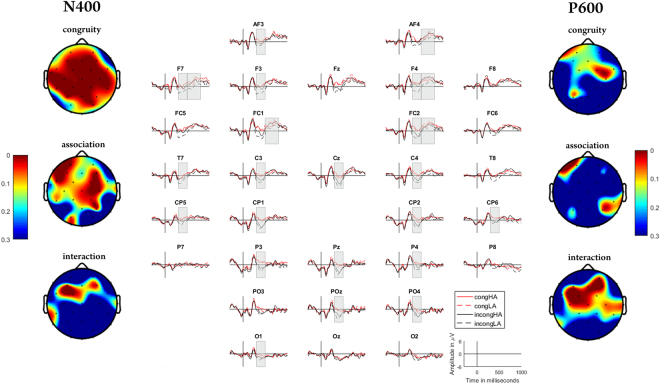
The processing of word associations in sentence context depends on several factors. EEG studies have shown that when the expectation of the upcoming word is high (high semantic constraint), the within-sentence word association plays a negligible role, whereas in the opposite case, when there is no expectation (as in pseudo-sentences), the role of word association becomes more pronounced. However, what happens when the expectations are not high (mild to moderate semantic constraint) is not yet clear. By adopting a cross-factorial design, crossing sentence congruity with within-sentence word association, our EEG recordings show that association comes into play during semantic processing of the word only when the sentence is meaningless. We also performed an exploratory source localization analysis of our EEG recordings to chart the brain regions putatively implicated in processing the said factors and showed its complementarity to EEG temporal analysis. This study furthers our knowledge on sentence processing and the brain networks involved in it.
句子语境中词的联想处理取决于几个因素。脑电图研究表明,当对即将到来的单词的期望很高(高语义约束)时,句子内的词的联想作用可以忽略不计,而在相反的情况下,当没有期望(如在伪句子中)时,词的联想作用变得更加明显。然而,当期望不高(中等语义约束)时会发生什么情况尚不清楚。通过采用交叉因子设计,将句子一致性与句子内词的联想交叉,我们的脑电图记录显示,只有在句子没有意义时,联想才会在词的语义处理中发挥作用。我们还对脑电图记录进行了探索性的源定位分析,以绘制假定参与处理上述因素的大脑区域,并显示其与脑电图时间分析的互补性。这项研究进一步加深了我们对句子处理和涉及其中的大脑网络的理解。