Badacz Rafal, Przewłocki Tadeusz, Gacoń Jacek, Stępień Ewa, Enguita Francisco J, Karch Izabela, Żmudka Krzysztof, Kabłak-Ziembicka Anna
Department of Interventional Cardiology, School of Medicine, Jagiellonian University, John Paul II Hospital, Krakow, Poland.
Department of Invasive Cardiology, E. Szczeklik's Hospital, Tarnow, Poland.
Postepy Kardiol Interwencyjnej. 2018;14(1):75-84. doi: 10.5114/aic.2018.74358. Epub 2018 Mar 22.
Circulating microRNAs (miRNAs) levels are potentially important biomarkers and therapeutic targets of cerebral ischemic event (CIE) in patients with internal carotid artery stenosis (ICAS).
This prospective study investigated associations between circulating miRNAs and symptomatic and asymptomatic ICAS, carotid plaque morphology and future cardiovascular events.
Circulating miRNAs (miR-1-3p, miR-16-5p, miR-34a-5p, miR-124-3p, miR-133a-3p, miR-133b, miR-134-5p, miR-208b-3p, miR-375 and miR-499-5p) were analyzed in 92 consecutive patients with significant ICAS referred for revascularization. Group I comprised 65 subjects (41 males, age 69.3 ±9.7 years) with a recent CIE. Group II comprised 27 patients (15 males, age 68.2 ±8.4 years) with asymptomatic ICAS. The ICAS degree and plaque morphology was assessed by ultrasonography. The incidences of cardiovascular death (CVD), myocardial infarction (MI) and recurrent CIE (CVD/MI/CIE) were recorded prospectively (mean: 38.7 ±3.8 months).
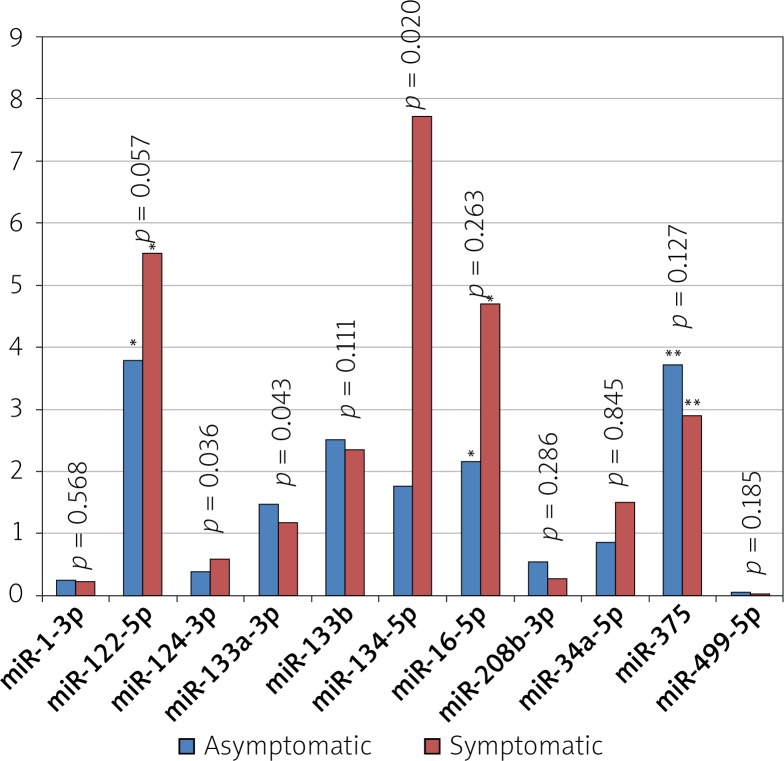
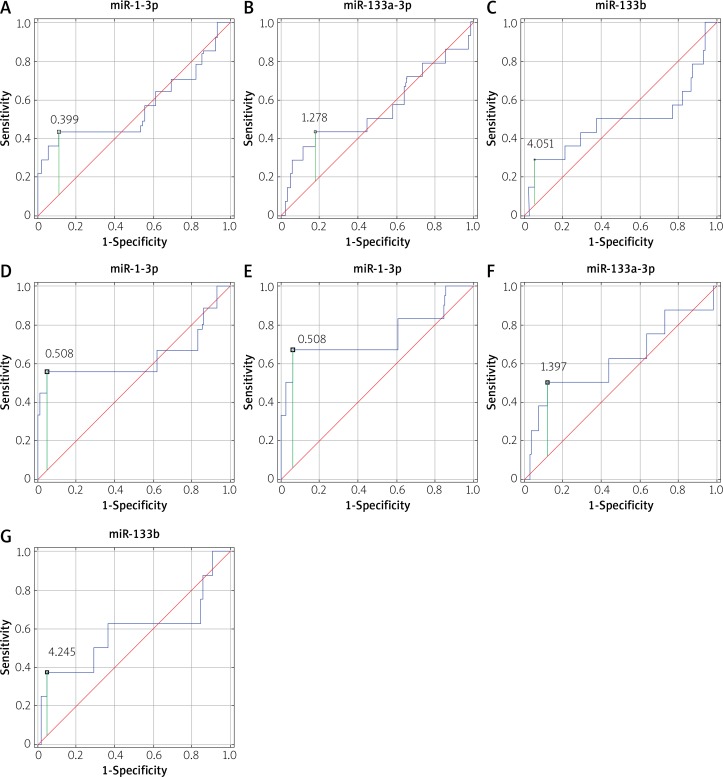
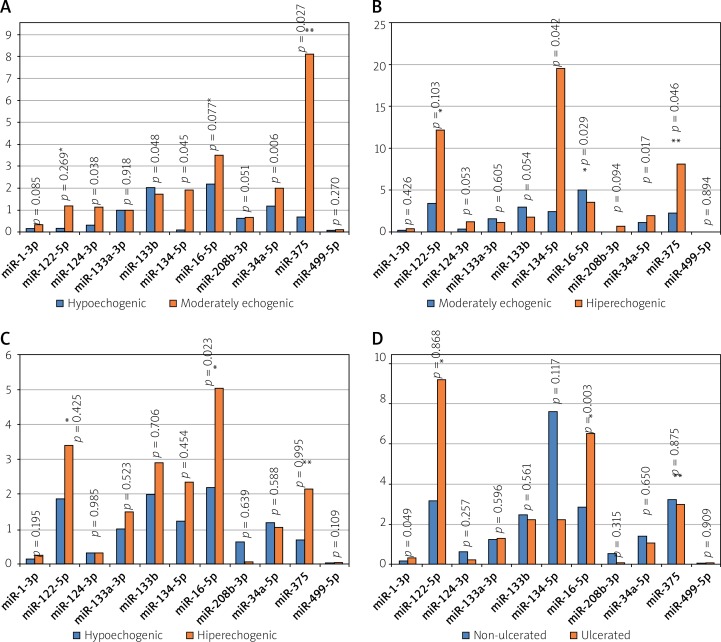
Groups II and I differed significantly in levels of miR-124-3p ( = 0.036), miR-133a-3p ( = 0.043) and miR-134-5p ( = 0.02). Hypoechogenic, as compared to echogenic, plaques differed in levels of miR-124-3p ( = 0.038), miR-34a-5p ( = 0.006), miR-133b ( = 0.048), miR-134-5p ( = 0.045), and miR-375 ( = 0.016), while calcified plaques differed in miR-16-5p ( = 0.023). Ulcerated plaques showed higher levels of miR-1-3p ( = 0.04) and miR-16-5p ( = 0.003), while thrombotic plaques showed lower levels of miR-1-3p ( = 0.032). CVD/MI/CIE occurred in 14 (15.5%) out of 90 follow-up patients. Multivariate Cox and ROC analysis showed associations between miR-1-3p and CVD (AUC = 0.634; HR = 4.84; 95% CI: 1.62-14.5; = 0.005), MI (AUC = 0.743; HR = 7.8; 95% CI: 2.01-30.0; = 0.003), and CVD/MI/CIE (AUC = 0.560; HR = 4.6; 95% CI: 1.61-13.1; = 0.004), while miR-133b was associated with recurrent CIE (AUC = 0.581; HR = 2.25; 95% CI: 1.01-5.02; = 0.047).
A significant difference in levels of selected miRNAs is observed in symptomatic vs. asymptomatic ICAS. Plaque morphology and structure is associated with change of miRNA levels. The expression of miR-1-3p may be a potential prognostic factor for future cardiovascular events.
循环微小RNA(miRNA)水平可能是颈内动脉狭窄(ICAS)患者脑缺血事件(CIE)的重要生物标志物和治疗靶点。
本前瞻性研究调查了循环miRNA与有症状和无症状ICAS、颈动脉斑块形态及未来心血管事件之间的关联。
对92例因血管重建而转诊的严重ICAS连续患者的循环miRNA(miR-1-3p、miR-16-5p、miR-34a-5p、miR-124-3p、miR-133a-3p、miR-133b、miR-134-5p、miR-208b-3p、miR-375和miR-499-5p)进行分析。第一组包括65名受试者(41名男性,年龄69.3±9.7岁),近期发生过CIE。第二组包括27例患者(15名男性,年龄68.2±8.4岁),患有无症状ICAS。通过超声评估ICAS程度和斑块形态。前瞻性记录心血管死亡(CVD)、心肌梗死(MI)和复发性CIE(CVD/MI/CIE)的发生率(平均:38.7±3.8个月)。
第二组和第一组在miR-124-3p(P = 0.036)、miR-133a-3p(P = 0.043)和miR-134-5p(P = 0.02)水平上有显著差异。与等回声斑块相比,低回声斑块在miR-124-3p(P = 0.038)、miR-34a-5p(P = 0.006)、miR-133b(P = 0.048)、miR-134-5p(P = 0.045)和miR-375(P = 0.016)水平上有差异,而钙化斑块在miR-16-5p(P = 0.023)水平上有差异。溃疡斑块显示miR-1-3p(P = 0.04)和miR-16-5p(P = 0.003)水平较高,而血栓斑块显示miR-1-3p(P = 0.032)水平较低。90例随访患者中有14例(15.5%)发生CVD/MI/CIE。多变量Cox和ROC分析显示miR-1-3p与CVD(AUC = 0.634;HR = 4.84;95%CI:1.62 - 14.5;P = 0.005)、MI(AUC = 0.743;HR = 7.8;95%CI:2.01 - 30.0;P = 0.003)和CVD/MI/CIE(AUC = 0.560;HR = 4.6;95%CI:1.61 - 13.1;P = 0.004)相关,而miR-133b与复发性CIE相关(AUC = 0.581;HR = 2.25;95%CI:1.01 - 5.02;P = 0.047)。
在有症状与无症状ICAS中观察到所选miRNA水平存在显著差异。斑块形态和结构与miRNA水平变化相关。miR-1-3p的表达可能是未来心血管事件的潜在预后因素。